
ACE Money Transfer
ACE Money Transfer
29 May 2026
If you plan to send money abroad, understanding Halifax SWIFT codes is very important. These codes help banks identify each other during international transfers and ensure that your money reaches the right destination. Without the correct code, your payment may be delayed or even rejected.
Cross-border payments are now a normal part of daily life. According to the Bank for International Settlements, trillions of dollars move through international banking systems every day. This shows how essential secure identification systems like SWIFT codes are in global finance.
The UK uses a few different types of bank codes, and each one does a different job. It is easy to mix them up, but knowing the difference can save you a lot of trouble when sending money.
The three main codes you will come across with Halifax are the Sort Code, the IBAN, and the SWIFT/BIC Code. The sort code is used for payments within the UK — things like paying a friend or setting up a direct debit. The IBAN (International Bank Account Number) is used to identify your specific account for international transfers. The SWIFT/BIC code identifies Halifax as a bank to other banks around the world. For international transfers into a Halifax account, you will usually need both the IBAN and the SWIFT code together.
| Code Type | What It Does | Used For |
|---|---|---|
| Sort Code | Identifies a UK bank and branch | Domestic UK transfers only |
| Account Number | Identifies your personal account | UK domestic transfers |
| IBAN | Identifies your account internationally | International incoming transfers |
| SWIFT / BIC Code | Identifies Halifax as a bank globally | International wire transfers |
Still unsure about how bank codes work? Find out everything in this Bank Codes guide.
Every financial institution has a unique identity in the banking world. Halifax’s identity is built into its SWIFT code, which helps distinguish it from other banks globally.
Halifax operates under the umbrella of Lloyds Banking Group, meaning some of its international operations are supported by shared systems. This makes it even more important to use the correct details when sending money abroad.
Here are some examples of Halifax SWIFT codes:
Halifax is part of Bank of Scotland PLC / Scotland PLC in the United Kingdom, and the code for Halifax can vary by service or branch, so always verify the right one before making a transfer.
Branch identification plays an important role in ensuring accurate transfers across different branches. In the UK, Halifax mainly uses sort codes for domestic transactions. However, SWIFT codes can also include branch-specific information.
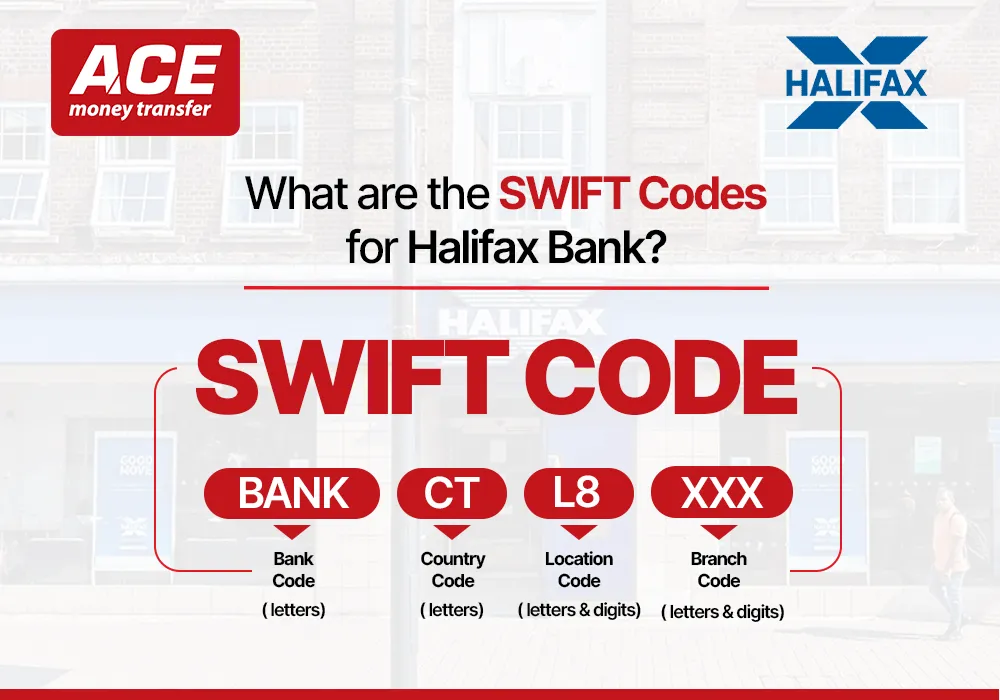
An 8- to 11-character SWIFT code includes the bank code, the bank's country code, the location code, and sometimes a branch code. If the code ends with “XXX,” it usually refers to the main office.
Providing correct branch details helps avoid routing issues and ensures faster processing of your payment by identifying the right city or branch location.
SWIFT codes, also known as BIC codes, are globally accepted identifiers used for international banking. They help banks communicate securely and process transactions efficiently.
A Halifax SWIFT code typically contains 8 to 11 characters and follows a standard format:
This structure ensures that each bank and branch can be identified correctly in the united kingdom and anywhere in the world.
Some common Halifax SWIFT code formats include:
This is an example of Halifax SWIFT/BIC formatting.
Remember: Keep in mind that even a small typing error can delay your transaction.
If you are sending money to a Halifax account from another UK bank, the process is simple. You only need the recipient's sort code and 8-digit account number. The payment goes through the UK Faster Payments network, which means the money usually arrives within 2 hours — and most of the time it lands instantly.
Halifax lets you send up to £25,000 per day through Online Banking or the mobile app using Faster Payments. If you need to send a larger amount, you can go into a branch and send up to £250,000 using Faster Payments in branch (with valid photo ID).Halifax processes CHAPS payments on the same day if you submit before 4:25 PM on a working day. Payments made after that time — or on weekends and bank holidays — are processed the next working day. (Source: Halifax official site)
If someone abroad wants to send money to your Halifax account, they will need more than just your sort code. For international transfers, you must provide the sender with the correct banking details for the relevant banking services, including your IBAN and the Halifax SWIFT code (HLFXGB22XXX).
Payments sent in euros from within the European Economic Area (EEA) should arrive by the end of the next working day. Transfers in other currencies may take longer, as Halifax cannot control when the sending bank processes the payment. Once it arrives, Halifax converts the money into British pounds, so funds are typically received in GBP before crediting your account.
Halifax allows you to send international payments of up to £100,000 online. If you need to send more, you can do this in a branch. There is no upper limit for international payments made in person. A fee may apply depending on the sending bank or transfer method.
It can feel confusing knowing which code to use and when. Here is a simple breakdown.
| Situation | Code(s) You Need |
|---|---|
| Sending money from one UK bank to another | Sort Code + Account Number |
| Receiving money from abroad into your Halifax account | IBAN + SWIFT Code (HLFXGB22XXX) |
| Sending money from your Halifax account to a European bank | Recipient's IBAN + Recipient's SWIFT Code |
| Sending money from Halifax to a US bank | Recipient's SWIFT Code + Account Number |
| Setting up a Direct Debit within the UK | Sort Code + Account Number |
| Making a large same-day transfer within the UK | Sort Code + Account Number (via CHAPS in branch) |
Quick Tip: Don’t confuse SWIFT codes with sort codes. Sort codes are for local UK transfers, while SWIFT codes are for global payments.
Banking systems vary across countries, and understanding these differences can make international transfers easier.
European banks rely heavily on IBAN to identify accounts. When sending money from Halifax to Europe, both IBAN and SWIFT codes are often required. According to Wikipedia, by December 2024, 89 countries were using the IBAN system — showing just how widely adopted it has become.
American banks do not use IBAN at all. Instead, the US uses a 9-digit routing number (also called an ABA number) for domestic transfers, and SWIFT codes for international transfers. According to IBAN, Canada and the US have not adopted IBAN, so when sending money from a US bank to Halifax, the US sender needs Halifax's SWIFT code (HLFXGB22XXX) and your IBAN — not a routing number.
If someone in the US is sending you money, make sure you give them your Halifax IBAN and the SWIFT code. Do not give them a sort code — it will not work for international payments from the US.
India uses a system called IFSC — Indian Financial System Code — for domestic transfers. It is an 11-character code that identifies each bank branch in India. Like the UK sort code, it is used only within the country. Indian banks sending money to Halifax will use HLFXGB22XXX, and Halifax sending money to India will use the Indian bank's SWIFT code.
So if you have family or friends in India sending money to your Halifax account, ask them to use HLFXGB22XXX as the SWIFT code and give them your full IBAN. The IFSC code on their end is used by their bank internally — it does not replace the SWIFT code for international transfers.
Finding the correct SWIFT code is simple if you know where to look. You can check your bank statement, log in to your online banking account, contact Halifax customer support, or check Halifax branches if you need branch-specific code information.
Some different branches may use distinct identifiers for specific services, so confirm the exact branch details.
Another reliable option is to ask the recipient to confirm the correct code. This helps ensure that your transfer is processed without any issues.
Doing this can help you avoid delays, extra charges, or failed transactions.
Yes — sharing your SWIFT code and IBAN is completely safe. These codes simply tell a bank where to send money. They cannot be used to take money from your account or access your account in any way. Think of them like your home address — sharing it lets people send things to you, but it does not let them walk into your house.
Your IBAN is also safe to share. It contains your sort code and account number in a standardised format, but that information alone is not enough for anyone to withdraw money or make payments without your permission.
The demand for fast, affordable international transfers keeps growing. According to SWIFT's latest data, 90% of cross-border payments on the SWIFT network now reach the destination bank within an hour
A Halifax bank code is a unique identifier used to recognize the bank during financial transactions. It is usually part of the SWIFT code and helps ensure that funds are sent to the correct institution. This code is especially important for international transfers, where multiple banks are involved in processing the payment.
Yes, Halifax requires IBAN when sending money to countries that use the IBAN system, especially in Europe. The IBAN identifies the specific account, while the SWIFT code identifies the bank. Using both ensures that your transfer is completed accurately and without delays.
A SWIFT code plays a key role in international banking because it allows financial institutions to communicate securely. Without it, banks would not be able to identify each other easily. This could lead to delays or errors in processing payments. That is why SWIFT codes are considered essential for cross-border transactions.
A Halifax SWIFT code usually contains 8 or 11 characters. The shorter version identifies the main office, while the longer version can identify a specific branch or city. Understanding this format can help you confirm whether the code you are using is correct.
In most traditional banking systems, a SWIFT code is required for international transfers. Some digital services may offer alternatives, but banks like Halifax typically rely on SWIFT codes to process cross-border payments. Providing the correct code ensures that your transaction is completed smoothly.
Now that you know your Halifax SWIFT codes, your IBAN, and exactly which code to use when — sending or receiving international transfers should be simple and stress-free.
But even when you have the right codes, bank-to-bank international transfers can still be expensive. Traditional banks often add a margin to the exchange rate on top of their transfer fees — meaning you could end up paying far more than you expect. Using a calculator can help you estimate the total fee and compare how much is likely to be received before you send.
That is where ACE Money Transfer can help. ACE is a trusted international money transfer service with a 4.7 rating on Trustpilot. ACE lets you send money to the UK quickly, securely, and at competitive rates — often without the hidden fees that come with traditional bank transfers. Whether you are sending money to family, paying a business, or managing personal finances across borders, ACE makes it easy.
Create your ACE Money Transfer account today and enjoy a smooth, secure start to sending money abroad.