ACE Money Transfer
ACE Money Transfer
29 May 2026
Understanding Citibank SWIFT codes is essential if you want to send or receive money internationally without delays. These codes act as unique identifiers for banks and ensure that your funds reach the correct destination safely. Whether you are making a personal remittance or handling business payments, using the right SWIFT code can make the entire process smooth and secure.
International transactions are becoming more common every year. According to Statista, global digital payments are expected to exceed $14 trillion by 2027, showing how rapidly cross-border transfers are growing. This growth highlights the importance of reliable systems like SWIFT codes in modern banking.
Citibank uses different types of codes depending on the type of transaction you are making. Each code has a specific purpose and helps identify the bank, branch, or country involved in the transfer.
For international payments, SWIFT or BIC codes are required. These codes ensure that money is routed to the correct bank across borders. For domestic transfers within the United States, routing numbers are used instead. In some regions, additional codes like IBAN may also be required.
Understanding these codes is important because using the wrong one can delay your transfer or even result in failed transactions. Many users confuse these codes, but each plays a unique role in the banking system.
A bank code is a unique identifier assigned to a financial institution. In the case of Citibank, this code is part of the SWIFT structure and helps distinguish it from other banks worldwide.
These codes are especially important for international transfers, where multiple banks may have similar names. The bank code ensures that your money is sent to the correct institution without confusion.
Citibank operates in many countries, and each location has its own SWIFT code. Some commonly used examples include:
These codes may vary depending on the branch, so it is always recommended to verify the exact code before making a transfer. Even a small mistake in the code can cause delays.
Branch codes help identify specific branches within a bank. In Citibank SWIFT codes, the branch code is usually included in the last three characters of the code.
If the SWIFT code ends with “XXX,” it typically represents the bank’s main branch. However, some bank branches use unique branch-level codes, and choosing the right place or branch matters for accurate routing, especially for large or business-related payments. Using the correct branch code ensures that your money reaches the intended branch without unnecessary routing delays. Some banking services may also require a branch-specific code for Citibank.
In 2024 alone, Citi handled $380 billion worth of cross-border transaction value, which shows the scale of trust placed in Citibank for global transfers. (Source:BOSS Revolution)
SWIFT codes, also known as Bank Identifier Codes (BIC), are used worldwide to facilitate secure international transactions. These codes are standardized and recognized globally, making them essential for cross-border payments.
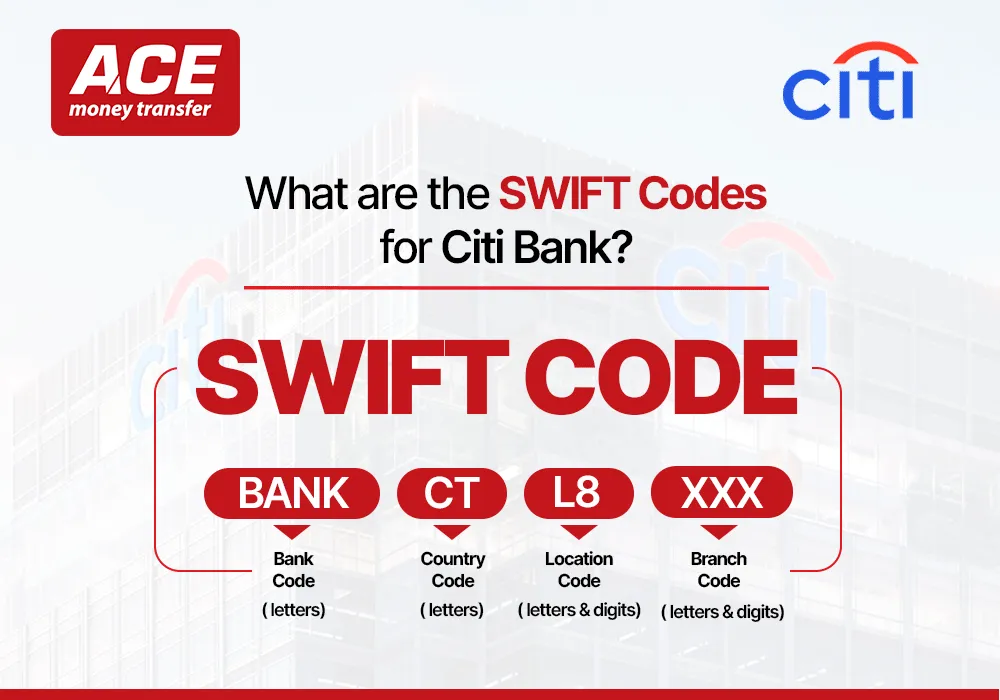
A typical Citibank SWIFT code contains 8 or 11 characters. Each part of the code provides specific information:
This structured format helps banks quickly identify each other and process transactions efficiently.
Here are some examples of Citibank SWIFT codes used globally:
Always confirm the correct SWIFT code with the recipient or the bank before sending money, especially if you are unsure. Clerical errors when entering the code can delay transfers or trigger bank return fees.
Quick Tip: Understand the code format so you can spot errors quickly and avoid confusion.
The main Citibank SWIFT code for international wire transfers to the United States is CITIUS33XXX. This is the code used when sending money to a Citibank account at the bank’s New York headquarters located at 388 Greenwich Street, floor details should be confirmed with Citibank, New York, NY 10013.
You may also see it written as CITIUS33 — both are accepted. The XXX simply indicates the head office rather than a specific branch. If you are not sure which branch code to use, you can safely use the head-office code for Citibank branch transfers and the funds will still reach the correct account. This is the main code for Citibank for US head-office transfers. Clerical errors in entering the SWIFT code can lead to delayed transfers or unexpected bank return fees.
Want to understand SWIFT codes better? Check out our simple guide on what a SWIFT number is and how it works.
Because Citibank operates globally, its SWIFT codes vary by country. Using the US code for a UK account — or vice versa — will cause your transfer to be misrouted. Always use the code that matches the country where the recipient's account is held.
| Country | Bank Name | SWIFT / BIC Code | City |
|---|---|---|---|
| United States | Citibank N.A. | CITIUS33XXX | New York |
| United Kingdom | Citibank N.A. London | CITIGB2LXXX | London |
| United Arab Emirates | Citibank N.A. UAE | CITIAEADXXX | Dubai |
| India | Citibank N.A. India | CITIINBXXXX | Mumbai |
| Australia | Citibank N.A. Australia | CITIAU2XXXX | Sydney |
| Hong Kong | Citibank N.A. Hong Kong | CITIHKHXXXX | Hong Kong |
| Japan | Citibank N.A. Tokyo | CITIJPJTXXX | Tokyo |
| Singapore | Citibank N.A. Singapore | CITISGSGXXX | Singapore |
| Czech Republic | Citibank Europe plc Prague | CITICZPXXXX | Prague |
| Hungary | Citibank Europe plc Budapest | CITIHUHXXXX | Budapest |
| Israel | Citibank N.A. Tel Aviv | CITIILITXXX | Tel Aviv |
| Turkey | Citibank A.S. Istanbul | CITIVBITXXX | Istanbu |
Always double-check this information with your recipient or the recipient's bank before initiating a transfer. SWIFT code details can change, and using verified information avoids unnecessary delays.
Before you initiate an international wire transfer through Citibank, you need to gather a few key pieces of information. You will need the recipient's full legal name as it appears on their bank account, their bank account number, the name and address of the recipient's bank, the correct SWIFT/BIC code for the recipient's country, and the purpose of the transfer in some cases.
For countries in Europe, you will also need the recipient's IBAN (International Bank Account Number). The IBAN identifies the specific account, while the SWIFT code identifies the bank. Both are required together for European transfers.
International wire transfers from Citibank usually take 1 to 3 business days. However, depending on the destination country and verification steps, it can stretch to up to 5 business days. According to Citi's own guidance, international wire transfers may take up to 5 business days due to fraud detection processes and varying banking regulations in different countries.
Citibank processes international wires submitted before 6:00 PM Eastern Time on the same business day. If you miss that cutoff — or submit on a weekend or public holiday — the transfer will be processed the next business day. Transfers routed through intermediary banks may also take longer to arrive.
Transfer fees at Citibank vary depending on your account type. Standard accounts are typically charged $25 to $35 for outgoing international wires and $15 for incoming wires. However, Citigold, Citigold Private Client, and Citi Private Bank account holders have their outgoing wire fees waived entirely. On top of Citibank's own fees, additional intermediary bank charges of $20 to $50 may apply when your transfer passes through correspondent banks on its way to the destination.
Banking systems vary across countries, and understanding these differences can help you navigate international transfers more effectively.
In Europe, banks use IBAN (International Bank Account Number) to identify accounts. IBAN is different from a SWIFT code.
When sending money to Europe from Citibank, you usually need both IBAN and SWIFT code. Without IBAN, money may not reach the right account.
In the US, banks use a 9-digit routing number for local transfers.
For sending money from outside the US to Citibank, you need the SWIFT code (CITIUS33XXX), not the routing number. Routing numbers only work inside the US.
In India, banks use IFSC codes for local transfers between Indian banks.
For international transfers to or from India, the SWIFT code is required. IFSC works only inside India, while SWIFT is used globally.
There are several ways to find the correct Citibank SWIFT code if you know where to look. You can check your bank statement, visit the official website, contact customer support, or ask at the relevant branch or place where the account is held.
Another reliable option is to ask the recipient directly. Additionally, this helps confirm you have the correct code for the specific branch or service. This ensures that you are using the correct and updated code.
Always double-check the SWIFT code before sending money. Even a small error can cause delays or failed transactions.
Pro Tip: Confirm details with the recipient to ensure you’re using the correct Citibank branch and code.
Many people make simple mistakes when using SWIFT codes, and common questions often come from mixing up branch, country, or outdated code details. These mistakes can lead to delays, extra fees, or even failed transfers.
Sharing SWIFT codes is generally safe because these codes only identify the bank, not your personal account details. However, you should still be careful when sharing financial information.
Never share sensitive details such as your password or PIN. Always use trusted platforms for sending and receiving money.
The primary Citibank SWIFT code for the United States is CITIUS33XXX. This is used for most international wire transfers to Citibank accounts in the US. However, Citibank uses different SWIFT codes for different countries. Always confirm the correct code for the recipient's country.
No. Different Citibank branches and country entities have different SWIFT codes. For example, Citibank UK uses CITIGB2LXXX, while Citibank UAE uses CITIAEADXXX. Within the United States, some individual branches may also have their own branch-level codes, though using the head office code (CITIUS33XXX) is acceptable in most cases.
Yes. SWIFT code and BIC code mean exactly the same thing. BIC stands for Bank Identifier Code, and SWIFT stands for Society for Worldwide Interbank Financial Telecommunication. Banks and financial institutions use the terms interchangeably. You may see either term on transfer forms, but they refer to the same code.
For most international wire transfers, no. The SWIFT code is required to route your payment to the correct bank. Without it, banks cannot identify where to send the money, and your transfer will either be rejected or delayed. The only exception is Citibank's Global Transfers service, which allows fee-free transfers between Citibank accounts in select countries — but even this requires your account details to be correct.
Most international wire transfers arrive within 1 to 3 business days. In some cases — depending on the origin country, local bank processing times, and compliance checks — it may take up to 5 business days. Transfers submitted after the 6:00 PM ET cutoff or on weekends and holidays will be processed on the next business day.
Using the wrong SWIFT code can result in your transfer being delayed, returned to the sender, or in rare cases sent to the wrong institution. If you realise you have made an error, contact your bank as soon as possible. For international transfers, you may have a short window — sometimes as little as 30 minutes — to cancel before the payment is processed.
It depends on the destination country. If you are sending money to a European country, you will need both a SWIFT code and an IBAN. Citibank accounts in the US do not use IBANs — for those, you provide the SWIFT code, account number, and routing number. Always check the transfer requirements for the specific destination country.
Understanding Citibank SWIFT codes is the first step to stress-free international transfers. But even with the right code, bank-to-bank wire transfers can be slow and expensive — with fees stacking up between the sending bank, intermediary banks, and the recipient’s bank.
That’s where ACE Money Transfer comes in. ACE is a trusted international money transfer service with a 4.7 rating on Trustpilot, and many customers use that score and published reviews as trust signals when choosing how to send money. Reviews from new customers can also help illustrate the service experience. ACE helps people send money to over 100 countries quickly, securely, and at competitive exchange rates — often without the hidden fees that traditional banks charge.
The global demand for reliable cross-border transfers continues to grow. According to SWIFT data published in 2024, 90% of SWIFT payments now reach destination banks within one hour. But the final step — getting funds from the bank into the recipient’s account — can still cause delays. ACE Money Transfer is designed to close that gap, offering a fast, transparent, and user-friendly experience for international remittances, with different ways to receive money where supported on the destination corridor.
Whether you are supporting family abroad, paying international invoices, or managing finances across borders, ACE Money Transfer gives you a smarter, more affordable alternative to traditional bank wire transfers. Sign up and send your first transfer today.