ACE Money Transfer
ACE Money Transfer
11 Sep 2026
Morocco has one of the most developed banking sectors in Africa and serves as an important financial gateway between Europe, the Middle East, and the African continent. The country's banking industry plays a vital role in supporting economic growth, international trade, investment, and financial inclusion. Regulated by Bank Al-Maghrib, Morocco's central bank, the sector is known for its stability, modernisation efforts, and expanding international presence. Over the past decade, Moroccan banks have invested heavily in digital transformation, mobile banking, and financial technology solutions. At the same time, several major Moroccan banking groups have expanded across Africa, making them influential players in regional finance. Customers today can access a wide range of services, including retail banking, business financing, mortgages, investment products, Islamic banking, and international money transfer solutions. This guide explores the best banks in Morocco in 2026 and compares their services, strengths, and international reach.
Not all banks in Morocco offer the same products, digital capabilities, fee structures, available options, or international banking services. Some institutions focus on retail banking and mortgages, while others specialise in corporate banking, investment services, Islamic finance, or international transactions.
Bank fees can vary significantly across institutions, including monthly or quarterly maintenance fees and ATM withdrawal fees.
Digital banking is becoming increasingly important in Morocco as consumers adopt mobile banking apps, online account management tools, and payment solutions as part of broader digital services. Banks continue investing in technology to improve convenience, security, and accessibility for customers across the country.
Morocco receives significant remittance inflows from Moroccans living and working abroad. International money transfers contribute to household incomes and the national economy, making banking and remittance services important for many families.
Attijariwafa Bank
Attijariwafa Bank, founded in 2004 through the merger of Banque Commerciale du Maroc and Wafabank, is Morocco's largest banking group.
Morocco's leading banking institution with extensive African operations and comprehensive financial services.
Largest banking network in Morocco
Strong digital banking platform
Comprehensive personal and corporate banking products
Extensive branch presence
Premium services may involve higher fees
A large customer base can sometimes affect service speed
Attijariwafa Bank operates in more than 26 countries across Africa, Europe, and the Middle East. It is best for families, professionals, businesses, and customers requiring international banking services.
Banque Populaire du Maroc, founded in 1961, is part of the BCP Group and operates through a cooperative and regional banking structure. It also has a strong retail and cooperative banking framework.
USP of Banque Populaire
Strong focus on retail banking and serving Moroccan communities both locally and abroad.
Extensive branch network
Strong remittance services
Accessible banking products
Competitive financing solutions
Some digital features are less advanced than competitors
Customer service quality may vary by location
Banque Populaire maintains a strong presence in Europe through subsidiaries and partnerships. It is best for Moroccan expatriates, families, and retail banking customers.
Bank of Africa, formerly BMCE Bank, was founded in 1959 and is one of Morocco's leading international banking groups.
Strong pan-African banking network supporting international trade, investments, and broader banking needs across Africa. Established in 1959, the bank was rebranded in 2020.
Extensive African presence
Strong business banking solutions
Reliable digital banking services
Competitive international transaction capabilities
Some products may have higher fees
Complex corporate banking procedures for certain services
Bank of Africa operates in more than 20 African countries. It is best for businesses, investors, exporters, and customers engaged in international trade.
Crédit du Maroc, founded in 1929, is a Moroccan banking institution with a long history in the country's banking sector.
Strong customer-focused banking services with expertise in retail and commercial banking.
Good customer service
Competitive mortgage products
Reliable banking solutions
Growing digital banking capabilities
Smaller branch network than larger competitors
Limited international presence
Crédit du Maroc primarily operates in Morocco while maintaining international banking relationships. It is best for families, professionals, and homeowners.
BMCI, founded in 1943, is part of the BNP Paribas Group.
International banking experience supported by its connection with BNP Paribas, a major European financial institution.
Strong international banking services
Reliable digital platforms
Comprehensive financial products
Excellent corporate banking capabilities
Some premium banking services can be costly
Smaller local footprint than leading domestic banks
Through BNP Paribas, BMCI benefits from operations in more than 64 countries. It is best for multinational companies, expatriates, and professionals.
The bank started in Morocco in 1913 before its recent rebrand under new ownership, and it is a major banking institution in the country.
Strong banking expertise with a growing focus on digital transformation.
Strong customer support
Comprehensive banking products
Reliable business banking services
Expanding digital offerings
Ongoing brand transition may create temporary adjustments
Smaller network than market leaders
The bank maintains international banking relationships across Europe and Africa. It is best for professionals, SMEs, and retail banking customers.
CIH Bank, founded in 1920, has developed a strong focus on digital banking and e-banking services in Morocco.
Innovation-driven banking with strong digital and mobile banking services.
Excellent mobile banking application
Competitive account offerings
Strong digital innovation
Popular among young people
Smaller branch network
Some advanced services may be limited compared to larger banks
CIH Bank primarily operates within Morocco. It is best for students, young professionals, and digital banking users.
Al Barid Bank, founded in 2010 as a subsidiary of Morocco's postal service group, focuses on financial inclusion.
Accessible banking services designed for broad customer segments.
Wide accessibility
Affordable banking products and basic savings solutions
Large service network
Strong focus on financial inclusion
Limited premium banking services
Fewer wealth management solutions
Al Barid Bank primarily serves customers across Morocco. It is best for first-time banking customers, low-income households, and rural communities.
Umnia Bank, founded in 2017, is a Moroccan participatory (Islamic) bank offering a range of participatory banking products and services.
Modern Shariah-compliant banking services from a universal bank.
Comprehensive Islamic banking products
Strong digital banking services
Competitive financing solutions
Customer-focused approach
Relatively new institution
Smaller branch network
Umnia Bank primarily operates within Morocco. It is best for customers seeking Islamic banking and Shariah-compliant financial products.
CFG Bank, founded in 1992 and granted full banking status in 2015, has emerged as an innovative banking institution.
Premium banking services combined with innovative financial solutions.
Personalised customer service
Modern banking technology
Strong investment products
Competitive wealth management services
Smaller branch network
Limited mass-market presence
CFG Bank primarily operates in Morocco while supporting international transactions through banking partnerships. It is best for affluent customers, investors, and professionals.
Morocco's banking industry continues to evolve through digital innovation, financial inclusion initiatives, and growing regional expansion. Banks are investing heavily in technology while strengthening their presence across Africa.
According to Bank Al-Maghrib and Morocco's banking industry reports, mobile banking usage and digital payment transactions have increased significantly in recent years. Financial institutions continue investing in mobile apps, contactless payment systems, and online banking platforms to meet growing customer demand.
According to Bank Al-Maghrib, remittances from Moroccans living abroad remain an important source of external income for Morocco. These transfers remain one of the country's most important sources of foreign currency and play a crucial role in supporting household incomes and economic activity.
Millions of Moroccans rely on international money transfers from family members working abroad. Choosing a reliable remittance provider can help you send funds with clear information on transfer times, security measures, and applicable fees.
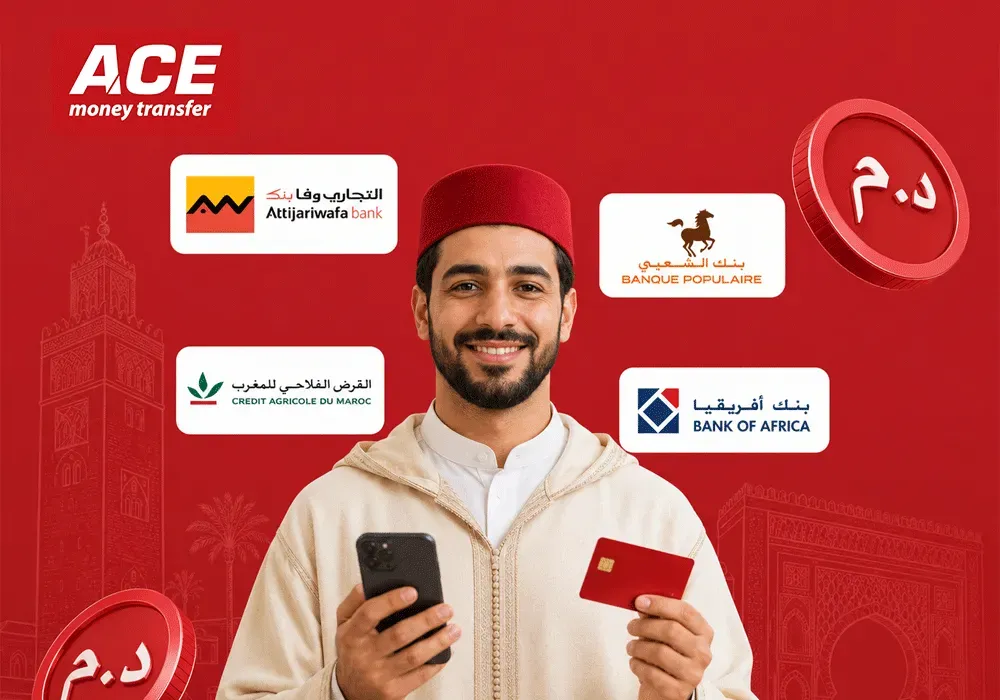
ACE Money Transfer enables customers to send money to Morocco through available transfer methods, with transfer times depending on the payment method and transfer route.
Through its website and mobile application, ACE Money Transfer allows users to send money anytime and from anywhere, making international remittances more convenient than traditional transfer methods.
Rates and fees may vary by transfer corridor, payment method, and transaction. Check the current exchange rate, applicable fees, and amount received on ACE Money Transfer before sending.
Morocco's banking sector offers a strong combination of stability, innovation, and international connectivity. When you choose a bank, keep in mind that residency status can affect which account types are available, and review the official fee information each institution must publish on its website or display in-branch. Read the published terms carefully before opening an account. Some banks also waive certain fees if you maintain a minimum balance. Attijariwafa Bank, Banque Populaire, and Bank of Africa continue to lead the market through their scale, financial strength, and regional influence. Meanwhile, institutions such as CIH Bank and Umnia Bank are attracting customers through digital innovation and specialised banking solutions.
As digital banking adoption continues to accelerate and international financial activity expands, choosing the best bank in Morocco can help individuals and businesses access better financial services, manage money efficiently, and benefit from secure international transactions. Students planning to study abroad may also need euro account options.
Attijariwafa Bank is one of Morocco's leading banking groups, with a strong market presence, extensive branch network, digital banking services, and international operations. It was named Morocco's Best Bank for 2026 by Euromoney.
Banque Populaire and Attijariwafa Bank are particularly popular among Moroccan expatriates because of their strong remittance services and international banking capabilities.
CIH Bank, Attijariwafa Bank, and Bank of Africa are known for offering advanced digital banking platforms and user-friendly mobile applications.
Umnia Bank is one of the leading participatory banks in Morocco and offers a wide range of Shariah-compliant financial products and services.
Foreigners may be able to open a bank account in Morocco, depending on the bank, account type, and residency status. Banks may request documents such as a valid passport, proof of address, and residency documentation where applicable. Requirements vary by bank, so applicants should check the current requirements with their chosen bank.
Disclaimer: This article is intended for general informational and educational purposes only and should not be construed as legal, regulatory, tax, business, or financial advice. While reasonable efforts have been made to ensure that all facts, figures, and data are accurate and valid as of the date of publication, no warranty or guarantee is given as to the ongoing completeness, accuracy, or currency of the information.
The content is based on information available at the time of publication. Regulations, government policies, market conditions, and service offerings may change over time and vary across jurisdictions and providers. As a result, some information may no longer be current or applicable. Readers should independently verify all information and consult qualified professional advisors before making any financial, legal, or business decisions.
Best Banks Worldwide
Explore our guides to banks and learn about international banking services and transfer options.