ACE Money Transfer
ACE Money Transfer

22 Jan 2025
Planning a trip to Morocco means getting to grips with a currency system that works differently from most European destinations. This guide covers everything UK travellers need to know about the Moroccan dirham, from exchange rates and ATM fees to haggling in the souks and avoiding common money pitfalls.
The official currency in Morocco is the Moroccan dirham (MAD). It is a partially closed currency, meaning you generally cannot buy it freely outside the country, and there are strict rules on how much you can carry across the border.
Most travellers should plan to get the bulk of their Moroccan currency after arrival. Some UK providers sell limited amounts, but rates are often poor and stock unreliable.
As of late June 2026, 1 British pound is worth roughly 12.38–12.40 Moroccan dirhams at mid-market rates. Rates change daily, so always check before you travel.
Cash is the most widely used payment method in Morocco, but cards (including contactless and mobile wallet payments) are increasingly accepted in major cities and tourist areas.
The standard practice for most UK travellers is to bring a primary debit card, a backup bank card, plus a small amount of GBP or EUR in cash, and then withdraw money in dirhams from ATMs after landing.
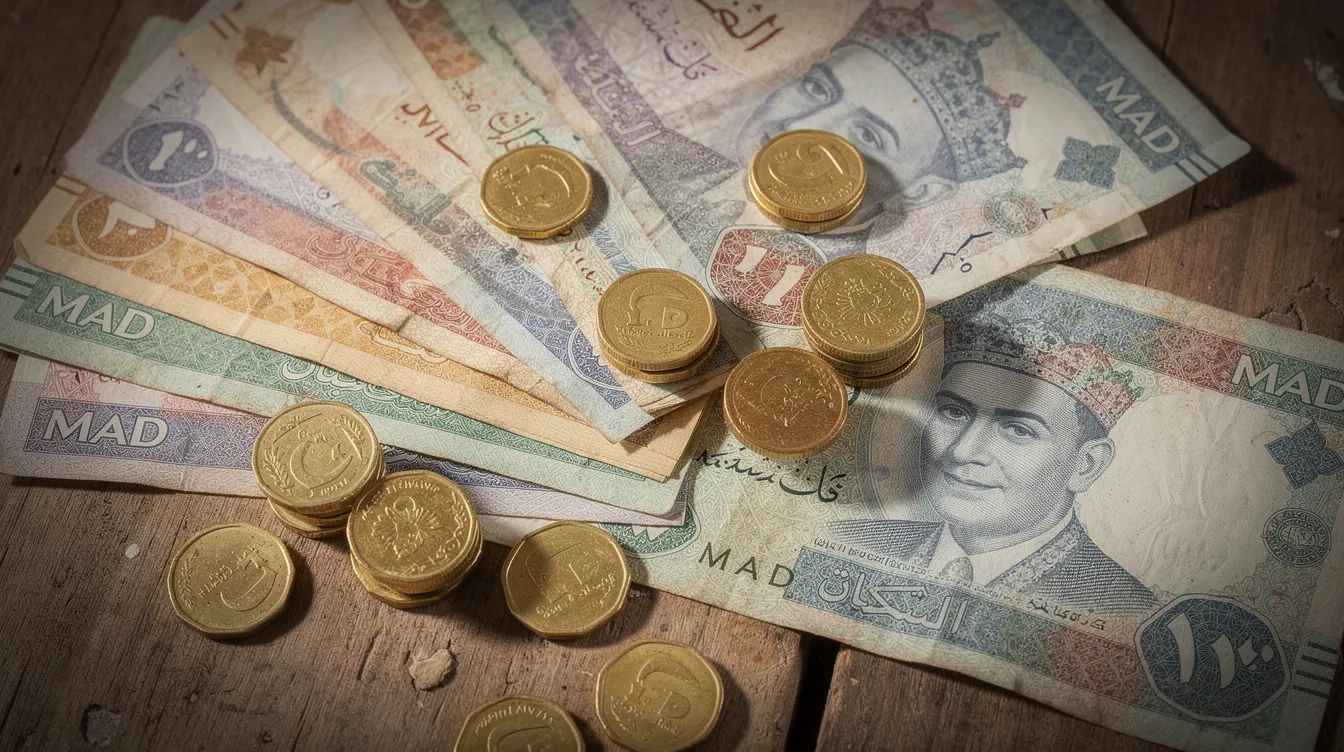
The official currency of Morocco is the Moroccan dirham. The currency code is MAD, and you will see it written as "DH" or "?.?." on price tags, menus and in shops across the country. The currency symbol appears on everything from taxi meters to restaurant bills.
The Moroccan dirham is subdivided into 100 santimat (also called centimes). In everyday conversation, locals still sometimes quote prices in "rials" - 1 Moroccan dirham equals 20 rials, the former currency unit - or even in "francs," a holdover from the Moroccan franc era.
Moroccan dirham coins also include 5, 10, and 20 centimes for very small transactions. Coins in circulation include 1, 2, 5, and 10 dirhams, used for buses, small snacks, café tips and market purchases.
Banknotes are issued in denominations of 20, 50, 100, and 200 dirhams. The 20 and 50 are your workhorses for taxis, street food and souk shopping, while 100 and 200 notes suit restaurants and hotels. Moroccan dirham denominations spanning 1, 5, 10, 20, 50, and 100 dirhams cover both coins and banknotes across daily use.
Morocco's modern coinage and note designs were updated in 2023–2024 with improved security features. Older series are being progressively withdrawn.
Bank Al Maghrib, Morocco's central bank, issues all Moroccan currency and manages the exchange rate within a ±5% band against a basket of roughly 60% euro and 40% US dollar.
The dirham was reintroduced in Morocco in 1960, replacing the Moroccan franc that had been used since the French protectorate period. Coinage traditions in the region stretch back centuries - the word "dirham" itself traces linguistic roots through Arabic to the ancient Byzantine Empire's drachma.
The Moroccan dirham is a closed currency, meaning it is only available in Morocco and subject to strict import and export controls.
You can bring up to 2,000 dirhams into Morocco in cash per person. The same limit applies on exit - it is illegal to take more than 2,000 MAD out of Morocco, and customs officers can confiscate excess amounts.
Because the dirham is a restricted currency, many high-street bureaux de change in the UK will not stock it at all. You effectively cannot exchange pounds for dirhams before arriving in Morocco in any meaningful quantity.
The standard approach is to exchange foreign cash or withdraw money in dirhams after landing - at the airport bureau de change, city banks, exchange offices or ATMs.
Keep all exchange receipts. You must convert leftover dirhams back to pounds before leaving the country, and banks or exchange offices at departure may ask for proof of your original conversion.
Attempting to export large sums of MAD without documentation can result in confiscation, fines, or delays at the border.
Exchange rates shift every business day, so treat any figures here as a planning guide rather than a guarantee.
On 29 June 2026, mid-market rates sat around 1 GBP ? 12.39 MAD, and inversely 1 MAD ? £0.081. Exchange rates for the dirham are tightly managed by the central bank, which keeps fluctuations relatively modest compared to free-floating currencies.
The mid-market rate (sometimes called the wholesale or interbank rate) is the standard rate you see on currency converters online. The tourist rate you actually receive from ATMs, banks and exchange offices will always be slightly worse, reflecting margins and fees.
Check live exchange rates shortly before your trip using a reputable website or multi-currency app. Avoid relying on printed rates from weeks earlier.
To visualise your spending power: at approximately 12.39 MAD per pound, 100 GBP converts to roughly 1,239 MAD; 500 GBP gives you about 6,195 MAD; and 1,000 GBP yields around 12,390 MAD before any fees or commissions.
Because the dirham is generally considered a restricted currency, you usually cannot and should not plan to buy large amounts in the UK before departure.
Some UK travel money providers and banks may sell up to around 2,000 MAD per person, but availability is inconsistent and the spread over the mid-market rate can be significant.
Rather than ordering dirhams in advance, bring a modest amount of British pounds or euros as a backup, and convert them in Morocco where rates are regulated more tightly by Bank Al-Maghrib.
Scottish, Gibraltar and Northern Irish pound notes may be refused by Moroccan exchange offices and banks. If you plan to exchange your pounds for cash dirhams, prioritise Bank of England notes.
Compare total costs before you go: airport bureaux vs. city centre exchange offices vs. withdrawing locally with a debit card or multi-currency card. The difference across a week-long trip can be substantial.
ATMs are the simplest way for most travellers to get Moroccan dirhams on arrival and throughout their trip, especially if they carry a modern debit or travel card.
You can withdraw cash from ATMs throughout Morocco. Machines are widespread in cities like Marrakech, Casablanca, Rabat, Tangier, Agadir and Fez. Coverage thins out in remote villages, mountain areas and the desert - carry enough cash before heading off-grid.
Typical ATM withdrawal limits sit between 2,000 and 3,000 MAD per transaction, though individual banks set their own ceilings. Most machines allow multiple withdrawals per day if your account permits.
Watch for fees: Moroccan ATM operators commonly charge 22–50 MAD per foreign withdrawal. Your UK bank may add its own foreign transaction fees or flat charges on top.
Always choose to be charged in Moroccan dirhams (MAD) when prompted at an ATM or card terminal. Selecting GBP triggers dynamic currency conversion (DCC), which almost always results in a worse rate.
Bring at least two different cards - for example, one primary debit card and one backup. Enable travel settings or notify your bank via their app before departure so your card in Morocco isn't blocked as suspicious activity.
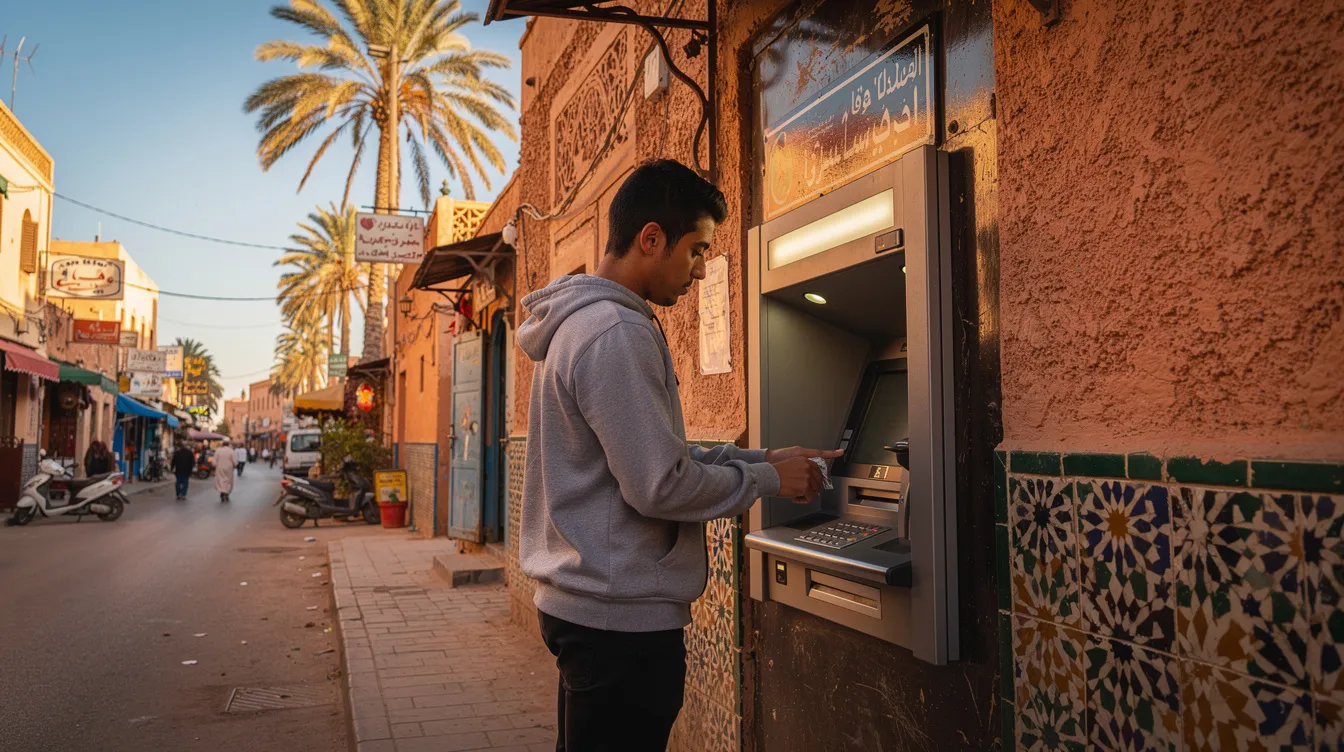
Card payments in Morocco are increasingly common, particularly in hotels, chain restaurants, supermarkets and major tourist attractions in cities.
Visa and Mastercard are commonly accepted in tourist areas. American Express is less widely accepted than Visa or Mastercard, and Diners Club even less so - neither should be relied upon as your sole card.
Contactless card payments and mobile wallet transactions (phones and watches linked to your account) are widely used in modern venues, malls and urban cafés.
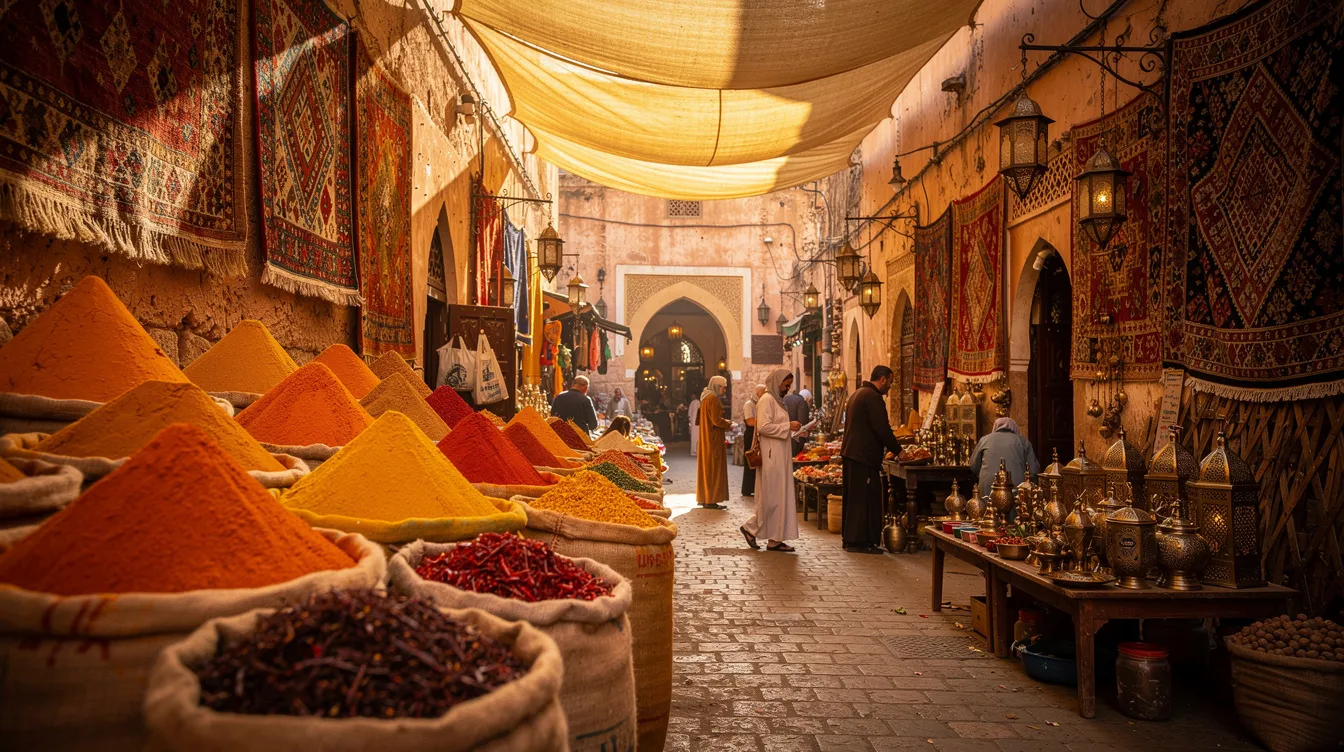
In souks, small cafés, traditional riads and rural shops, cash in Moroccan dirhams remains essential. Vendors there often cannot process card payments and may struggle to break large 200 MAD notes.
If a terminal asks whether you want to pay in British pounds or MAD, always select MAD. Paying in pounds triggers DCC and a poor exchange rate set by the terminal operator.
Frequent travellers may benefit from a low-fee multi-currency or travel debit card, which typically converts at rates closer to the mid-market and makes it easier to track spending in your app.
Prices in Morocco are generally 60% lower than in the UK, making it an affordable destination once you have your currency sorted. Most travelers spend between £40 and £50 daily on food, transport and activities (excluding flights and accommodation).
Food: A street food snack runs 15–30 MAD. An inexpensive local meal costs 30–70 MAD. A three course meal for two at a mid-range restaurant comes to around 250 MAD. Mint tea or coffee in a café is typically 10–25 MAD.
Drinks: Bottled water costs 5–10 MAD, a soft drink around 10–15 MAD, and a simple espresso in Marrakech or Casablanca roughly 10–20 MAD.
Transport: Local transport tickets cost about 5 MAD for a one-way bus journey in big cities. Petit taxi starting fares sit around 7–10 MAD depending on the city. An airport taxi from Marrakech Menara to the medina typically runs 70–150 MAD depending on negotiation.
Attractions: Entrance fees for medina monuments and museums range from 10 to 70 MAD. Popular sites like Jardin Majorelle charge around 150 MAD per person.
Daily budgets: Budget travellers can manage on roughly 300–500 MAD per day. Mid-range visitors should plan for 500–800 MAD. Those wanting higher-end dining and activities might spend 1,000 MAD or more.
The best currency to actually spend in Morocco is the Moroccan dirham. The real question is which foreign currency to bring as backup for exchange.
British pounds are accepted by Moroccan banks and many exchange offices, but may attract slightly worse rates than euros in some tourist cities, since the euro makes up a larger share of the dirham's reference basket.
Some businesses accept euros, but at unfavorable exchange rates. Paying directly in euros usually means a poor conversion and change returned in dirhams.
US dollars are among the popular currencies accepted at major exchange points, but they are less practical than euros for UK travellers on a short-haul trip to this country.
The best approach for most UK visitors: rely on a good card in Morocco for larger payments and ATM withdrawals, and treat any foreign cash (GBP or EUR) purely as an emergency backup to exchange at banks or a bureau de change.
Do not plan on spending British pounds or euros directly in shops or souks. Quoted prices in other currencies nearly always include a hidden markup.
Modern multi-currency debit cards have become a popular way for UK and European travellers to manage travel money in Morocco without worrying about carrying large amounts of cash.
You load British pounds into your account at home, and the card automatically converts to Moroccan dirhams at the point of purchase or ATM withdrawal. A Revolut card, for instance, functions as a standard Visa or Mastercard debit card at any accepting terminal.
Most apps let you check live MAD exchange rates on your phone and may allow you to pre-convert GBP to MAD during favourable market movements, locking in a rate before your trip.
ATM withdrawals in Moroccan dirhams often come with a monthly fee-free allowance from the card provider, making them cost-effective for regular small withdrawals.
Third-party ATM operators in Morocco still charge their own fees (typically 22–50 MAD), regardless of whether the card issuer charges. Always decline DCC when prompted.
These cards work like any standard Visa or Mastercard payment in Moroccan shops, restaurants and hotels that accept card payments, and spending is tracked in your app in near real-time.
Exchanging foreign cash into Moroccan dirhams is straightforward in cities and tourist areas, but exchange rates vary at different locations in Morocco.
Banks offer regulated rates and are available in all larger towns and cities. Opening hours can be limited (typically Monday to Friday, mornings and afternoons with a lunch break), and queues are common.
Airport and port bureaux de change are convenient for a first small exchange on arrival. Rates may be slightly less favourable than city-centre offices, but the difference on a small amount is usually minor.
Many larger hotels in Marrakech, Casablanca, Rabat and Agadir offer on-site currency exchange at slightly worse rates than banks - useful for late arrivals or when banks are closed.
Avoid unlicensed street exchangers and informal offers in souks. Any exchange that does not provide a printed receipt should be treated as suspect.
Always check the posted buy/sell rate, ask whether commission is charged on top, and keep your receipts. You will need them if you want to convert leftover dirhams back into British pounds at the end of your visit.
Cash is the most widely used payment method in Morocco, but urban areas increasingly accept cards and digital payments across a growing number of stores and venues.
Cash in Moroccan dirhams is essential for small shops, markets, unmetered taxis, street food, tipping, and rural guesthouses. You simply cannot visit Morocco without carrying physical notes and coins.
Debit and credit cards are typically accepted in mid- to high-end hotels, many riads in big cities, chain supermarkets, modern cafés, and major tourist attractions.
Mobile and contactless payments tied to Visa or Mastercard are expanding in cities, but do not rely on them outside major urban centres.
Carry a mix every day: one primary card, one backup card, and a daily amount of cash in Moroccan dirhams so you can pay in any situation.
Store larger sums of cash and spare cards securely in your accommodation safe or a money belt. Carry only what you need for the day.
Tipping and bargaining are woven into daily life in Morocco. Be prepared to use small Moroccan coins and notes frequently.
Tipping norms: Round up taxi fares, leave 5–10% in restaurants with table service, and offer small tips (10–20 MAD) for hotel staff, porters and guides.
Where to haggle: Bargaining is expected in souks and with market traders, but not in supermarkets, most restaurants or official transport counters. It is a normal part of the shopping experience, not a confrontation.
How to haggle: Start your offer at roughly 30–40% of the first price quoted and work upward gradually. Stay polite and be willing to walk away - the average final price often lands around 50–60% of the opening ask.
Keep a supply of small coins and low-value notes (5, 10, 20 dirhams). Many vendors struggle to break large 200 MAD notes, and having exact change speeds up every transaction.
Agree total prices in Moroccan dirhams before taking services like unmetered taxis, guides or small tours. Confirming the cost upfront in MAD avoids misunderstandings and prevents prices being quoted in confusing rials or inflated figures.
Morocco is generally safe for handling money if you follow basic precautions and stay aware of a few recurring tricks.
DCC traps: Some ATMs and card terminals display the amount in British pounds instead of MAD. This dynamic currency conversion uses a poor exchange rate and benefits the operator, not you. Always select MAD.
Taxi confusion: Drivers may refuse to use meters, quote prices in rials or francs rather than dirhams, or claim a note you handed over was smaller than it was. Agree fares in dirhams before getting in, and try to pay with exact or near-exact change.
Rial misunderstandings: Learn that 1 dirham = 20 rials. If a vendor quotes "200," confirm whether that means 200 dirhams or 200 rials (which is only 10 dirhams). This distinction trips up many visitors.
Use hotel safes, money belts or neck wallets for larger sums of cash, passports and spare cards. Keep only a modest amount of spending money on your person each day.
Photograph or note down key card numbers and your bank's emergency contact details. If a card is lost or stolen, you can freeze it immediately from the app on your phone and fall back on your backup card.
Here are quick answers to the questions UK travellers ask most often when planning a trip.
Can I use British pounds in Morocco? A few tourist businesses may accept pounds, but at heavily marked-up rates. The currency of Morocco is the dirham, and you will get far better value paying in MAD everywhere.
How many Moroccan dirhams should I take per day? Budget travellers can manage on 300–500 MAD per person per day. Mid-range visitors typically spend 500–800 MAD. At the current rate, that works out to roughly £40–£65 per person daily.
Can I withdraw money with my UK card in Morocco? Yes. Most Visa and Mastercard debit and credit cards work at Moroccan ATMs, subject to your bank's foreign withdrawal limits and fees.
Can I use my Revolut card or similar in Morocco? These cards usually work wherever Visa or Mastercard is accepted. Check your app for any weekend exchange rate markup and confirm your free ATM withdrawal allowance before you fly.
What happens to leftover Moroccan dirhams? Exchange them back into pounds at the airport or a local bank before departure. You will need your original exchange receipts, and you cannot legally export more than 2,000 MAD in cash.
Is it better to pay in cash or card in Morocco? A mix is best. Use your card for larger purchases, accommodation and restaurants that accept it, and carry cash in Moroccan dirhams for everyday expenses, markets and tips. Planning this split before your trip means you will rarely be caught short.