ACE Money Transfer
ACE Money Transfer

26 Aug 2026
Uruguay's financial system was assessed as stable and resilient by the Financial Stability Committee in July 2026. The banking sector is tightly regulated, heavily concentrated, and surprisingly welcoming to both locals and foreign clients. But with a handful of major banks dominating the landscape, choosing the right one can feel overwhelming.
Whether you're a resident looking for everyday personal banking, an expat trying to open a bank account in Uruguay, or a business owner who needs corporate banking and international connectivity, this guide breaks down the top banks in the country, what makes each one stand out, and how to pick the one that fits your situation.
Uruguay's banking landscape is compact but competitive. The top five banks held 90% of total banking assets at the end of 2023, indicating a highly concentrated banking sector.
Here's what we evaluated:
Market share and client base - how many customers each bank serves and how large its asset portfolio is
Branch network and physical accessibility - especially coverage outside Montevideo in interior departments
Digital banking technologies - quality of mobile apps, online banking platforms, and fintech integrations
International accessibility - services for foreign clients, multi-currency accounts, and cross-border wire transfers
Account opening requirements - documentation, fees, and minimum deposits for residents vs. non residents
Range of banking products - from savings accounts and personal loans to investment services and trade finance
Regulatory compliance and financial stability - capital adequacy, credit ratings, and oversight by the central bank
All banks in Uruguay require authorization to operate, with the Central Bank of Uruguay (BCU) involved in the authorization and supervision process. The BCU's regulatory framework includes capital and liquidity requirements and a roadmap for adopting Basel III standards.
Banco Republica is the country's largest bank and the dominant state owned bank in Uruguay's financial system. Founded in 1896, BROU has served as the backbone of banking in Uruguay for over a century. Banco Santander was named Bank of the Year in Uruguay by The Banker in 2023 and ranked third overall in the Merco Empresas y Líderes Uruguay 2023/24 corporate reputation ranking.
Why It Stands Out: BROU has a significant presence in Uruguay's banking sector and operates a broad domestic branch network, with locations across Montevideo and departments throughout the country.
Best For: Local residents, businesses seeking comprehensive banking services, and anyone who values maximum branch access and government backing.
Key Strengths:
Provides a broad range of deposit, lending, payment, and other banking products for individuals and businesses.
Assigned a Baa1/P-2 rating by Moody's, subject to the rating agency's methodology and assessment.
BROU features lower base administration fees that can be waived with modest balances
Full range of retail, agricultural sector lending, and government contracts
Possible Limitations: Digital adoption has historically been slower than private peers. Some customers report bureaucratic processes for complex transactions, and the user experience of digital channels has room for improvement.
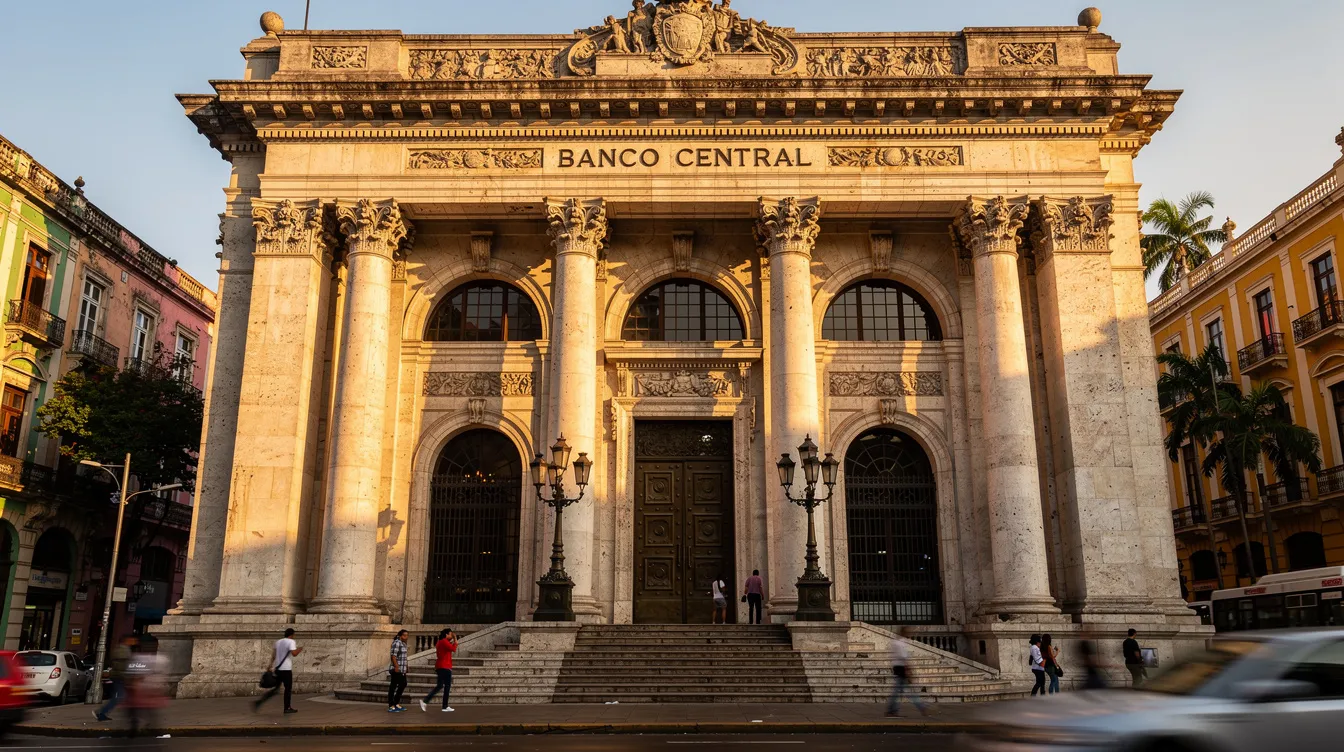
Banco Santander Uruguay has a significant presence in the country's private-sector banking market, with its market position reflected across assets, loans, and deposits. Banco Santander was established in 1997 and offers digital banking across its customer base.
Why It Stands Out: As part of the global Santander Group, the bank offers international banking services and cross-border solutions, including international transfers and multi-currency transactions.
Best For: International clients, expats, and businesses with cross-border needs who want to transfer funds seamlessly between countries.
Key Strengths:
Global banking network for international wire transfers and multi-currency accounts
Strong digital platform with growing digital penetration across its customer base
Competitive in mortgages, auto lending, and consumer credit
ROA of 2.2% and ROE of 23.6% in 2025.
Possible Limitations: Fees can be higher for premium services. Branch coverage in rural and less populated areas is more limited compared to BROU. May require higher minimum deposits for certain account types.
Banco Itaú Uruguay is part of Brazil's Itaú Unibanco, offering diverse services across retail, SME, and digital payment segments. The bank serves more than 450,000 customers through 24 branches across Montevideo and interior departments.
Why It Stands Out: Itaú Uruguay has expanded its digital banking services and monitors customer satisfaction through NPS. The bank has invested heavily in fintech platforms like Paigo, Handy, and Plexo to support e-commerce and digital sales for small and medium businesses.
Best For: Tech-savvy customers, small to medium businesses, and those seeking personalized service with modern digital banking.
Key Strengths:
Itaú Uruguay has a AAA.uy local rating and a Baa3 international rating from Moody's Investors Service.
Itaú provides a mobile banking app with features for account management, payments, transfers, and other everyday banking needs.
Strong SME focus with digital payment and invoicing tools
New branches designed with accessibility features for clients with disabilities
Possible Limitations: The 24-branch network is significantly smaller than BROU's, and rural presence remains modest. Some users report that certain digital features could be more robust.
BBVA Uruguay has been operating since 1997, focusing on customer satisfaction and business banking. BBVA Uruguay accounted for 10.7% of private-bank turnover as of August 2020, according to Uruguay XXI data based on BCU figures.
Why It Stands Out: BBVA Uruguay focuses on digital banking services and provides access to international banking services through its parent company's global network.
Best For: Business banking clients, those seeking innovative financial solutions, and companies that need international connectivity.
Key Strengths:
BBVA's local rating is uyAAA/Stable and international rating is BBB+/Stable/A-2 from S&P
ROA of 1.4% and ROE of 21.1% as of June 2026
Strong in corporate banking with specialized wealth management and investment solutions
Good range of banking products for mid-sized and large companies
Possible Limitations: Smaller client base than the top three. Branch presence is concentrated in Montevideo and a few major cities, with limited coverage in remote zones.
In July 2026, BTG Pactual completed the acquisition of HSBC Uruguay for approximately US$211 million. The deal received regulatory approval from the Central Bank of Uruguay (BCU) in June 2026.
Why It Stands Out: BTG Pactual brings investment banking expertise to Uruguay's retail and corporate landscape. The bank aims to combine its regional strength in wealth management with the established digital platform inherited from HSBC Uruguay.
Best For: High-net-worth individuals, investment-focused clients, and those seeking premium wealth management alongside standard banking services.
Key Strengths:
Investment banking pedigree with deep expertise in digital assets and capital markets
Inherited HSBC's client base, including institutional and corporate divisions
Enhanced digital platform for personal and corporate online banking
Strong for foreign clients needing sophisticated financial institutions
Possible Limitations: The recent transition may cause temporary service disruptions. Minimum requirements for premium accounts could be higher than other banks. Clients accustomed to HSBC's pricing model may experience policy changes.

| Bank | Best For | Key Advantage | Rating |
|---|---|---|---|
| BROU | Comprehensive local banking, maximum branch access | 124+ branches, government backing | Baa1/P-2 (Moody's) |
| Banco Santander Uruguay | International banking, cross-border transactions | Global network, ~30% private market share | Strong regional |
| Banco Itaú Uruguay | Customer service, modern digital banking | 450,000+ customers, top-rated app | Baa2/P-2 (Moody's) |
| BBVA Uruguay | Business banking, innovative financial solutions | Corporate focus, international network | BBB+/Stable (S&P) |
| BTG Pactual | Wealth management, investment banking services | US$1.8B assets, investment expertise | Developing |
Foreigners can open bank accounts in Uruguay without residency, which is one reason the country attracts international clients. However, requirements differ:
Residents: You need an identity card (Cédula de Identidad) and local address to open an account. Most banks require a tax ID (RUT) and proof of income. Opening requirements and processing times vary by bank and individual circumstances.
Non residents: Must provide a valid passport, proof of funds, and a banking reference (a reference letter from your bank abroad). Some banks may require a minimum deposit or balance to open certain current accounts. Rates and fees may vary. Visit acemoneytransfer.com for current rates. Foreign nationals can open a bank account in one day at certain financial institutions, though full processing may take longer.
US citizen note:US citizen note: US citizens with foreign financial accounts may have additional reporting requirements under FATCA. Laws and regulations may change. Please verify with a local professional. Banks require extra documentation, including tax returns in some cases.
Private banks in Uruguay generally require proof of income and local tax IDs for account opening. Most banks also request a recent utility bill as proof of address.
Uruguay requires banks to apply customer due diligence measures, and account-opening requirements vary by bank and customer circumstances. This is a general overview only. Legal obligations vary and are subject to change.
Your banking needs should drive your decision:
Personal banking: Look for low maintenance fees, a good debit card, and convenient ATM access. Uruguay's banking sector faces average maintenance fees of $400 to $900 UYU per month. Rates and fees may vary. Visit acemoneytransfer.com for current rates.
Private banks generally charge maintenance fees based on account types and balances.
Business banking: Prioritize credit lines, export facilities, foreign exchange, and digital invoicing platforms. Itaú's payment tools are particularly strong here for SMEs.
Investment and wealth management: BTG Pactual and Santander offer investment and wealth management services. Offshore banks and representative offices may also serve high-net-worth individuals.
International needs: If you regularly bank abroad or need to transfer funds across borders, Santander's global network or BTG Pactual's international connectivity are your strongest options.
Uruguay features a heavily dollarized dual-currency economy - over 75% of funds in Uruguayan banks are held in US dollars. All major banks provide accounts in both Uruguayan Pesos and US Dollars, and the country's economy operates fluidly in both currencies.
Uruguay generally does not impose withholding tax on incoming funds, subject to the nature and source of the funds. Foreigners can own property in Uruguay without citizenship. Laws and regulations may change. Uruguay has statutory bank-secrecy provisions that protect certain customer and account information, subject to legally defined exceptions.
If you prefer managing everything from your phone, private banks like Itaú and Scotiabank score better for user-friendly mobile apps. According to recent surveys, 69% of Uruguayans now use fintech alongside their traditional bank, with 80% of that usage focused on payments and transactions.
Most banks now offer online banking with 24/7 access, but feature depth varies. BROU's digital tools are functional but less polished. Santander and BBVA benefit from global digital banking investments. Itaú offers digital banking and payment solutions for commercial and SME clients, including online business banking, electronic payments, and mobile tools for managing business transactions.
International transfers to Uruguay provide a channel for sending funds to recipients and bank accounts in the country. ACE Money Transfer supports the initiation of these transactions through its digital platform, while the receiving bank or financial institution manages the funds upon receipt.
Exchange rates fluctuate, and the rate applicable to your transfer can differ from rates shown at another time. Check the current rate atacemoneytransfer.combefore sending.
Through its digital platform and applicable payment infrastructure, ACE Money Transfer supports transfers to Uruguay. The exchange rate and applicable fees are presented before confirmation, with the final rates and charges subject to market conditions, service terms, and relevant regulatory requirements.
Transfer completion times vary according to the payment method, receiving institution, and local processing procedures. Any fees applied by the recipient’s bank are determined by the receiving institution and remain outside ACE Money Transfer’s control. Check acemoneytransfer.com for current rates and fees.
Local banking: BROU provides a range of banking services for customers seeking a locally focused banking provider.
International banking: Santander offers services that include international and cross-border banking.
Digital and business banking: Itaú provides digital banking services alongside products for individuals and businesses.
Business banking: BBVA offers banking and financial services for business customers in Uruguay.
Investment and wealth management: BTG Pactual focuses on investment, wealth management, and capital markets services.Final Thoughts
Uruguay's banking system is compact, well-regulated, and designed to serve both local and international needs. Uruguay's financial system has maintained a resilient banking sector, while the country's top five banks held 90% of total banking assets at the end of 2023.
The best bank in Uruguay for you depends on three things: your residency status, your banking needs, and how much you value digital convenience versus branch access. Many banks in the country serve overlapping segments, so the differences come down to fee structures, digital capabilities, and international reach.
One important note: account opening requirements, fees, and minimum balances change regularly. Before you open accounts or commit to any financial houses, confirm the latest terms directly with your chosen bank. Whether you're looking at commercial banks for everyday use or specialized financial institutions for currency risk management, Uruguay's financial stability makes it a compelling place to bank.
Disclaimer: This article is intended for general informational and educational purposes only and should not be construed as legal, regulatory, tax, business, or financial advice. While reasonable efforts have been made to ensure that all facts, figures, and data are accurate and valid as of the date of publication, no warranty or guarantee is given as to the ongoing completeness, accuracy, or currency of the information.
The content is based on information available at the time of publication. Regulations, government policies, market conditions, and service offerings may change over time and vary across jurisdictions and providers. As a result, some information may no longer be current or applicable. Readers should independently verify all information and consult qualified professional advisors before making any financial, legal, or business decisions.