24 Oct 2025
Whether you're scheduling a conference call with colleagues in Mumbai, planning a family catch-up with relatives in Delhi, or timing a money transfer to arrive on the right day, understanding the uk and india time difference is essential. This guide breaks down exactly how the offset works, why it changes with the seasons, and how to use it to your advantage.
India follows Indian Standard Time (IST), which is fixed at UTC +5:30 year-round. The united kingdom switches between Greenwich Mean Time (GMT, UTC+0) in winter and British Summer Time (BST, UTC+1) in summer. Because India does not observe daylight saving time, the gap between the two countries shifts depending on what the UK clocks are doing.
During UK winter (roughly late October to late March), India is 5 hours and 30 minutes ahead of UK time.
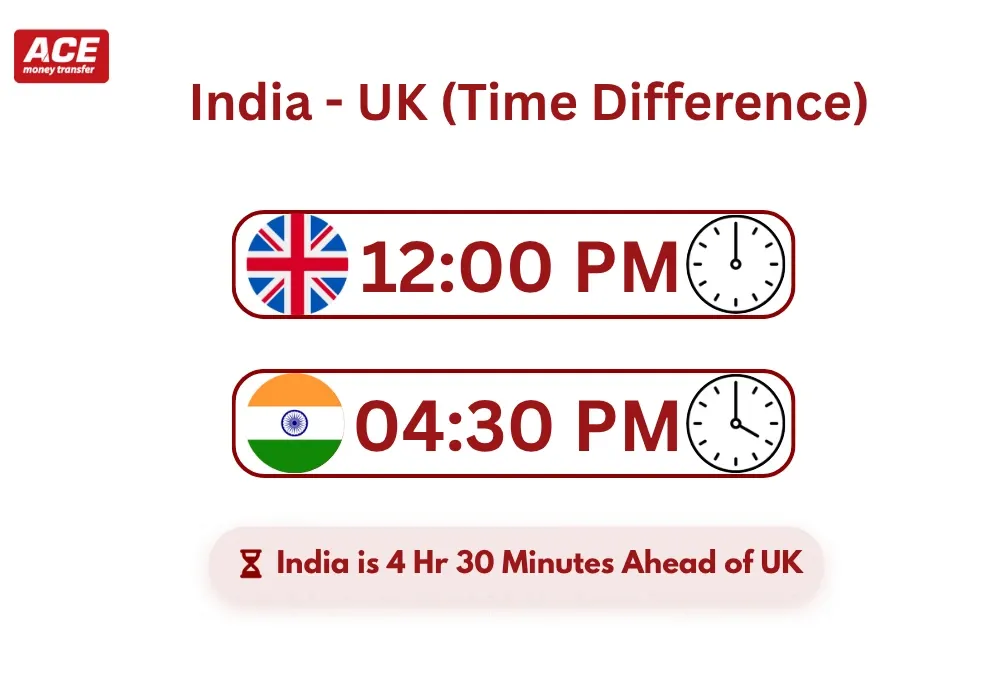
During UK summer (roughly late March to late October), India is 4 hours and 30 minutes ahead of UK time.
Here are a couple of concrete examples using london time:
9:00 AM in London (BST, June 29, 2026) = 1:30 PM in India (IST).
6:00 PM in London (GMT, January 15, 2026) = 11:30 PM in India (IST).
| Period | UK Offset | India Ahead By |
|---|---|---|
| GMT (late Oct ? late Mar) | UTC+0 | 5 hours and 30 minutes |
| BST (late Mar ? late Oct) | UTC+1 | 4 hours and 30 minutes |
London is therefore either 4 hours 30 minutes or 5 hours 30 minutes hours behind india time, depending on the season.
India uses a single time zone for the entire country: india standard time (IST), set at UTC 5:30. The reference meridian is 82°30? E longitude, which passes near Mirzapur in Uttar Pradesh. This was chosen as a geographic compromise to balance solar time across India's wide east-west span.
Key facts about IST:
IST does not change throughout the year. India does not observe Daylight Saving Time, so there are no seasonal clock adjustments.
All major cities share the same current time. Whether you're checking the clock in New Delhi, Mumbai, Bengaluru, Kolkata, or Chennai, the local time is always identical.
The half-hour offset (5 hours and 30 minutes rather than a round number) is a historical decision based on India's central longitude. It makes mental conversions slightly trickier than full-hour time zones.
Because every city in India runs on the same standard time, using an india time converter is simpler than converting times for countries with multiple different time zones. You only need one offset, and it never changes.
The UK operates on two time settings depending on the season:
Greenwich Mean Time (GMT, UTC+0) from late October to late March. During winter the UK is on Greenwich Mean Time (GMT, UTC+0).
British Summer Time (BST, UTC+1) from late March to late October. During summer the UK is on British Summer Time (BST, UTC+1). This is the UK's version of daylight saving time.
The UK shifts its clocks forward in the spring and back in the autumn. For 2026, the key dates are:
Clocks move forward 1 hour on the last Sunday in March 2026 (March 29).
Clocks move back 1 hour on the last Sunday in October 2026 (October 25).
London time, Birmingham time, and united kingdom time generally refer to this same national clock. While the UK has overseas territories in other time zones, mainland Britain follows a single schedule.
Quick conversion examples:
12:00 noon GMT in London (February) = 5:30 PM IST. Noon UK time is 5:30 PM IST in winter.
12:00 noon BST in London (July) = 4:30 PM IST. Noon UK time corresponds to 4:30 PM IST in summer.
UK time is UTC +0 in winter and UTC +1 in summer - that single hour of difference is what causes the time gap with India to shift between 4 30 and 5 30 hours throughout the year.
The time difference between India and the UK changes during daylight saving time. Because India's clocks stay fixed, all variation comes from the UK switching between GMT and BST. The time difference shifts throughout the year due to UK's daylight saving time.
The two key offsets:
GMT period: India is 5 hours 30 minutes ahead of UK time.
BST period: India is 4 hours and 30 minutes ahead during UK daylight saving time. During daylight saving, the UK is 4:30 hours behind India.
Here are date-specific illustrations:
On March 1, 2026 (GMT): 8:00 AM in London = 1:30 PM in India.
On June 29, 2026 (BST): 4:47 PM in London = 9:17 PM in India.
On November 15, 2026 (GMT): 3:00 PM in London = 8:30 PM in India.
A common misconception is that the difference is always "4 30 hours" or always "5 30 hours." In reality, you need to know the date to determine which offset applies. From late March through late October, the gap is 4 hours and 30 minutes. For the rest of the year, it is 5 hours and 30 minutes. Always check whether the UK is currently on GMT or BST before doing your conversions.
Converting london time to india time takes just one mental step:
During GMT (winter months): add 5 hours 30 minutes to UK time.
During BST (summer months): add 4 hours 30 minutes to UK time.
Practical examples:
4:30 PM in London (BST, July) ? add 4h 30m ? 9:00 PM IST.
9:00 AM in the UK (GMT, December) ? add 5h 30m ? 2:30 PM IST.
5:00 PM in the UK (BST, August) ? add 4h 30m ? 9:30 PM IST.
| UK Time (BST – Summer) | India Time (IST) |
|---|---|
| 7:30 AM | 12:00 PM |
| 12:30 PM | 5:00 PM |
| 4:30 PM | 9:00 PM |
| 6:30 PM | 11:00 PM |
| UK Time (GMT – Winter) | India Time (IST) |
|---|---|
| 7:30 AM | 1:00 PM |
| 12:00 PM | 5:30 PM |
| 3:00 PM | 8:30 PM |
| 6:00 PM | 11:30 PM |
An online india time converter or world clock tool handles dates automatically, which is especially useful around the days clocks change. The same conversion rule applies across the entire united kingdom - London, Manchester, Edinburgh, and Cardiff all share the same offset to IST.
Because the UK is 4 30 or 5 30 hours behind India, finding overlapping working hours takes a bit of planning. Best call times are 9:00 AM to 1:30 PM UK time, which maps neatly onto India's afternoon.
For UK callers during BST (summer):
Ideal meeting window: 9:00 AM–1:30 PM in London = 1:30 PM–6:00 PM in India.
Acceptable extended window: 7:00 AM–6:30 PM in London = 11:30 AM–11:00 PM in India.
For calls, 2:30 AM to 6:30 PM UK time works well if you're flexible.
For UK callers during GMT (winter):
Good business window: 8:00 AM–12:30 PM UK = 1:30 PM–6:00 PM in India. India's working hours are typically 1:30 PM to 6:00 PM UK time.
For family calls, evenings in India often correspond to late morning or early afternoon in the UK:
7:30 PM IST family call = 2:00 PM BST in London (summer).
9:30 PM IST = 4:00 PM GMT in London (winter).
The best time for a conference call is when both sides are within their daytime or early evening hours. Avoid scheduling before 9:00 AM or after 10:30 PM local time for either party.

The time difference directly influences when banks and payment providers can process transfers, especially rupee settlements aligned with Indian banking hours (roughly 9:30 AM–5:30 PM IST, Monday to Friday).
Initiating a transfer at 11:00 AM GMT in London (December) = 4:30 PM in India, typically still within same-day processing cut-offs.
Sending at 4:30 PM BST in London (June) = 9:00 PM IST, which may push processing to the next working day.
Initiate transfers before 3:00 PM GMT for efficiency, as this still falls within Indian business hours.
Things to keep in mind:
Public holidays in India (such as Diwali, Holi, or Republic Day) and weekends can delay bank-based transfers regardless of the current time in the UK.
Cutoff times vary by provider. Even if the time conversion looks favourable, some banks have earlier internal deadlines.
For business users, schedule meetings during overlapping working hours and use a time zone calculator to avoid confusion during the transition days between GMT and BST. A misread clock change can mean a missed conference call or a delayed payment.
Here is a series of real-life conversions for different parts of the day, with the season clearly stated:
Morning: 7:30 AM in London (BST, July 10, 2026) = 12:00 PM in India.
Noon: 12:00 PM in London (GMT, February 2, 2026) = 5:30 PM in India.
Late afternoon: 4:30 PM in London (BST, June 29, 2026) = 9:00 PM in India.
Night: 11:30 PM in London (GMT, November 20, 2026) = 5:00 AM in India (next day).
While the headline offsets are 4 30 or 5 30 hours, always think in terms of specific dates to know which one applies. A couple of useful "check" times to memorise:
3:00 PM UK time (BST) = 7:30 PM IST.
5:00 PM UK time (BST) = 9:30 PM IST.
6:00 PM UK time (GMT) = 11:30 PM IST.
11:00 AM UK time (GMT) = 4:30 PM IST.
These reference points make it easy to quickly estimate the corresponding india time for any given moment.
India's half-hour offset makes it stand out compared to many other countries. Here is how the gap compares with a few other time zones:
Central European Time (CET, UTC+1) to India: 4 hours 30 minutes (standard) and 3 hours 30 minutes (when CET moves to CEST in summer).
US Eastern Time (ET, UTC?5 / UTC?4) to India: typically 9 hours 30 minutes or 10 hours 30 minutes difference.
US Pacific Time (PT / PST, UTC?8 / UTC?7) to India: often 12 hours 30 minutes or 13 hours 30 minutes difference.
India's 30-minute component makes mental math trickier than converting between full-hour time zones. This is why an india time converter is particularly useful when coordinating across multiple cities and countries in different time zones.
One clarification: the phrase "30 hours difference" sometimes appears online and is entirely incorrect. The real offset between the UK and India is never more than 5 30 hours. The "30" refers to the 30-minute component, not 30 hours.
Time zone calculators help convert UK time to India time automatically, accounting for GMT/BST transitions and even flagging Indian public holidays.
Basic steps to follow:
Select "London" or "United Kingdom" as the starting location.
Select "India" or a specific Indian city (for example, Mumbai or New Delhi) as the destination.
Choose the exact date and time to see the correct india time instantly.
Common use cases:
Planning video calls between London and India.
Checking the current time in India before sending a late transfer.
Scheduling travel itineraries that cross multiple time zones.
Pay special attention around the last Sunday of March and the last Sunday of October. These are the days the UK switches between GMT and BST, and they are the most common source of scheduling errors.
Most free world clock apps on your phone or computer handle these transitions seamlessly. If you regularly coordinate between the two countries, keeping a dual time zone widget on your home screen saves time and eliminates guesswork.
India Standard Time (IST) is UTC+5:30 all year. India follows Indian Standard Time (IST) year-round and does not change its clocks.
UK time is GMT (UTC+0) in winter and BST (UTC+1) in summer.
India is 5 hours and 30 minutes ahead of the UK during GMT months.
India is 4 hours and 30 minutes ahead of the UK during BST months.
London time is therefore either 4 30 or 5 30 hours behind india time, depending on the date.
Understanding this time difference makes a real difference when it comes to planning calls, managing business hours across both countries, and timing money transfers so they arrive without unnecessary delays. Refer back to this guide whenever you need a quick conversion, and consider using a world clock tool for dates near the seasonal clock changes.