
ACE Money Transfer
ACE Money Transfer
10 Feb 2026
Sending money from the United Kingdom to Nigeria is more than just a financial transaction. It is a lifeline that supports families, pays tuition, covers medical bills and sustains small businesses. Nigeria is the largest recipient of remittances in Sub?Saharan Africa; in 2023 Nigerians abroad sent $19.5 billion back home, representing about 35 % of all remittance flows to the region. The figure is expected to increase to $26 billion by 2025. Migrants in the UK play a major role in this flow. Surveys show that 58 % of Nigerians living in the UK send between £100 and £500 home each month and that 64 % of them time their transfers to take advantage of favourable pound?to?naira exchange rates. Digital channels and mobile wallets now dominate the market, allowing transfers to arrive within minutes. Among these digital wallets, Opay has become a household name. It boasts over 50 million users, more than 1 million merchants, 10 million daily active users and monthly transaction volumes exceeding US$12 billion.
This blog explores why sending money from the UK to an Opay wallet via ACE Money Transfer is an attractive option. We compare it with other services, highlight relevant statistics, and provide step?by?step guidance and tips to maximise value and convenience. The goal is to create a comprehensive resource that outranks existing articles by being more detailed, data?driven and reader?friendly.
Opay’s meteoric rise is part of a broader shift in Nigeria toward mobile money. Digital wallets let recipients receive funds instantly without needing a bank account. They can pay bills, buy airtime, send money to others or withdraw cash through thousands of agents. ACE’s blog notes that mobile wallets such as Opay, Paga, Carbon, MoniePoint, PalmPay and GoMoney are popular because they offer instant transfers, competitive exchange rates and strong security. With an Opay wallet, recipients only need a phone number to receive funds.
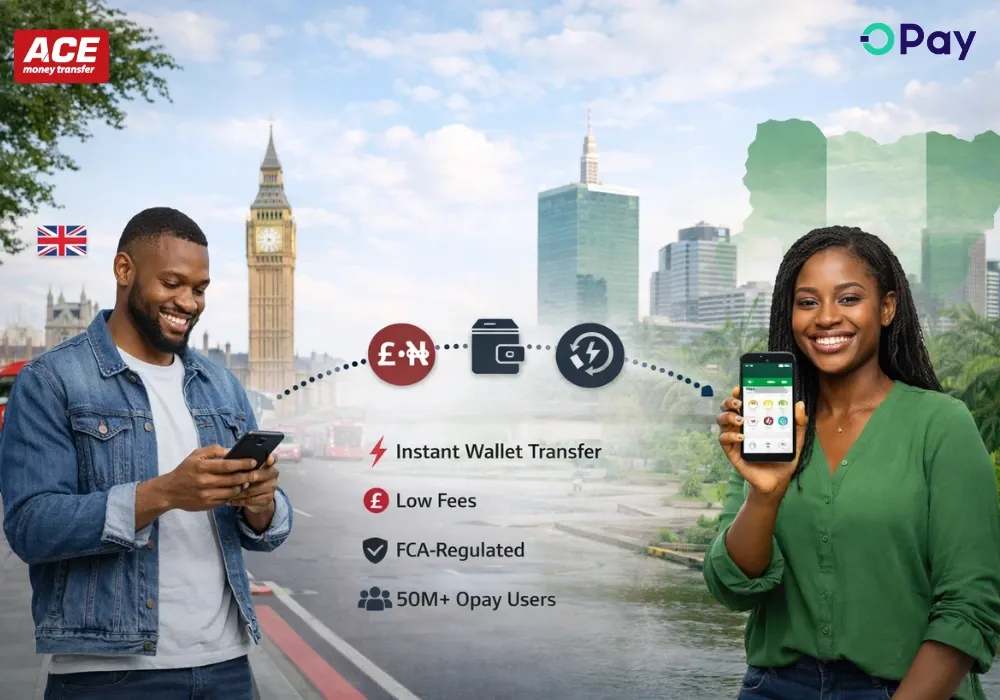
In August 2025 ACE launched direct wallet transfers to Nigeria. The service allows senders from the UK (and other countries) to send money straight to an Opay wallet. According to ACE’s announcement, transfers are mostly completed instantly and delays are rare. Senders input the recipient’s phone number linked to their Opay wallet, choose the transfer amount and confirm payment. ACE prides itself on competitive exchange rates and low fees, making it an appealing choice for regular remitters.
ACE is licensed in numerous countries, enabling Nigerians across Europe, North America and Australia to send money home. The company’s Send Money to Nigeria Online page lists the supported sending countries, which include Australia, Austria, Belgium, Canada, Cyprus, Czech Republic, Denmark, Estonia, Finland, France, Germany, Greece, Ireland, Italy, Latvia, Lithuania, Luxembourg, Malta, Netherlands, Norway, Poland, Portugal, Romania, Slovakia, Slovenia, Spain, Sweden, Switzerland and the United Kingdom. Focusing on the UK, ACE offers payments by debit/credit cards, Apple Pay, Google Pay, and Ecospend (online bank transfer). These payment methods support instant or near?instant transfers, enabling UK senders to fund an Opay wallet quickly.
Safety is paramount in remittance. ACE is regulated by the UK’s Financial Conduct Authority (FCA), and transactions are encrypted and monitored for anti?fraud compliance. The company requires proof of identity, address and source of funds. These measures protect both senders and recipients from unauthorised activity.
Following a clear process ensures that funds reach the recipient promptly and safely. ACE recommends the following steps:
The rapid adoption of mobile wallets like Opay stems from their convenience and flexibility compared with traditional bank transfers. The table below summarises key differences, based partly on data from ACE’s blog about Irish transfers:
Feature | Opay Wallet | Bank Transfer |
Transfer speed | Usually completed within minutes | 1–3 business days for Nigerian bank deposits |
Required information | Recipient’s phone number | Full bank account details (account number, bank name) |
Accessibility | Recipients can access funds 24/7 via their mobile phone | Bank branches operate during limited business hours |
Convenience | Funds can be used instantly to pay bills, buy airtime or withdraw cash; no need for a bank account | Recipients may need to visit a branch or ATM to withdraw money |
Transfer cost | Competitive, often lower fees thanks to fewer intermediaries | Banks may charge higher fees and include correspondent bank costs |
Choosing an Opay wallet reduces friction for recipients, particularly those in rural areas or without bank accounts. It also means senders can support loved ones more efficiently, sending smaller amounts more frequently—an emerging trend in UK–Nigeria remittances.
While this blog focuses on UK senders, ACE serves a broad diaspora. Nigerians working or studying abroad can transfer money to Opay from 28 countries in Europe, North America and Oceania. The list below helps readers determine if they can send money from their current location:
Region | Supported sending countries |
Europe | Austria, Belgium, Cyprus, Czech Republic, Denmark, Estonia, Finland, France, Germany, Greece, Ireland, Italy, Latvia, Lithuania, Luxembourg, Malta, Netherlands, Norway, Poland, Portugal, Romania, Slovakia, Slovenia, Spain, Sweden, Switzerland, United Kingdom |
North America | Canada |
Oceania | Australia |
Residents of these countries benefit from ACE’s wallet transfer feature and competitive rates. However, UK residents remain the largest group sending money to Nigeria, so the rest of this article focuses on their needs.
The OhentPay UK–Nigeria Remittance Report 2025 surveyed 655 Nigerians in the UK and provides valuable insights. Key findings include:
These findings are crucial for businesses like ACE because they underscore the need for flexible, low?cost services that accommodate frequent, smaller transfers and rate?sensitive customers.
The World Bank aims to reduce global remittance fees to below 3 % by 2030. Remitly’s 2025 statistics show that the average fee for a £148 transfer fell from 7.16 % in 2019 to 5.89 % in 2024. Over 52 % of UK remittances are completed in under an hour across more than 80 providers, and 85 % arrive the same day or next day. These improvements are driven by digital channels like Opay and ACE that bypass slow, costly banking infrastructure.
Remittances are a vital part of Nigeria’s GDP and foreign exchange reserves. Nigeria’s remittance inflows of $19.5 billion in 2023 account for 35 % of Sub?Saharan Africa’s total. The same report predicts that remittances could reach $26 billion by 2025, reflecting continued reliance on diaspora support despite economic headwinds. This growth highlights the importance of providing efficient channels for senders.
Opay is not just a payment app; it is a comprehensive financial ecosystem. As of April 2024, Opay had over 50 million users, more than 1 million merchants and 10 million daily active users, processing more than US$12 billion in monthly transactions. The company aims to serve 1 billion users by 2031. This scale underscores why remittance providers integrate directly with Opay; they gain access to a massive user base and infrastructure that ensures funds are immediately accessible.
The following chart visualises how Nigerians in the UK distribute their monthly remittances, based on the OhentPay survey. It underscores that the majority send moderate amounts of £100–£500 rather than large lump sums.
The data behind the chart are summarised in the table below:
Transfer amount category | Percentage of respondents (%) |
< £100 | 12 % |
£100–500 | 58 % |
£500–1,000 | 18 % (approx.) |
> £1,000 | 12 % |
These figures align with the trend toward smaller, frequent transfers described earlier.
Most Opay transfers through ACE are instant; some may take a few hours due to network congestion. Bank transfers to Nigeria typically take 1–3 business days.
No. Recipients only need an active Opay wallet linked to their phone number.
ACE requires proof of identity, proof of address and proof of funds. During sign?up you may need to upload a passport or driver’s licence, a recent utility bill and bank statements.
UK senders can pay using debit/credit cards, Apple Pay, Google Pay, or Ecospend (for bank transfers).
Limits vary based on your verification level, destination country and payment method. ACE will inform you of your limit during the transaction process.
You may be able to cancel a transaction before it is processed. Contact ACE’s customer support immediately if you enter incorrect details. Once the money has been delivered to the recipient’s wallet, cancellation is usually not possible.
The UK–Nigeria remittance corridor is evolving rapidly. With millions relying on support from family abroad, digital transfers are becoming the standard. Opay’s massive user base and ACE Money Transfer’s direct wallet integration offer a powerful combination: instant transfers, competitive rates and unmatched convenience. This blog has shown that:
To start sending money to an Opay wallet today, visit ACE Money Transfer’s Nigeria page. Their platform is designed to help you support your loved ones quickly and securely. By choosing a wallet transfer over traditional bank remittances, you save time, reduce costs and ensure that every naira reaches its destination when it matters most.