
ACE Money Transfer
ACE Money Transfer
29 May 2026
If you have a Lloyds Bank account and someone needs to send you money from another country, you will need to give them the correct Lloyds Bank SWIFT code. Using the wrong code — or missing details — can cause your transfer to be delayed, returned, or lost. This guide explains everything in simple, easy way so you know exactly what to do.
Lloyds Bank is one of the most established banks in the United Kingdom. According to Wikipedia, Lloyds Bank was originally founded in 1765 in Birmingham, making it one of the oldest banks in the UK. Today, Lloyds Banking Group serves around 30 million customers and employs over 65,000 people. It holds an estimated 20% market share in UK retail banking as of 2024.
When using Lloyds Bank SWIFT codes, it is important to understand that banks use different codes for different types of transactions. In the UK, Lloyds Bank mainly uses sort codes for local payments, but for international transfers, SWIFT/BIC codes are required.
Each code has a specific role. SWIFT codes identify the bank globally, sort codes help in UK domestic transfers, and IBAN is often needed for European payments.
A sort code is a 6-digit number used by UK banks to identify themselves and their individual branches within the UK payment system. It is only used for payments that stay within the UK — things like paying a friend, setting up a direct debit, or receiving your salary from a UK employer. It does not work for international transfers at all.
All Lloyds Bank sort codes start with 30. The full code is written as three pairs of numbers separated by hyphens — for example, 30-00-00. The first two digits (30) identify Lloyds Bank. The remaining four digits identify the specific branch where your account is held.
If someone in the UK is sending money to your Lloyds account, all they need is your sort code and your 8-digit account number. But if the sender is in another country, a sort code will not work. You will need to give them your IBAN and the Lloyds Bank SWIFT code instead.
| Branch / Location | Example Sort Code | Notes |
|---|---|---|
| Lloyds Bank Head Office (London) | 30-00-00 | General Lloyds UK prefix |
| London branches | 30-94-71 | Example London branch code |
| Birmingham | 30-12-00 | Birmingham area branch example |
| Manchester | 30-13-22 | Manchester branch example |
| Bristol | 30-12-94 | Bristol branch example |
Your own sort code is printed on your Lloyds debit card, shown in the Lloyds app under account details, and appears at the top of every bank statement. Always use your exact personal sort code, as different branches have different codes.
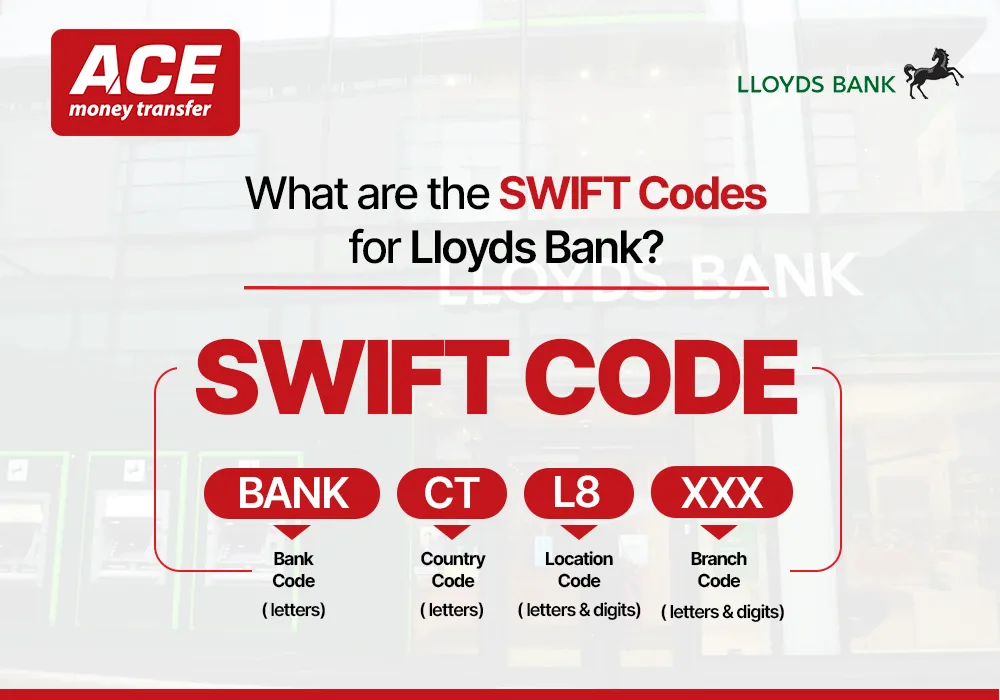
The Lloyds Bank SWIFT code — also called a BIC (Business Identifier Code) — is the code that banks around the world use to identify Lloyds during an international money transfer. Think of it as Lloyds Bank's global address. The primary Lloyds Bank SWIFT code is LOYDGB2LXXX.
You may also see it written as LOYDGB2L — without the XXX. Both versions work and are accepted by international banks. The XXX simply confirms it is the head office rather than a specific branch. If you are unsure which code to use, LOYDGB2LXXX is the correct choice for most personal bank transfers.
A standard Lloyds SWIFT code includes:
This format ensures global consistency in banking transactions.
Always confirm the correct code before sending money internationally.
Sending money between UK banks with Lloyds is quick, easy, and usually instant. You just need the recipient's sort code and 8-digit account number. Lloyds processes most standard payments through the Faster Payments system, which means money arrives in seconds to a few hours at most — with no fee for online transfers.
Lloyds allows you to send up to £25,000 per day online or through the app using Faster Payments. For larger amounts, CHAPS (Clearing House Automated Payment System) is available for same-day transfers with no upper limit, though a fee applies and it must be arranged in a branch. According to Lloyds' own business payment information, Lloyds also supports standing orders and direct debits, all of which only need the sort code and account number for domestic transfers.
To receive money from another country into your Lloyds account, give the sender your IBAN and the SWIFT code LOYDGB2LXXX. To send money abroad from Lloyds, you need the recipient's name, address, their bank's SWIFT code, and their IBAN or account number.
Lloyds Bank charges a flat fee of £9.50 for online international transfers. Euro payments within the EEA are free. On top of the transfer fee, correspondent bank charges apply — £12 for payments to the USA, Canada and Europe, or £20 for the rest of the world.
Pro Tip: Always match the SWIFT code with the country and branch to make sure your international transfer is routed correctly.
Not sure which code to use? Here is a simple table that tells you exactly which codes are needed for each situation.
| Situation | Code(s) You Need |
|---|---|
| Sending money to another UK bank account | Sort Code + Account Number |
| Receiving money from abroad into Lloyds | IBAN + SWIFT Code (LOYDGB2LXXX) |
| Sending from Lloyds to a European bank | Recipient's IBAN + Recipient's SWIFT Code |
| Sending from Lloyds to a US bank | Recipient's SWIFT Code + Account Number + ABA Routing Number |
| Sending from Lloyds to an Indian bank | Recipient's SWIFT Code + Account Number |
| Setting up a UK direct debit or standing order | Sort Code + Account Number |
| Receiving a SEPA euro payment from the EEA | IBAN + SWIFT Code (LOYDGB2LXXX) |
| Large same-day UK payment via CHAPS | Sort Code + Account Number (in branch) |
Want to know how global transfers actually work? Read our guide on Understanding SWIFT Codes: How They Work in International Money Transfers.
Different countries use different banking codes to send and receive money. When you are using Lloyds Bank SWIFT codes for international transfers, it helps to understand how other systems work so you can provide the correct details the first time.
European countries use IBAN as the main code for both local and international transfers. The UK also uses IBAN for international payments, which makes sending money between the UK and Europe easier. Usually, both IBAN and SWIFT code are required.
A UK IBAN is 22 characters long and includes the country code (GB), bank code, sort code, and account number.
For example: GB29 LOYD 3094 7112 3456 78.
Remember: You can find your exact IBAN in the Lloyds app or online banking.
The United States does not use IBAN. Instead, it uses a 9-digit routing number (ABA number) for domestic transfers. For international payments, US banks rely on SWIFT codes.
If someone in the US sends money to a Lloyds account, they will need your IBAN and SWIFT code (LOYDGB2LXXX).
Recent SWIFT updates show that most cross-border payments now reach the destination bank within an hour, but only when all details are correct.
India uses IFSC codes for local transfers between Indian banks. Each IFSC code identifies a specific branch inside India. However, it is not used for international transfers.
For sending money between India and the UK, the SWIFT system is used instead. If someone is sending money to a Lloyds account, they only need your IBAN and SWIFT code (LOYDGB2LXXX). The IFSC code is only used inside India and is not required for UK transfers.
Finding your SWIFT code is simple:
Always verify before sending money to avoid mistakes or delays.
Helpful Tip: Use official Lloyds Bank sources or your online banking app to get the most accurate and updated SWIFT code.
Many users make mistakes when using banking codes:
These errors can cause delays or failed transactions. Always double-check details before sending money.
Yes, sharing SWIFT codes is safe because they only identify the bank, not your personal account.
However:
The primary Lloyds Bank SWIFT code is LOYDGB2LXXX. It is registered to Lloyds Bank PLC at 25 Gresham Street, London, and is the correct code for the vast majority of personal international wire transfers to Lloyds accounts in the UK. You may also see it written as LOYDGB2L — both versions are accepted by international banks. Always confirm yours in the Lloyds app or on your bank statement.
Yes, in most cases. The sender needs both your IBAN and the SWIFT code LOYDGB2LXXX for an international wire transfer to reach your Lloyds account. The SWIFT code identifies Lloyds Bank in the global payment network. The IBAN pinpoints your exact account within Lloyds. If either one is wrong or missing, the transfer will likely be rejected or returned.
For most personal account transfers, LOYDGB2LXXX works across all Lloyds branches in the UK. Different internal services — like corporate banking or securities clearing — use their own specific codes. For everyday personal banking, LOYDGB2LXXX is the correct and safe code to use. If you are unsure, check your BIC in the Lloyds app under account details.
A sort code is a 6-digit number used only in the UK for payments between UK banks. A SWIFT code is an 8 or 11-character code used internationally to identify banks across the world. Sort codes do not work outside the UK. For any payment coming from another country, the sender needs the SWIFT code — not a sort code.
For standard bank-to-bank international wire transfers, no — the SWIFT code is required to route the payment to Lloyds Bank correctly. Without it, most international banks cannot process the transfer. However, some money transfer services like ACE Money Transfer handle routing on your behalf, meaning you may only need to provide your IBAN. For direct bank wires, always provide both the IBAN and the SWIFT code.
Euro payments from EEA countries arrive by the next working day. Payments in other currencies generally take 1 to 4 working days, depending on the sending country and bank. According to SWIFT's October 2024 data, 90% of cross-border payments now reach the destination bank within one hour. The time for money to appear in your Lloyds account can still vary depending on local processing at the UK end.
If the wrong SWIFT code is used, your transfer can be sent to the wrong bank, delayed in the payment network, or returned to the sender — sometimes with a fee deducted. If you realise a mistake has been made, ask the sender to contact their bank immediately. Acting quickly gives the best chance of stopping or redirecting the payment before it is fully processed and credited to a wrong account.
You now have everything you need to confidently send and receive international transfers with Lloyds Bank. With the right SWIFT code, a correct IBAN, and a clear understanding of which code to use when — your money will arrive safely and on time.
But bank transfers can be costly. Lloyds charges a £9.50 flat fee, plus correspondent bank charges of up to £20, plus an exchange rate margin of around 3.55%. On a £50,000 transfer, that exchange rate cost alone adds up to over £1,700.
ACE Money Transfer is a smarter, more affordable way to send money internationally. With a 4.7 rating on Trustpilot, ACE offers fast, secure transfers to over 100 countries at competitive exchange rates — with clear, transparent pricing and no hidden costs. Whether you are sending money to family, paying for overseas study, or managing finances across borders, ACE gives you more value for every pound you send.
International transfers are getting faster than ever — SWIFT's 2024 data shows that 90% of payments now reach destination banks within one hour. ACE Money Transfer is built to move at the same speed, at a fraction of what banks charge. Sign up and make your first transfer today.