
ACE Money Transfer
ACE Money Transfer
16 Sep 2026
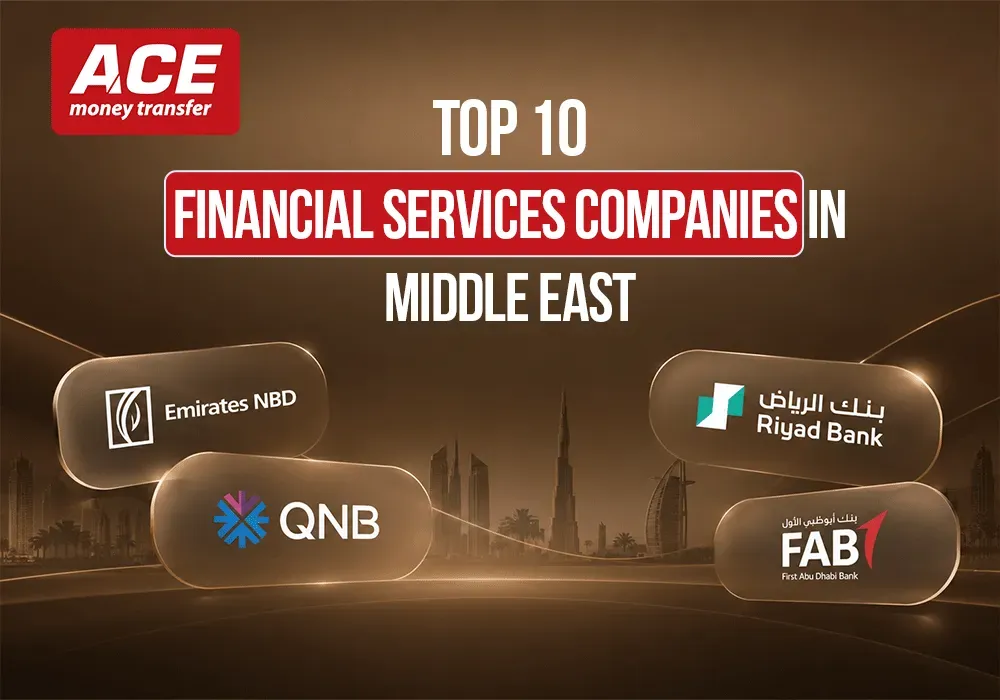
The Middle East has become one of the most dynamic financial services regions in the world. Cities like Dubai, Abu Dhabi, Riyadh, Doha, and Kuwait City now compete directly with London, Singapore, and Hong Kong for capital flows, talent, and institutional headquarters. The Middle East's financial services sector is centered within the Gulf Cooperation Council economies, where sovereign wealth funds and government agendas provide extraordinary liquidity to banks, enabling scale that few global competitors can match.
Financial services companies in this region span a wide range: commercial and investment banks, wealth managers, insurance providers, payment platforms, and digital finance companies. Together, they support financial management for individuals, businesses, and governments - from everyday deposits and loans to complex cross-border investment solutions and trade financing.

Regional economic visions are accelerating growth across the sector. Saudi Vision 2030, UAE Centennial 2071, and Qatar National Vision 2030 are driving regulatory reform, foreign investment openings, and rapid adoption of financial technology. The region has a strong focus on economic diversification away from oil reliance, and finance companies are central to that shift.
This list focuses on scale, financial performance, regional reach, innovation, and impact, using primarily FY2025 financial results and relevant 2026 developments. Here is some key context:
The UAE and Saudi Arabia are emerging as the two most important banking centres in the Gulf.
Leading financial institutions in the Middle East are massive state-backed banking groups, often with significant ownership stakes held by governments or sovereign wealth funds.
The region anchors global Sharia-compliant banking and Islamic finance.
Middle Eastern financial institutions act as financial infrastructure for regional trade and facilitate international trade and investment flows.
Large banks in the Middle East are increasingly investing in digital transformation and fintech innovations.
This ranking covers the largest and most influential financial services providers operating in the Middle East - not exclusively fintech startups, but the institutions that define how money moves in the region.
Total assets under management: Balance-sheet size for banks or funds under management for wealth firms, using the latest available audited and reported financial data, primarily covering FY2025.
Net profit and growth: Year-on-year profit trends, return on equity, and revenue diversification.
Regional presence: Operations across multiple Middle East countries and international reach.
Digital transformation: Progress on mobile banking, fintech partnerships, AI tools, and digital payments infrastructure.
Customer base: Market share in retail banking, corporate finance, and wealth management.
Role in national development: Involvement in mega-projects, sovereign partnerships, and ensuring compliance with evolving regulations.
Qualitative influence: Companies that shape financial services and financial management practices weigh heavily, even if slightly smaller by assets.
Sources include publicly available annual reports, central bank disclosures, and investor presentations.
Saudi National Bank is Saudi Arabia's largest commercial bank and one of the most powerful financial services institutions in the Middle East. Its strategic alignment with state goals makes it a cornerstone of the Kingdom's economic transformation.
Saudi National Bank reported total assets of SAR 1.104 trillion (approximately US$294 billion) at the end of 2024.
SNB reported record net income of SAR 25.0 billion in 2025, up 18% from SAR 21.2 billion in 2024.
SNB plays a pivotal role in financing Vision 2030 projects - including NEOM, Red Sea coastal developments, and energy sector transformation - positioning it at the center of Saudi Arabia's infrastructure investment pipeline.
Core services include retail banking, corporate lending, investment banking, treasury, and wealth management, serving millions of customers.
Digital initiatives include advanced mobile banking apps, online corporate banking platforms, and integration with government e-services for streamlined payment processing.
SNB's close relationship with the Public Investment Fund strengthens its capital base. The Public Investment Fund's assets under management reach over US$925bn, and this partnership amplifies SNB's regional influence and access to sovereign-scale deal flow.
First Abu Dhabi Bank is the largest bank in the United Arab Emirates and a dominant regional player headquartered in Abu Dhabi.
First Abu Dhabi Bank has total assets exceeding US$330bn, making it one of the top finance companies in the broader Middle East by sheer scale.
FAB was created through the 2017 merger of First Gulf Bank and National Bank of Abu Dhabi, forming a regional champion with diversified revenue streams.
Lines of business include wholesale banking, personal banking, Islamic banking (via FAB Islamic), and global markets - supporting cross-border trade and investment flows across the region.
FAB ended 2025 with total assets of AED 1.40 trillion. Net profit reached AED 21.11 billion in 2025, up 24% year on year.
Sustainable finance has become increasingly relevant to Gulf financial institutions, and FAB has been active in issuing green bonds and ESG-linked financing solutions.
Emirates NBD ranks among the largest banks in the Middle East and is widely recognized as one of the most innovative in digital banking.
Emirates NBD reported a record profit before tax of US$8.1bn in 2025, underlining its strong operating momentum and efficient business model.
Emirates NBD's total assets exceeded AED 1 trillion in 2025, while profit before tax reached a record AED 29.8 billion.
The bank earned its reputation as a digital leader through early adoption of AI-powered personal finance tools, blockchain-based trade finance, and fully digital account opening for individuals.
Consumer brands include Liv. (a digital-only banking platform targeting millennials and Gen Z) and a digital wealth platform providing access to over 11,000 global and regional equities.
Emirates NBD supports Dubai's status as a global financial hub, offering trade finance, capital markets, and wealth management for clients across the region.
National Bank of Kuwait is Kuwait's largest bank and one of the oldest financial institutions in the Middle East, founded in 1952. Its track record of conservative risk management and consistent dividends has earned it recognition across the industry.
NBK reported net profit of KD 575.6 million (approximately US$1.9 billion) in 2025, while total assets reached KD 45.6 billion (approximately US$149.4 billion).
NBK operates across the GCC with international branches in Europe, the US, and Asia, connecting Middle East clients to global markets.
Its digital bank Weyay targets youth with a mobile-first approach, reflecting broader digital transformation in its financial management tools and retail banking services.
NBK plays a critical role in corporate banking, project finance, and sovereign-related business, particularly in energy and infrastructure sectors - regional banks play a critical role in funding large-scale infrastructure and development projects.
QNB Group is one of the largest banks in the Middle East and Africa by total assets, headquartered in Doha, Qatar.
QNB Group's total assets reached QAR 1.391 trillion (US$382 billion) at the end of 2025, while net profit reached QAR 17.0 billion (US$4.7 billion).
The group operates across more than two dozen countries in Africa, Asia, and beyond, enabling cross-border corporate, institutional banking, and wealth services.
QNB plays a pivotal role financing Qatar's gas and energy sector, post-World Cup infrastructure, and regional trade flows.
Its diversified portfolio covers retail banking, corporate and institutional banking, asset management, and treasury operations.
Digital channels include mobile banking apps and online trade platforms used by corporate customers across the region, with a cost-to-income ratio of approximately 20% - among the lowest of any major bank globally.
Dubai Islamic Bank is one of the world's largest Islamic banks and a pioneer in Sharia-compliant financial services since its founding in 1975. Islamic banks offer ethical financial models that prohibit interest and speculative risk, making DIB a standard-bearer for the industry.
2023 net profit hit a record AED 7,010 million, rising 26% year-on-year, with total assets of AED 314 billion.
Core offerings include retail and corporate Islamic banking, sukuk issuance, real estate finance, SME financing solutions, and mortgages.
DIB's sukuk investment portfolio rose 30.5% to approximately AED 91 billion, reinforcing the UAE's position as a global centre for Islamic finance.
Digital initiatives include mobile-first onboarding, Sharia-compliant investment apps, and online financing approvals, expanding access for consumers and businesses.
Amlak Finance is a Dubai-based, Sharia-compliant real estate finance company with a strong presence in the UAE and exposure to broader regional markets.
Amlak specializes in property and mortgage finance, offering tailored home financing for residents, non-residents, and investors.
The company manages hundreds of residential units and provides competitive payment plans tied to project completion and rental yields.
Dedicated relationship managers offer personalized financial management advice, helping individuals and investors navigate the complexities of property ownership.
Recent portfolio optimization and profitability improvements in 2023–2024 reflect a strengthened operating position within the sector.
While headquartered in Europe, Lombard Odier and BNP Paribas Wealth Management have become major players in Middle East wealth management, serving ultra-high-net-worth individuals and family offices.
Lombard Odier, founded in 1796, has grown its GCC assets under management rapidly, with ambitions to double regional assets within five years. It has earned recognition including Best Overall GCC Private Bank awards.
BNP Paribas Wealth Management has operated in the UAE for over 45 years, with hubs in Dubai and other key centres across the Middle East.
Both institutions offer bespoke portfolio management, succession planning, sustainable investing, and cross-border tax and estate structuring - providing sophisticated investment solutions for wealthy clients navigating global and regional markets.
Alongside big national banks, a new wave of digital-first finance companies is transforming digital payments and day-to-day financial management in the Middle East.
Tabby is a leading Buy Now, Pay Later provider partnering with thousands of retailers across the GCC. Tabby reached a valuation of US$4.5bn in October 2025, signaling massive investor confidence in alternative credit for consumers.
Mamo simplifies business payments, expense management, and corporate cards for SMEs in the UAE. Mamo surpassed AED$1.2bn in total payment volume by 2025.
NymCard enables banks and fintechs with Banking-as-a-Service and card issuing infrastructure across MENA. NymCard secured US$33m in funding in early 2025 to scale its platform.
e& money is a UAE digital wallet focusing on remittances, bill payments, and merchant transactions for expatriates. e& money issued 1.76 million cards by the end of 2025.
Rasan provides instant insurance quotes using real-time data, streamlining insurance comparison for millions of users. Rasan reported 82% revenue growth, reaching SAR 653m in 2025.
These platforms support both consumers and businesses with instant payment solutions, improved cash-flow management, and alternative credit solutions. While they may not match big banks by total assets, they are increasingly central to the region's financial services ecosystem.
ACE Money Transfer is a specialized international remittance and money transfer service that complements the region's top finance companies by focusing on fast, low-cost cross-border payments. For expatriates working in countries across the Middle East, it is the best money transfer app for sending money home.
Competitive FX rates with forex spreads as low as 0.1%–2.5% depending on the corridor, and transfer fees around 1% of the sending amount - far lower than most bank wire charges.
Fast delivery to bank accounts, cash pickup locations, and mobile wallets across Asia, Africa, and dozens of other countries including Pakistan, India, Bangladesh, and the Philippines.
Real-time tracking, multilingual support, a user-friendly mobile app, and strict security and compliance standards ensure a transparent process for every transaction.
Expatriates working with employers who bank at institutions like Saudi National Bank, Emirates NBD, or National Bank of Kuwait can use ACE Money Transfer to send salaries home efficiently, with full control over their cross-border money flows.
ACE Money Transfer serves as a practical tool for personal financial management for migrants and overseas workers - improving transparency and helping individuals manage every aspect of their remittance needs.
Exchange rate margins and transfer fees vary by provider, corridor and promotional offer. Rates and fees may vary. Visit acemoneytransfer.com for current rates.

Matching your needs - everyday banking, investing, borrowing, or remitting - with the right institutions is essential. Explore these criteria before committing:
Regulatory strength: Choose well-capitalized institutions supervised by a credible central bank with a strong compliance framework.
Breadth of services: Large national banks like FAB and QNB offer retail banking, corporate finance, wealth management, and digital tools under one roof.
Digital channels: Evaluate mobile apps, online banking, and instant payment options - especially if you need remote access across countries.
Cost structure: Compare fees, FX spreads, loan rates, and hidden charges. Details matter - especially for brokers, trade finance, and remittances.
Cross-border capabilities: For expats and SMEs, combine large banks for core banking with specialized apps like AceMoneyTransfer for optimized international money transfers.
The top 10 financial services companies in the Middle East combine scale, innovation, and strong regulation to support the region's growth ambitions. Many Middle Eastern financial institutions benefit from close strategic alignment with state goals and sovereign wealth funds, giving them a foundation few global peers can match. As regional economies diversify beyond oil, demand for sophisticated financial management, wealth solutions, and efficient money transfer apps like ACE Money Transfer will keep rising.
Continued consolidation among GCC banks will drive further scale in digital services and cross-border capabilities.
Islamic finance will expand into new geographies beyond its traditional core markets.
Open banking, AI-driven credit scoring, and instant payment rails will reshape how consumers and businesses interact with financial institutions.
Specialized platforms - from Tabby in lending to ACE Money Transfer in remittances - will join traditional banks as essential parts of the financial services landscape across the world.
Disclaimer: This article is intended for general informational and educational purposes only and should not be construed as legal, regulatory, tax, business, or financial advice. While reasonable efforts have been made to ensure that all facts, figures, and data are accurate and valid as of the date of publication, no warranty or guarantee is given as to the ongoing completeness, accuracy, or currency of the information.
The content is based on information available at the time of publication. Regulations, government policies, market conditions, and service offerings may change over time and vary across jurisdictions and providers. As a result, some information may no longer be current or applicable. Readers should independently verify all information and consult qualified professional advisors before making any financial, legal, or business decisions.