
ACE Money Transfer
ACE Money Transfer
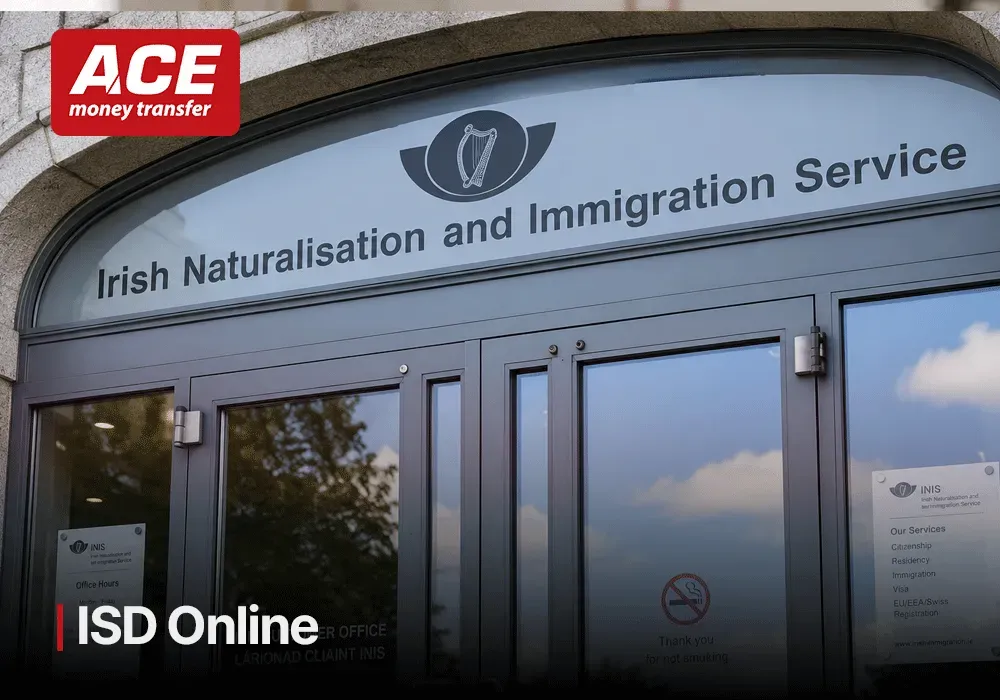
17 Aug 2026
Moving to Ireland as a non-EEA national involves more than just arriving and finding a place to live. You need to register your presence with the Irish immigration authorities, get your Irish Residence Permit (IRP), and keep it renewed as long as you stay in the country.
Immigration rules are subject to change. Always verify current requirements at irishimmigration.ie before applying.
Since November 2024, all IRP renewals moved exclusively online through the Immigration Service Delivery (ISD) portal, and first-time registrations centralised through ISD in January 2025. Processing times are long, documentation requirements are strict, and small mistakes can cause delays.
The Irish Residence Permit (IRP) is a credit-card-sized plastic document issued by Immigration Service Delivery. It shows your name, photo, date of birth, immigration stamp type, registration number, and the expiry date of your current permission. Without a valid IRP, you cannot board a flight back to Ireland, open a bank account in most cases, or apply for many services.
You must register with Immigration Service Delivery and get an IRP if you are a non-EEA national planning to stay in Ireland for more than 90 days and you are:
• A citizen of a country outside the EEA, Switzerland, or the UK
• In possession of permission to remain in Ireland
• Aged 16 or over
EU, EEA, Swiss, and UK nationals do not need an IRP.
Go to www.irishimmigration.ie and create your account. You can do this before you even travel to Ireland.
Log into the portal once you are in Ireland and book an appointment at the ISD Registration Office at Burgh Quay in Dublin. Appointments are normally available within 2 to 3 weeks (subject to change — verify at irishimmigration.ie).
You will need your passport biometric page, entry visa where applicable, evidence of the basis for your permission (such as an employment permit or college admission letter), proof of address in Ireland, and proof of financial means where required.
The IRP fee is €300 for most applicants. Some categories are exempt. Fees are subject to change — verify at irishimmigration.ie.
Bring all your original documents to Burgh Quay. You must complete registration within 90 days of arriving in Ireland. After your appointment, your IRP card will be sent to you by post.
You can apply to renew from 12 weeks before your IRP expiry date. Applications submitted earlier than 12 weeks before expiry will be refused. Renewal delays are currently running at up to 12 weeks (subject to change — verify at irishimmigration.ie).
Go to the ISD renewal portal at www.irishimmigration.ie.
You will need the biometric page of your current passport, the front and back of your current IRP card, and supporting documents depending on your stamp type.
It costs €300 to renew most permissions (subject to change — verify at irishimmigration.ie). Have your credit or debit card ready.
The ISD website provides a live update on processing times. Your new IRP card will be sent to your registered address by post.
| Stamp | Permission |
| Stamp 1 | Employment permit holders, working holiday authorisation, business permission |
| Stamp 1G | Third Level Graduate Scheme; spouses and partners of Critical Skills permit holders |
| Stamp 2 | Full-time students (permitted to work 20 hours per week during term) |
| Stamp 3 | Ministers of religion, volunteers, dependants of certain permit holders (no work permitted) |
| Stamp 4 | Spouses of Irish citizens, people with international protection, long-term residents |
| Stamp 5 | Permission to remain without time conditions |
Your email confirmation and old IRP card serve as proof that you are in the renewal process. Employers and authorities are instructed to accept that your permission is extended. If you remain in Ireland with an expired IRP and no renewal in process, contact ISD immediately.
If you are a visa-required national and you leave Ireland before your renewal application is complete, you will need to apply for a D entry visa from the nearest Irish Embassy or Consulate to return to Ireland. Apply for a visa at least 8 weeks before travel (subject to change — verify at irishimmigration.ie). Always check the current ISD guidance before booking travel if your renewal is pending.
Immigration rules are subject to change. Always verify current requirements at irishimmigration.ie before applying.
Getting your immigration status right in Ireland is one of the most important things you can do after arriving. The online ISD system has made it simpler than it used to be, but it still requires attention to detail, the right documents, and early action on renewals. Always verify current requirements at irishimmigration.ie before applying.
To send money home securely, visit acemoneytransfer.com or download the ACE Money Transfer app.
First-time registrations require an in-person appointment at Burgh Quay, booked through the online portal. Renewals are fully online. Rules are subject to change — verify at irishimmigration.ie.
Renewal delays are currently running at up to 12 weeks. First-time registrations are generally faster once your appointment takes place. Timeframes are subject to change — verify current processing times at irishimmigration.ie.
Yes. There is a notice to employers confirming eligibility to work while awaiting IRP renewal. Keep your renewal confirmation email as proof for your employer.
From March 2026, Beneficiaries of Temporary Protection with a valid Temporary Protection Certificate can renew their IRP card via the ISD online renewal portal. Rules are subject to change — verify at irishimmigration.ie.
Disclaimer: This article is intended for general informational and educational purposes only and should not be construed as legal, regulatory, tax, business, or financial advice. While reasonable efforts have been made to ensure that all facts, figures, and data are accurate and valid as of the date of publication, no warranty or guarantee is given as to the ongoing completeness, accuracy, or currency of the information.
The content is based on information available at the time of publication. Regulations, government policies, market conditions, and service offerings may change over time and vary across jurisdictions and providers. As a result, some information may no longer be current or applicable. Readers should independently verify all information and consult qualified professional advisors before making any financial, legal, or business decisions.
Enjoy guaranteed competitive INR exchange rates, ultra-fast transfers, and zero fee promotions directly to bank accounts across India.
Ireland Employment & Schemes | Ireland Family & Allowances |