ACE Money Transfer
ACE Money Transfer

01 Jan 2025
South Korea, the United States, and China launched the first commercial 5G networks in 2019. By the end of 2023, global 5G connections had surpassed 1.6 billion, covering roughly 20 percent of all mobile connections worldwide. The fifth generation of mobile networks is now the fastest-deployed cellular network technology in history, and it is reshaping industries from surgery suites to shipping ports.
What separates 5G technology from previous generations is not a single improvement but three simultaneous ones: faster speeds (peak download speeds up to 20 Gbps in lab conditions), lower latency (as low as 1-2 milliseconds in advanced deployments), and the capacity to connect far more devices simultaneously (up to one million per square kilometer). These three qualities combine to create a wireless technology platform that serves consumers, machines, and critical infrastructure on a single converged network.
The changes are already visible. In China, surgeons in Hangzhou have performed robot-assisted laparoscopic operations on patients 3,700 km away, with round-trip latencies averaging 37.7 ms and zero packet loss. In Germany, manufacturers run private 5G networks inside factories to connect robots, sensors, and automated guided vehicles on production lines. In the Netherlands, the Port of Rotterdam uses connected sensors and real time data processing to manage container logistics across one of Europe's busiest trade hubs. These are not prototypes; they are operational systems. Enhanced mobile broadband, massive machine type communications, and ultra low latency links are enabling emerging technologies such as autonomous vehicles, augmented reality, and large-scale industrial automation. The sections below break down how each of these capabilities works and where they are already making a measurable difference.
5G is not only about faster data transmission. The standard, developed by 3GPP and aligned with the International Telecommunication Union's IMT-2020 framework, is built around three distinct service types: enhanced Mobile Broadband (eMBB), Ultra-Reliable Low-Latency Communications (URLLC), and massive Machine Type Communications (mMTC). Each targets a different class of application.
These three pillars are what allow 5G networks to support streaming video for millions of consumers while simultaneously controlling factory robots and reading data from thousands of environmental sensors. A 4G network could handle mobile broadband well, but it was not designed for the other two. In rough comparison: 4G delivers typical download speeds of 20-50 Mbps, latency around 30-50 ms, and supports on the order of 100,000 devices per square kilometer. 5G targets 100-1,000 Mbps typical downloads, 1-5 ms latency, and 1 million devices per square kilometer. That represents 10-100 times more capacity than 4G networks, and 5G is designed to manage 1,000 times higher data volumes than 4G.
Enhanced mobile broadband focuses on faster speeds and higher capacity for data-hungry applications. 5G enables enhanced mobile broadband for high-definition streaming and cloud applications, making it possible to stream 4K and 8K video on mobile devices, run multi-angle live sports feeds, and hold high-resolution video conferences from a phone or tablet.
The numbers bear this out. 5G can achieve peak download speeds up to 20 Gbps in controlled lab tests. In practice, over 100 US cities recorded average 5G download speeds above 100 Mbps by 2022, with some areas using millimeter wave and dense mid-band spectrum approaching gigabit-level throughput. Upload speeds also see gains, supporting content creators and remote workers who need to push large files upstream.
eMBB relies on wider frequency bands, massive MIMO antenna arrays, and beamforming to deliver consistent performance even in crowded venues. 5G enhances the user experience in crowded locations like stadiums, train stations, and concert arenas by managing higher data volumes across multiple users without the congestion typical of older cellular networks.
Key benefits of eMBB for everyday users:
Streaming 4K/8K content on mobile internet connections without buffering
Instant downloads of large files (a full HD movie in seconds rather than minutes)
Stable mobile broadband for remote work and education
Higher network capacity in dense environments serving thousands of devices simultaneously
URLLC is the part of 5G designed for mission critical applications that cannot tolerate delays or dropped packets. Where 4G latency hovers around 30-50 ms, standalone 5G deployments reduce latency to as low as 1-2 milliseconds. That difference matters when a robotic arm needs to respond to a surgeon's hand movement in real time, or when a self-driving car needs to brake based on data from another vehicle 50 meters ahead.
5G's edge computing reduces data lag by processing information closer to users rather than routing it to distant data centers. Combined with network slicing, which allows operators to carve out dedicated virtual networks with guaranteed performance for specific applications, URLLC can maintain its reliability even when the broader network is busy. 5G's network slicing allows for dedicated connectivity for specific applications like remote surgery or industrial control, separate from consumer traffic on the same physical infrastructure.
Real-world examples of URLLC in operation:
A 21-case remote surgery program between Hangzhou and Aksu, China (3,700 km apart) achieved mean round-trip latency of 37.7 ms with zero packet loss across all procedures
Transcontinental urological telesurgery between Shanghai and Kuwait (11 human cases, roughly 7,000 km) reported latencies between 150-304 ms, with automatic failover to redundant network paths when latency spiked
Cooperative autonomous vehicle trials in Europe use 5G to share braking and steering data between vehicles with sub-10 ms response targets
Industrial robot control in German factories using private 5G with deterministic latency guarantees
Massive machine type communications enables dense internet of things deployments, supporting up to one million connected sensors or devices per square kilometer. This pillar targets a completely different use case than eMBB: instead of high-speed video, mMTC handles millions of small, infrequent data transmissions from low-power devices.
These devices are designed to be energy efficient, often running on batteries for 5-10 years while sending small data packets at intervals of minutes or hours. 5G variants like RedCap, NB-IoT, and LTE-M serve these needs with optimized signaling that minimizes power draw. 5G can connect billions of devices simultaneously, making it the backbone for city-scale sensor networks, industrial monitoring, and agricultural data collection.
Typical mMTC use cases:
Smart meters in European cities reporting electricity, gas, and water usage at regular intervals
Connected agriculture sensors monitoring soil moisture, temperature, and crop health across thousands of hectares
Environmental monitoring networks in cities tracking air quality, noise levels, and weather data
Logistics tracking for container fleets, parcels, and pallets across global supply chains

5G's capabilities come from a combination of new frequency bands, smarter antenna systems, and a cloud-native network architecture. None of these elements works alone; they reinforce each other. 5G networks utilize advanced technologies like MIMO and edge computing to deliver the speed, capacity, and reliability the standard promises.
Core enabling technologies:
Massive MIMO antennas: Arrays of 64 or more antenna elements that serve multiple users on the same frequency by directing beams to individual devices
Beamforming: Focusing radio energy toward specific users rather than broadcasting in all directions, improving signal quality and reducing interference
Small cells: Low-power base stations deployed densely in urban areas (on lampposts, building walls) to fill coverage gaps and add capacity
Edge computing: Distributed processing nodes placed near users to cut latency for real-time applications
Network slicing: Partitioning a single physical network into multiple virtual networks, each optimized for a specific application class
5G operates across three broad frequency bands, each with distinct trade-offs between coverage and speed.
Low-band 5G (below 1 GHz) provides wide coverage and good indoor penetration. Operators often deploy it by reusing spectrum previously allocated to 2G or 3G services. It delivers modest speed improvements over 4G but covers large geographic areas, making it useful for rural areas and suburban coverage.
Mid-band 5G (1-6 GHz) is the workhorse of most deployments worldwide. Popular mid-band allocations include 3.5 GHz (used in Europe and Asia) and the C-band (3.7-3.98 GHz) in the United States. US operators covered upwards of 130-175 million people with C-band service by late 2022-2023, with full nationwide clearance of the upper C-band planned by mid-2031.
High-band or millimeter wave spectrum (above 24 GHz) delivers the fastest theoretical speeds but over short distances (typically a few hundred meters). It works well in dense urban hotspots, stadiums, and airports where many users compete for bandwidth.
Summary by band:
Low-band: Wide coverage, moderate speed, good building penetration; ideal for broad geographic reach
Mid-band: Balance of coverage and performance; the primary band for most commercial deployment worldwide
Millimeter wave: Fastest speeds (multi-gigabit), short range, requires dense small cell deployment; suited for high-traffic locations
5G cores run on software and cloud computing infrastructure, a shift from the dedicated hardware that powered 3G and early 4G cores. This design uses software-defined networking and network functions virtualization to make the network programmable and scalable.
The practical effect: operators can spin up new services in hours rather than months, scale capacity on demand during events or emergencies, and implement network slicing without deploying new hardware. This architecture also makes it possible for enterprises to run private 5G networks that integrate with existing IT systems and cloud platforms.
Advantages for businesses and innovation:
Rapid service creation and deployment without physical infrastructure changes
Elastic scaling of network capacity to match demand
Integration with enterprise cloud computing environments and AI tools
Support for private and hybrid 5G deployments in factories, warehouses, and campuses
Forecasts estimate between 25 and 30 billion connected IoT devices globally by 2030. By 2029, nearly 40 billion IoT devices are expected globally, with a substantial share using 5G or 5G-related standards. 5G is expected to support nearly 40 billion IoT devices by 2029, ranging from wearable devices and home appliances to industrial sensors and city infrastructure.
5G enables large-scale sensor deployments that require reliable seamless connectivity but modest bandwidth per device. Unlike a smartphone streaming video, a smart water meter might send a few kilobytes of data once per hour; 5G's mMTC tier handles these transmissions efficiently without consuming the network resources needed for consumer traffic.
5G facilitates precision farming through IoT sensors and drones monitoring crop health, soil conditions, and irrigation needs across large agricultural operations. In cities, connected utilities use 5G-linked smart meters to track energy consumption in real time. Building automation systems use 5G to coordinate HVAC, lighting, and security across commercial properties.
IoT scenarios that benefit from 5G features:
Fleet tracking with real-time location, fuel consumption, and maintenance alerts across thousands of vehicles
Smart agriculture: soil sensors, weather stations, and crop-monitoring drones connected over a single 5G network
Connected utilities: electricity, gas, and water meters reporting consumption data for grid optimization
Building automation: HVAC, lighting, and access control managed through a unified sensor network
Wearable devices for worker safety in mining, construction, and logistics environments
In rural western China, a surgeon in Hangzhou guided a robotic system through 21 laparoscopic procedures on patients located 3,700 km away. The 5G link delivered mean round-trip latency of 37.7 ms, zero packet loss, and median jitter of 2.2 ms, with no network interruptions across any of the operations. Remote surgeries are becoming feasible with 5G's ultra low latency, though current implementations still use dedicated redundant network paths as safety measures.

Remote surgery and telehealth services require reliable high-bandwidth connections. 5G enables high-quality video consultations in telemedicine, allowing specialists in urban hospitals to diagnose and advise patients in developing regions or remote clinics. 5G allows instant transmission of large medical files like MRIs, reducing the time between imaging and diagnosis from hours to seconds.
5G facilitates remote patient monitoring through connected medical devices. Wearable devices with 5G support continuous health monitoring: glucose sensors, heart rate monitors, and blood pressure cuffs can stream data to clinicians around the clock. These devices form what the industry calls the Internet of Medical Things (IoMT), a growing ecosystem of connected health tools that rely on 5G's capacity for more devices and its low-power connectivity options.
5G improves remote work and education by providing stable mobile connections, and the same principle applies to medical training. Surgical residents can observe live procedures streamed in high definition from teaching hospitals hundreds of kilometers away.
Key benefits and challenges in 5G healthcare:
Real-time remote diagnostics and specialist consultations for underserved areas
Continuous patient monitoring through wearable and implantable connected devices
Faster transfer of imaging data (CT scans, MRIs) between facilities
Remote surgical procedures with latency low enough for precise instrument control
Challenges: patient data privacy, cybersecurity of medical devices, regulatory approval for remote procedures, and the need for redundant network paths in life-critical applications
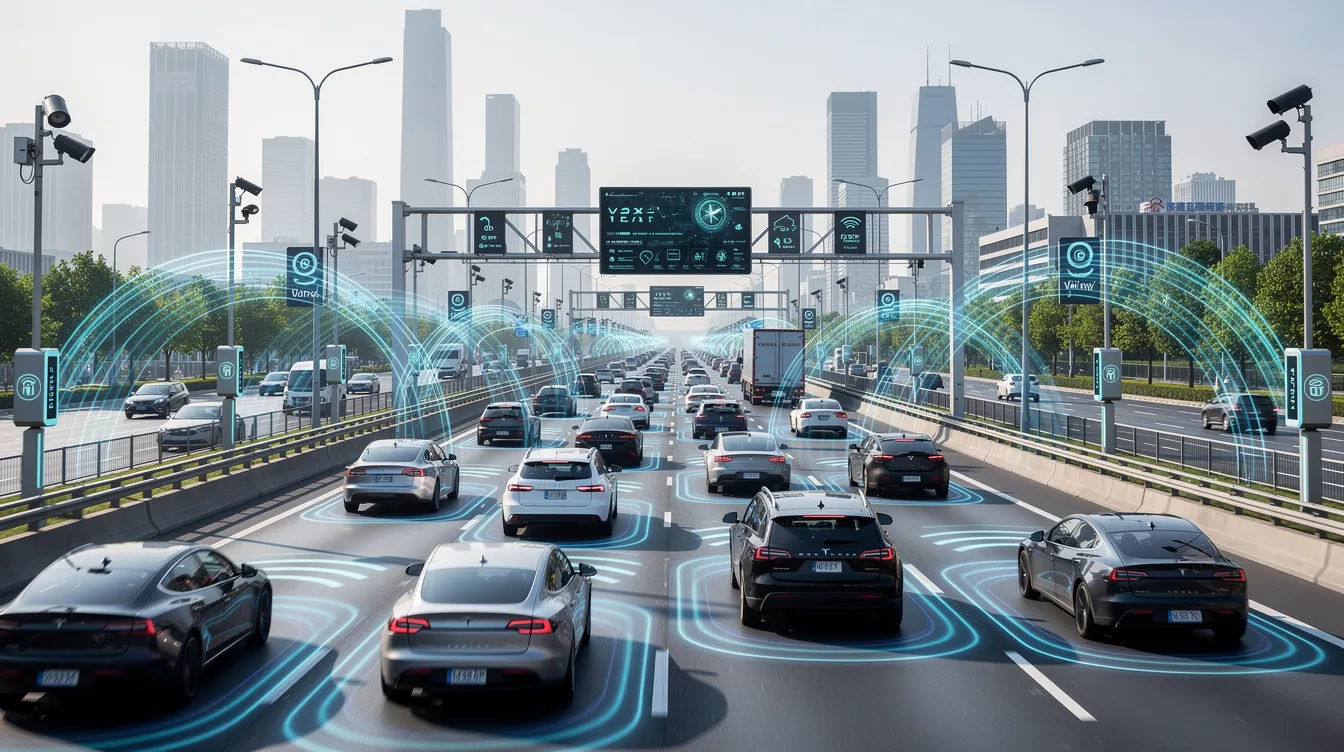
5G enables Vehicle-to-Everything (V2X) communication for autonomous vehicles, allowing cars, trucks, and buses to exchange data with each other, with traffic lights, and with road infrastructure in real time. Autonomous vehicles rely on instant data sharing with traffic infrastructure and other vehicles to make split-second decisions about braking, lane changes, and obstacle avoidance. 5G allows real-time communication between vehicles and infrastructure for better safety.
5G reduces latency to 1-2 milliseconds for real-time applications, which matters when a connected vehicle traveling at highway speed needs to react to a hazard reported by the car 200 meters ahead. Self driving cars generate and consume terabytes of data per day from cameras, lidar, and radar; 5G's higher capacity handles this data flow between vehicles and cloud-based processing systems.
Trials are already running. European smart city projects have tested 5G-enabled autonomous shuttles on public roads. Truck platooning experiments use 5G to link convoys of semi-autonomous trucks, reducing fuel consumption by maintaining tight, coordinated spacing. Smart cities use 5G to coordinate traffic lights and monitor environmental factors, while 5G supports real-time traffic management systems to optimize urban transportation and improve traffic flow across metropolitan areas.
5G can reduce traffic accidents by up to 80% with real-time data exchange between vehicles and infrastructure, according to industry projections. The US autonomous vehicle market is projected to reach $86 billion by 2030, driven in part by 5G-connected vehicle platforms.
Concrete transport use cases:
Autonomous shuttles and taxis operating on designated urban routes
Smart traffic lights that adjust timing based on real-time vehicle and pedestrian data
Connected logistics fleets with real-time tracking, route optimization, and predictive maintenance
Delivery drones using 5G for beyond-visual-line-of-sight navigation and control
Dynamic tolling and smart parking systems that respond to real-time occupancy data
5G is a foundation for the fourth industrial revolution, enabling flexible, data-driven automated manufacturing. Since 2019, private 5G networks have been installed inside factories in Germany, Japan, and the US, replacing wired connections and Wi-Fi with a single wireless technology that handles everything from robot control to quality inspection cameras.
Smart factories use wireless sensors and robots to enhance manufacturing processes. Germany led early among European nations in private standalone 5G network adoption for manufacturing, and in the US, over 240,000 CBRS-band devices were active across enterprise and industrial sectors by late 2023, many supporting factory-floor connectivity.
5G connects robots, automated guided vehicles, sensors, and high-resolution inspection cameras on the production line. Digital twins, virtual replicas of machines or entire plants fed by real-time 5G data, allow engineers to simulate production changes and identify bottlenecks before they cause downtime. Manufacturers benefit from predictive maintenance enabled by continuous sensor data: vibration, temperature, and performance metrics stream from equipment to analytics platforms that flag problems before failures occur.
5G features mapped to industrial gains:
Reliability: URLLC ensures robot and AGV control signals arrive within guaranteed time windows
Network capacity: Thousands of sensors per factory floor transmit data without interference
Energy efficiency: Low-power 5G variants keep battery-operated sensors running for years
Flexibility: Network slicing lets one physical network serve production control, logistics tracking, and employee communications separately
Cloud integration: Real-time data flows from factory sensors to cloud computing and AI technologies for analytics and optimization
5G serves as the connective layer of smart cities, linking sensors, cameras, connected vehicles, and infrastructure systems into coordinated networks. Connected grids using 5G can monitor power supply and demand continuously, balancing electricity generation and consumption in real time and integrating renewable sources like solar and wind more efficiently.
Smart street lighting adjusts brightness based on pedestrian and vehicle traffic, cutting energy use by 30-50 percent in pilot deployments. Connected water meters detect leaks in distribution networks within minutes rather than days. Intelligent waste management systems use fill-level sensors to optimize collection routes, reducing truck trips and fuel consumption.
5G equipment is designed to be more energy efficient per bit than previous generations of cellular networks, using advanced silicon, sleep modes, and intelligent resource allocation. The overall energy impact, however, depends on deployment density and traffic growth; more base stations and more data traffic can offset per-bit efficiency gains.
Urban use cases where 5G supports sustainability:
Real-time electricity grid balancing with distributed renewable energy sources
Smart street lighting that responds to actual usage patterns
Connected water and gas distribution monitoring for leak detection
Air quality sensor networks feeding data to public health and traffic systems
Intelligent waste collection optimized through fill-level sensing and route planning
5G's enhanced mobile broadband and low latency enable entertainment experiences that 4G could not reliably support. 5G can support augmented and virtual reality applications for more immersive experiences, from cloud gaming on smartphones to 360-degree live sports viewing and AR overlays at concerts.
Augmented reality applications use 5G to stream high-quality graphics from the cloud to lightweight glasses or phones, offloading heavy computation from the device. This is what makes consumer AR viable: instead of requiring expensive local hardware, the processing happens at edge computing nodes and the rendered output streams to the user's device with latency low enough to feel responsive. 5G technology supports in-store digital experiences and real-time payments, allowing retailers to overlay product information, reviews, and virtual try-on features through AR-equipped devices.
Early trials of 5G-powered virtual production stages in film and television use real-time rendered backdrops that replace traditional physical sets. Cloud gaming services now run on 5G mobile internet connections, eliminating the need for dedicated gaming hardware.
AR/VR use cases enabled by 5G:
Cloud gaming on mobile devices with response times comparable to local consoles
360-degree and multi-angle live sports broadcasts controlled by the viewer
AR navigation and information overlays in museums, airports, and city centers
Virtual production in film and TV using real-time cloud-rendered environments
Location-based AR experiences in theme parks and cultural landmarks
5G acts as a catalyst to drive digital transformation across manufacturing, logistics, retail, agriculture, and finance. Enterprises use private 5G networks to gain control over security, consistent performance, and coverage inside their own facilities, independent of public carrier networks.
The integration between 5G and cloud computing is where much of the business value sits. Data collected by connected devices and sensors is processed at edge or central clouds to power analytics, AI, and automation. 5G networks are projected to contribute over $1.3 trillion to the global economy by 2030, creating new revenue opportunities and business models across every sector.
Real-world business applications:
Connected warehouses with real-time inventory visibility, automated picking systems, and AGV coordination over private 5G
Retail stores using 5G-connected cameras and sensors for foot traffic analytics, dynamic pricing, and frictionless checkout
Precision agriculture operations linking drone surveys, soil sensors, and irrigation controllers through a single 5G network
Port and logistics operations using 5G to track containers, coordinate cranes, and manage vehicle traffic flow across terminals
Financial services using 5G for high-speed trading floor connectivity and mobile payment infrastructure
These deployments create new services and transform industries that previously relied on fragmented, purpose-built connectivity systems.
As 5G connects critical infrastructure and billions of connected devices, the stakes for cybersecurity rise. 5G increases cybersecurity risks with billions of connected devices, each representing a potential entry point for attackers. The digital landscape of a 5G-connected world includes power grids, hospital networks, autonomous vehicles, and industrial control systems, all of which become targets.
5G introduces enhanced security improvements over 4G: stronger encryption of subscriber identifiers (SUCI), better mutual authentication between devices and networks, and more granular access control. But new attack surfaces come with the territory. Software-defined, cloud-based network architectures expose APIs and virtualized functions that hardware-based systems did not. IoT devices with limited processing power may lack the ability to run robust security protocols, creating weak links.
Geopolitical tensions affect global 5G infrastructure deployment. Concerns over supply chain security have led the US, UK, and several EU member states to restrict or ban equipment from certain vendors. These debates extend to questions about data sovereignty, lawful intercept capabilities, and the trustworthiness of software updates pushed to critical network infrastructure. Public safety and emergency services depend on the integrity of these networks, raising the stakes for security concerns beyond commercial interests.
Main risk categories and mitigation approaches:
Device-level risks: Insecure IoT endpoints enabling DDoS attacks or data breaches; mitigated through device certification and firmware update requirements
Network-level risks: API exploitation in virtualized cores; addressed through zero-trust architectures and continuous monitoring
Supply chain risks: Compromised hardware or software from untrusted vendors; managed through vendor diversification and national security screening
Data privacy risks: Massive data collection from sensors and devices; governed by regulation (GDPR, CCPA) and encryption standards
Operational risks: Single points of failure in software-defined networks; reduced through redundancy, network slicing isolation, and automated failover
Infrastructure gaps hinder 5G deployment in rural areas. Rolling out mid-band and millimeter wave 5G requires dense small cell networks, fiber backhaul to each site, and spectrum licenses that vary by country and region. These costs concentrate early deployments in urban areas, leaving rural and low-income communities behind.
5G-compatible devices remain expensive, slowing consumer adoption. Although the average global retail price of a 5G phone has fallen below $500, devices under $150 are only beginning to appear in some markets. Data plan pricing adds another layer; not all consumers can afford plans that take advantage of 5G speeds.
By 2029, 85% of the global population is expected to have 5G coverage, with full global 5G coverage projected by 2028 in industry timelines. Reaching the remaining population, particularly in developing regions, will require government subsidies, public-private partnerships, and creative solutions like non terrestrial networks (satellite-based 5G extensions).
Main deployment challenges:
High infrastructure costs for dense small cell networks, fiber backhaul, and spectrum licensing
Rural coverage gaps widening the digital divide between urban and underserved areas
Device affordability constraints in lower-income markets
Spectrum clearing and regulatory delays (e.g., US upper C-band clearance timeline extending to 2031)
Need for compatible devices and affordable data plans to reach the broader global population
5G radio and core technologies use advanced silicon, sleep modes, and intelligent resource allocation to be more energy efficient per transmitted bit than 4G. A 5G base station processing the same data volume as a 4G base station uses less energy per bit, thanks to more efficient chipsets and antenna designs.
The tension: total network energy consumption may still rise because data traffic is growing faster than per-bit efficiency improves, and more base stations are needed for dense coverage. Operators have responded with AI-based energy management that shuts down capacity layers during low-traffic periods, and some have deployed renewable-powered base stations in off-grid locations.
5G's indirect environmental benefits may outweigh its direct energy footprint. By enabling telework, smart logistics, optimized industrial processes, and intelligent traffic systems, 5G reduces emissions in other sectors. Connected grids balance renewable energy more effectively, and precision agriculture cuts water and fertilizer waste.
Direct vs. indirect environmental impacts:
Direct: More energy-efficient per bit, but higher total consumption due to traffic growth and denser infrastructure
Indirect: Reduced transport emissions through remote work and optimized logistics
Indirect: Lower industrial waste through predictive maintenance and real-time quality control
Indirect: Smarter energy grids that integrate renewables and reduce peak demand
Mitigation: Operator initiatives including AI-driven network sleep modes, renewable-powered sites, and shared infrastructure
Global 5G deployment is still evolving. 5G-Advanced, developed under 3GPP Releases 18 and beyond, brings enhancements designed to mature the platform before the next generation arrives. These include better support for extended reality, improved indoor positioning accuracy (down to sub-meter levels), smarter network automation powered by AI, and deeper integration of advanced technology for IoT.
6G research is already underway, aiming for a more efficient future with commercial deployment targeted around 2030. Early 6G concepts envision holographic communication, pervasive sensing that blurs the boundary between physical and digital worlds, sub-millisecond end-to-end latency, and terabit-per-second throughput. These goals build directly on the infrastructure and lessons of 5G.
The "killer apps" of 5G may still be emerging. Video streaming and ride-sharing took several years to define the 4G era; similarly, the applications that fully exploit 5G's combination of speed, latency, and device density may not yet exist. What is clear is that 5G provides the next generation platform for innovation across the digital landscape.
What to watch:
5G-Advanced rollouts from 2025-2027 with AI-native network management and improved XR support
Expansion of non terrestrial networks linking satellites to 5G for global coverage
6G standardization beginning in earnest around 2028-2029
Growth of private 5G networks as enterprises build dedicated connectivity for industrial automation and campus operations
New business models and revenue opportunities enabled by network slicing and edge computing
5G is changing the world across three levels. For individuals, it delivers faster speeds, seamless connectivity, and access to augmented reality and cloud-based services that previous generations of mobile internet could not support. For industries, it enables smart factories, connected logistics, remote surgery, and precision agriculture through reliable, low-latency wireless links. For societies, it powers smart cities, more efficient energy grids, and traffic systems that reduce congestion and emissions.
By 2030, 5G is projected to contribute over $1.3 trillion to the global economy. The technology is not a standalone trend but a foundational enabler for the internet of things, cloud computing, and broader digital transformation. It connects the physical world to digital worlds through billions of sensors, devices, and machines that generate, transmit, and act on data in real time.
Challenges remain. Coverage gaps in rural areas, security concerns around billions of connected endpoints, and geopolitical friction over infrastructure supply chains will shape who benefits from 5G and how quickly. Policy choices and investment decisions made in the next five years will determine whether 5G's benefits reach the full global population or concentrate in already-connected urban centers. What began as a commercial deployment in three countries in 2019 is now the stepping stone to even more integrated, intelligent networks in the 2030s, binding the physical and digital worlds into a single, responsive fabric.