
ACE Money Transfer
ACE Money Transfer
21 May 2026
If you are living and working in Italy, sending money back home is likely a regular part of your life. Whether it’s for family support, savings, or an emergency, you want to make sure your hard-earned Euros reach their destination without any hiccups. But between IBANs, BIC codes, and various transfer fees, the process can feel a bit overwhelming.
One of the most common questions for expats using Credit Agricole Italia is: "What is the correct SWIFT code?" Getting this wrong can lead to delayed transfers or even your money being sent back to the bank. In this guide, we’ll simplify everything you need to know about the Credit Agricole Italia SWIFT code and how to ensure your next transfer is smooth and successful.
When you are setting up an international transfer, the bank will ask for a SWIFT or BIC code. This is essentially a digital address that tells the global banking system exactly where your money needs to go, routing international money transfers to the correct bank and branch for Credit Agricole Italia S.p.A.
For Credit Agricole Italia, the primary swift bic code used for international transactions is:
CRPPIT2PXXX
The code CRPPIT2PXXX is the SWIFT/BIC code for Credit Agricole Italia S.p.A. and is used across various branches and services.
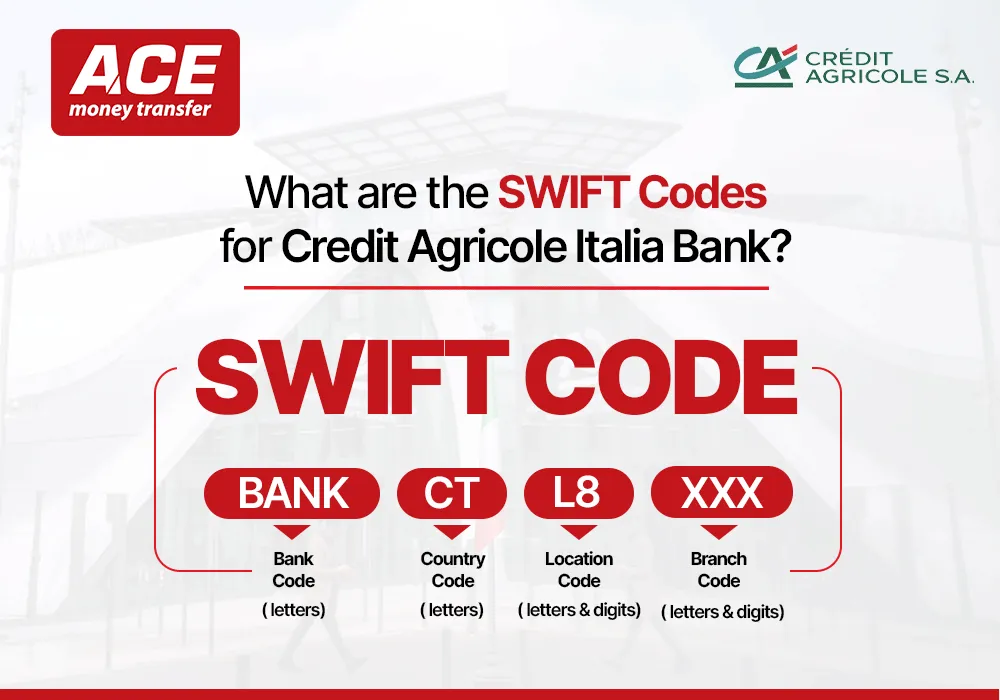
The SWIFT code isn't just a random string of letters; it follows a strict international format. Understanding this can help you verify the code before you hit send. For CRPPIT2PXXX, the breakdown is:
• Bank Code (CRPP): The first four characters represent Credit Agricole Italia.
• Country Code (IT): These two letters identify the bank's home as Italy.
• Location Code (2P): These two characters help identify the specific city or head office hub.
• Branch Code (XXX): The final three characters represent the head office. If you see a code with only 8 digits, it usually implies the head office by default, but the 11-digit version is the gold standard for accuracy.
The SWIFT (Society for Worldwide Interbank Financial Telecommunication) system facilitates the secure exchange of payment orders and financial messages between international banks. Without the correct code, your money is essentially “homeless” in the international banking network.
• Avoid Rejections: Using the wrong code often results in the receiving bank rejecting the transfer.
• Reduce Delays: Automated systems read the CRPPIT2PXXX code to move your money instantly through the network, and banks also use the system to communicate securely about fund transfers, currency exchanges, and settlements.
• Safety: It ensures your Euros are handled by the correct verified institution, so cross-border wire transfers are routed securely to the correct bank and financial institution, providing peace of mind for you and your family.
To understand the scale of these transfers, we can look at the data. According to the Bank of Italy (Banca d'Italia), remittances sent from Italy to non-EU countries have shown significant resilience. In recent years, annual outward remittances from Italy reached approximately 8.6 billion Euros, highlighting how crucial these bank codes are for millions of people.
Furthermore, statistics from the European Commission indicate that Italy remains one of the top sending countries in the Eurozone. This high volume of transactions means that banks like Credit Agricole Italia are constantly processing thousands of transfers daily using these very SWIFT codes.
Even the most careful person can make a mistake when typing in technical banking details. Here are the most frequent errors that cause transfer failures for expats:
• Confusing 'O' and '0': SWIFT codes only contain letters and numbers. Mixing up the letter 'O' with the number '0' is a leading cause of rejected transactions.
• Mixing up BIC and IBAN: Remember, the SWIFT/BIC (like CRPPIT2PXXX) identifies the bank, while the IBAN identifies your specific account. You need both for a successful transfer.
• Using Local Routing Numbers: Sometimes users try to use local Italian codes (like ABI or CAB) for international transfers. These do not work outside of Italy; you must use the SWIFT code.
Sending money abroad doesn’t have to be a stressful experience. If you are using your Credit Agricole account, follow these steps to ensure a successful transfer:
• Gather Recipient Details: You will need their full name (as it appears on their ID), their bank name, and their account number or IBAN.
• Enter the SWIFT Code: Input CRPPIT2PXXX when prompted for the BIC/SWIFT code. The code for Credit Agricole can vary across different branches, so verify your exact branch or service; for example, CRPPIT2P001 is used for the branch at VIA POGGIALI, 18, PIACENZA, 29121.
• Check the Exchange Rate: Be aware that banks often apply a margin to the mid-market exchange rate.
• Confirm the Fees: Review any outgoing transfer fees before you hit ‘send’.
• Keep the Receipt: Always save your transaction reference number until your family confirms they have received the funds.
While using your traditional bank is familiar, it is often not the most cost-effective way to send money home. Many expats find that traditional bank transfers come with high fixed fees and less competitive exchange rates.
If you are looking for ways to maximize the amount your family receives, it is worth exploring digital remittance services. These platforms are designed specifically for international transfers and often offer lower fees than traditional banking institutions.
By using the correct CRPPIT2PXXX SWIFT code, you have already cleared the biggest hurdle in international banking. Ensuring accuracy in your paperwork means your family receives the support they need without the stress of "lost" money.
Stay informed, double-check your codes, and always look for the most efficient way to move your money across borders.
In most cases, the 8-digit code (CRPPIT2P) is sufficient to identify the bank. However, the 'XXX' specifically denotes the head office. While many modern banking systems will still process the payment without the last three digits, including the full 11-digit code CRPPIT2PXXX is the safest way to ensure there are no technical glitches or manual intervention required by the bank.
While Credit Agricole has many branches throughout Italy, the code CRPPIT2PXXX serves as the primary gateway for international incoming funds. If you need an alternative to the main code, you can search for branch-specific codes on the bank’s website or in online banking. The banking system uses your unique IBAN to identify your specific local branch once the money arrives at the main bank. You can usually find these details on your bank statement or within your online banking profile under “Account Details.” One example is CRPPIT2P189, another valid and active SWIFT code for Credit Agricole Italia S.p.a., registered at VIA TIBURTINA 621 in Italy.
No, they serve different purposes. The IBAN (International Bank Account Number) identifies your individual bank account, while the SWIFT code identifies the bank as a whole. Think of the SWIFT code as the "zip code" for the bank and the IBAN as the specific "house address" for your money. You need both to successfully complete an international transfer from Italy.
When you use the correct code, a standard international transfer from Italy typically takes between 1 to 3 business days. However, factors such as the destination country’s banking holidays or intermediary bank processing times can occasionally extend this window. Using an accurate SWIFT code is the best way to prevent unnecessary delays in this process.
Most banks, including Credit Agricole Italia, may charge a fee for incoming international transfers. It is important to check your specific account terms and conditions, as these fees can vary based on the amount being sent and the country of origin. Additionally, remember that the sending bank may also charge their own separate fee for initiating the SWIFT transfer.