
ACE Money Transfer
ACE Money Transfer
10 Sep 2025
Most people have encountered country codes when trying to call foreign countries, register on a messaging app, or fill out an international phone number field on a website. Yet surprisingly few understand exactly what these codes mean, how they work, or why getting them wrong can prevent you from reaching your intended destination. This guide breaks it all down.
A telephone country code is a numeric prefix you dial before a national phone number when making international calls. These country codes are standardized short alphabetic or numeric codes assigned to countries so that telecommunications networks can determine where to route each call. Here is what you need to know at a glance:
Telephone country codes are numeric prefixes used for international dialing. They are typically 2 or 3 digits long, though a few single-digit codes exist.
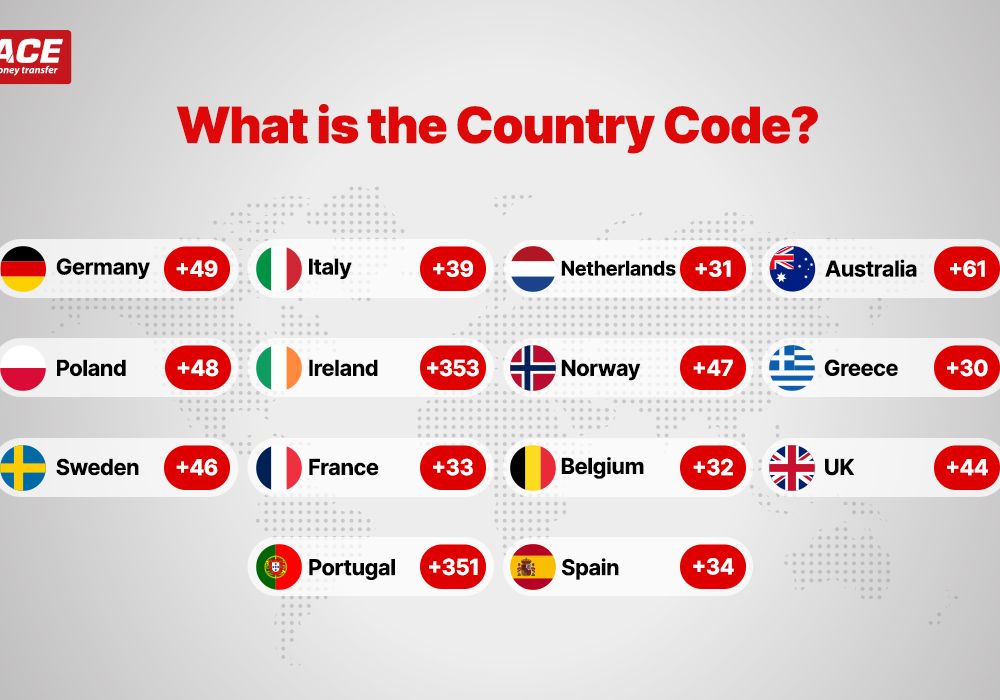
The UK country code is +44. Other well-known examples include +1 for the United States and Canada, +61 for Australia, and +81 for Japan.
Country codes are 2 or 3-digit numeric codes assigned to countries and defined by the International Telecommunication Union, a specialized agency of the United Nations responsible for global telecommunications standards.
The ITU introduced country codes in the 1960s for telecommunications, and they have been expanded and maintained ever since.
While this page focuses on telephone codes, the term can also refer to ISO codes (like US or GB) used in data systems, shipping, and travel documents. Both systems serve different purposes, and we compare them later on this page.

Country codes help route international calls accurately by telling phone networks which country you want to reach. Without the correct code, your call cannot connect to the right person or may land in an entirely different country. Country codes are unique to each country for routing calls, and they help identify the caller's destination in telecommunications.
Calling a person in foreign countries requires the correct country code so networks can route calls to the correct destination country.
Real-world use cases include calling friends or family abroad, business calls with international customers, reaching customer support representatives in another country, and even services that let you send money internationally.
Format examples help illustrate: +44 20 XXXX XXXX for London, +1 212 XXX XXXX for New York, +63 2 XXX XXXX for Manila.
Using the wrong country code can connect you to a different target location entirely or cause the call to fail. For example, dialing +45 (Denmark) instead of +44 (United Kingdom) will not reach your intended destination.
Even messaging apps like WhatsApp require you to register with the correct international number, so accurate country codes matter beyond voice calls.
Before you dial a country code, your network needs to know you are placing an international call rather than a local one. That is where exit codes come in.
An exit code (also called an international access code) is a short prefix that informs providers to route international calls. The most common exit code is 00, used across most of Europe and many other regions. The US exit code for international calls is 011, and Australia uses 0011.
International calls require an exit code before the country code. However, on mobile phones and apps, the "+" sign replaces the exit code entirely. Your service provider automatically converts the "+" into the correct exit code for your current location.
The basic structure of an international number is: [+] + [country code] + [area code if any] + [local subscriber number].
From the US to the United Kingdom (London): dial 011-44-20-XXXX XXXX, or simply write +44 20 XXXX XXXX on a mobile.
From Germany to the United States (New York): dial 00-1-212-XXX XXXX, or +1 212 XXX XXXX.
From India to Southeast Asia, for example Singapore: dial 00-65-XXXX XXXX, or +65 XXXX XXXX.
A country code and an area code serve different roles. The country code identifies the country, while area codes identify a specific geographic region within that country. The combination of both is needed to reach a specific local number from abroad.
The dialing format for the UK is +44 followed by area code. UK area codes vary by city, like 020 for London, 0161 for Manchester, 0141 for Glasgow, and 028 for Northern Ireland. England and Wales share many area code ranges with similar structures.
When dialing internationally, you drop the leading zero from the domestic area code. So 020 for London becomes 20 after +44, giving you +44 20 XXXX XXXX.
In the United States and Canada under +1, three-digit area codes serve the same purpose: 212 for New York, 213 for Los Angeles, 416 for Toronto.
The key distinction: a country code tells networks which country to route to, while area codes tell networks which city or region within that country. Both are required to connect an international call to its intended destination.
The North American Numbering Plan is a shared telephone numbering system where multiple countries and territories all use the single country code +1.
NANP members include the United States, Canada, and many Caribbean nations such as Jamaica, Barbados, the Bahamas, and the Turks and Caicos Islands. U.S. territories like Puerto Rico and Guam are also part of the plan.
The standard format is +1 NPA NXX XXXX, where NPA is a three-digit area code. For example, +1 305 for Miami, +1 604 for Vancouver, +1 441 for Bermuda.
Because different countries share +1, users cannot identify the destination country from the country code alone. The area code is what distinguishes whether you are calling Canada, the United States, or a Caribbean island nation.
This structure can blur the line between country codes and area codes for most people dialing within the +1 zone.
The ITU divides the world into 9 numbering zones. The first digit of a country code usually reflects the geographic region, which helps determine where a call should be routed.

Zone 1: North American Numbering Plan under +1.
Zone 2: Mostly Africa with codes like +20 (Egypt), +27 (South Africa), and +243 for the Democratic Republic of the Congo. Some Atlantic island territories, including South Georgia and the South Sandwich Islands, also fall within zone 2 allocations.
Zone 3 and 4: Mostly Europe with +33 (France), +34 (Spain), +39 (Italy), +49 (Germany). The UK sits in zone 4 with +44. Dutch territories in the Caribbean also carry European-zone-linked numbering through the Netherlands (+31).
Zone 5: Central Americas and parts of Latin America with +52 (Mexico), +503 (El Salvador), +506 (Costa Rica).
Zone 6: Southeast Asia and surrounding countries with +60 (Malaysia), +62 (Indonesia), +63 (Philippines), +65 (Singapore), +66 (Thailand). Pacific island nations like the Federated States of Micronesia (+691) also appear in this zone.
Zone 7: Russia and some neighbouring regions, currently +7 for both Russia and Kazakhstan.
Zone 8: East Asia and special territories with +81 (Japan), +82 (South Korea), +86 (China).
Zone 9: Middle East, South Asia, and others with +91 (India), +971 (United Arab Emirates).
Sparsely populated regions like Antarctica do not have their own country code. Calls there are routed through the parent country's numbering plan, such as Australia's +61 for certain Antarctic bases.
ISO 3166 defines country codes for global use in IT systems, government datasets, shipping, and travel documents. These are entirely separate from telephone country codes, though both represent the same countries. Country codes are used to avoid confusion caused by language variations and country name ambiguities, since country names can differ across languages.
Alpha-2: ISO 3166-1 alpha-2 codes are two-letter country codes, such as GB for the United Kingdom, US for the United States, CA for Canada, and SG for Singapore.
Alpha-3: ISO 3166-1 alpha-3 codes are three-letter country codes that visually associate with country names, like USA, GBR, CAN, and SGP.
Numeric-3: ISO 3166-1 numeric codes are three-digit codes useful in script-independent databases, such as 840 (United States), 826 (United Kingdom), and 356 (India).
Contrast: the United Kingdom has ISO code GB but telephone code +44. The United States has ISO code US but telephone code +1. Mexico has ISO code MX but telephone code +52.
Internet country code top-level domains (ccTLDs) are two-letter suffixes indicating a country's website, such as .uk or .de, and these are closely related to ISO alpha-2 codes.
ISO 3166-1 codes are maintained by the International Organization for Standardization, while telephone codes are coordinated by the ITU. ISO 3166 defines country codes for global communication clarity, and updates happen when countries change names, split, or merge. The ITU follows a similar but independent process developed over decades.
Here are step-by-step references you can follow when dialing internationally.
Calling the United Kingdom from the US: dial 011 44 20 XXXX XXXX for a London number. On a mobile, this becomes +44 20 XXXX XXXX.
Calling the United States from the UK: dial 00 1 212 XXX XXXX for New York, or store it as +1 212 XXX XXXX.
Calling Central Americas from Europe, for example Costa Rica (+506) or Guatemala (+502): dial 00-506-XXX XXXX or 00-502-XXX XXXX respectively.
Calling Southeast Asia from Australia, for example Singapore (+65) or Thailand (+66): dial 0011-65-XXXX XXXX or 0011-66-XXXX XXXX.
When dialing internationally, drop the leading zero from domestic area codes. UK's 020 becomes 20 after +44. Australia's domestic 02 for Sydney becomes +61 2 internationally.
Common reasons international calls fail include using the wrong country code, forgetting the exit code, mistyping the area code, or having international calling blocked by your service provider.

Country codes are essential for global interoperability and efficient data organization, not just for voice calls. Modern apps and platforms rely on them heavily.
Messaging apps like WhatsApp and Viber require users to enter their number in international format with the correct country code. Video-call platforms work the same way.
Many systems combine telephone codes with ISO alpha-2 codes. For example, a customer record might store "GB" as the country and "+44" as the dial code for the United Kingdom, enabling consistent data across billing, shipping, and customer assistance.
Typical UX patterns include dropdowns showing flags, country names, and codes so users can quickly identify their country. Validation logic then checks the expected number of digits for that country.
Businesses that operate across regions like Europe, Central Americas, and Southeast Asia benefit from consistent use of both code systems. Whether you need to contact customers, send money internationally, or route a support call to the right representatives, accurate country codes ensure quality service.
Below are direct answers to the queries that come up most often when people look into country codes.
Is +44 the same as the UK area code? No. +44 is the United Kingdom country code. Area codes like 20 for London or 28 for Northern Ireland come after the country code and refer to specific cities or regions within the UK.
Why do some countries share a country code like +1? They belong to a shared regional numbering plan such as the North American Numbering Plan. Each member country or territory has its own set of area codes within +1.
Are country codes ever reused or changed? Yes, but rarely. When countries split or merge, the ITU may assign new codes or reclaim old ones. ISO codes may change separately under ISO 3166. A recent example is South Sudan receiving its own code after separation from Sudan.
What is the difference between a country code and a time zone? A country code is for telephony and data identification. A time zone is for local time. A large country like Russia has one telephone country code (+7) but spans 11 time zones.
How do I know the best time to call another country? Check the time difference between your location and the destination country, then aim for local business or daytime hours. Keep daylight saving time in mind as well.
Before you place your next international call or save a contact from abroad, take a moment to verify the country code and local number format. Storing every international number with the "+" sign followed by the correct country code ensures it will work from anywhere in the world, saving you time and preventing failed calls.