ACE Money Transfer
ACE Money Transfer
17 Aug 2026
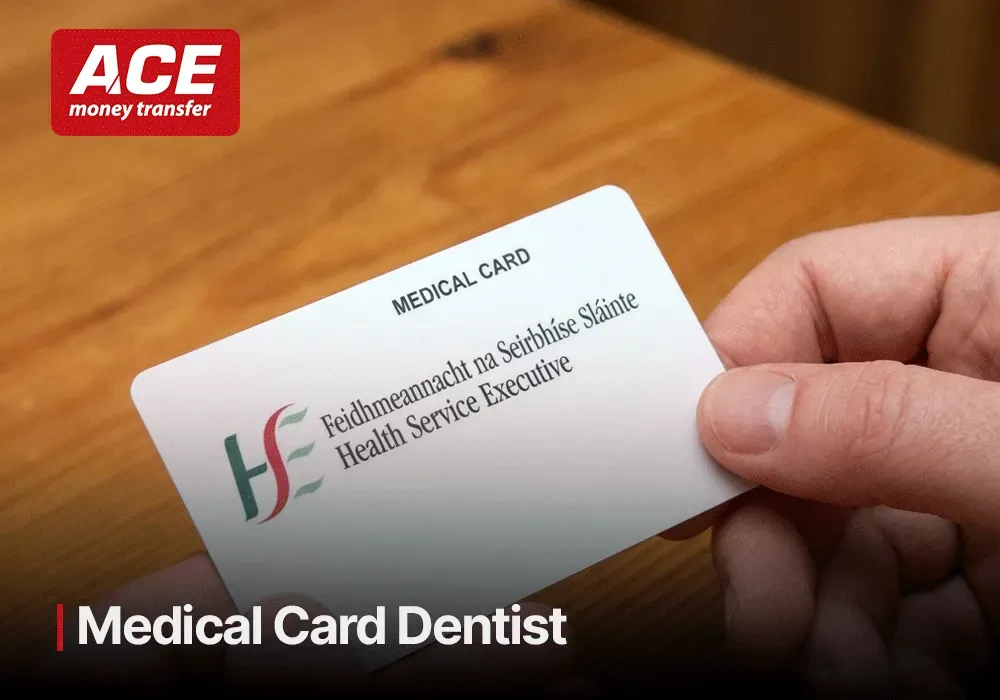
Understanding how a medical card dentist works in Ireland is important for anyone relying on public healthcare for affordable dental treatment. In Ireland, dental care is provided through the Health Service Executive (HSE) under the Medical Card scheme, offering essential oral healthcare services free of charge or at a reduced cost for eligible individuals.
According to Irish healthcare data, more than 1.6 million people in Ireland hold a Medical Card or GP Visit Card. Many people depend on publicly funded healthcare services, including dental care. However, patients are often unsure about what treatments are covered, how approvals work, and where to find participating dentists.
This guide explains how medical card dental treatment works in Ireland, what services are available, and what patients can expect during treatment.
A medical card dentist is a dentist who provides dental treatment under the HSE Dental Scheme in Ireland. These dentists are part of the public healthcare system and deliver essential oral healthcare services to eligible patients.
You may qualify for free or subsidised dental treatment through Ireland's public healthcare system, the Health Service Executive (HSE).
Medical card dental care is provided through:
HSE dental clinics in community and primary care centres
Approved private dentists under HSE agreements
Private dental clinics for non-eligible patients
The HSE provides dental services for eligible medical card holders through participating dentists.
The dentist checks your medical card eligibility
Covered treatments are confirmed
Some treatments may require HSE approval
Receive a dental assessment and oral health check-up
The dentist identifies any treatment needs
Depending on your needs, treatment may include:
Fillings
Tooth extractions
Emergency dental care
Denture assessment and repairs
Some services require prior HSE approval, such as:
Dentures
Multiple fillings
More complex dental procedures
Approved treatment is carried out by the dentist
Eligible services are provided free of charge or with reduced costs
Follow-up appointments may be arranged if necessary
This process helps ensure medical card holders receive essential dental care through the public dental scheme.
If you are 16 or older and hold a valid medical card, you may qualify for dental care through the Dental Treatment Services Scheme (DTSS).
One free dental examination each year
Tooth extractions covered when medically necessary
One first-stage root canal treatment per year
Typically available for front teeth only
Subject to clinical assessment by your dentist
Up to 2 free fillings per year
Replacement fillings within 5 years usually require HSE approval
One free dental cleaning per year
Additional cleanings require HSE approval
High-risk patients, including people with diabetes or cancer treatment, may qualify for cleaning every 6 months
Denture repairs are covered under the scheme
New full or partial dentures may be available but generally require prior HSE approval
Clinical Dental Technicians may provide dentures following a dentist's assessment
Emergency care may include:
Pain relief treatment
Control of bleeding
Treatment of dental infections
Prescriptions where required
Orthodontic treatment (braces) for adults aged 18 and over
Certain advanced or cosmetic dental procedures
Some treatments may require approval from the HSE before they can be provided under the DTSS scheme.
Children in Ireland can access free dental services through the HSE Dental Scheme.
Children receive free dental screening in primary school
Conducted by HSE dental teams
Follow-up appointments arranged if needed
Free dental examinations for primary school children
Available for children with special educational needs
Follow-up treatment provided at local HSE dental clinics
Children under 16 can access emergency dental care for:
Toothache and dental pain
Broken or damaged teeth
Dental injuries affecting the teeth, mouth, or lips
Parents should contact their local HSE dental clinic for urgent care.
Free orthodontic treatment may be available for children with severe orthodontic needs.
To qualify:
The child must usually be referred before age 16
Treatment must meet HSE clinical eligibility criteria
Examples include:
Teeth that fail to erupt properly
Multiple missing permanent teeth
Severely protruding front teeth
Significant bite or jaw alignment problems
Children usually receive a free dental check-up in sixth class
Dentist may refer for orthodontic assessment
Referral depends on clinical need and HSE guidelines
If orthodontic treatment is refused, parents should first discuss the decision with the dentist
All approvals are based on HSE clinical assessment and eligibility rules
Patients with intellectual, physical, or sensory disabilities may need extra support for dental care.
Treatment may be provided at a HSE dental clinic
More complex cases may be referred to a hospital dental service
Patients can contact local HSE dental clinics for routine or emergency care support
You may qualify for dental benefits under the PRSITreatment Benefit Scheme.
Benefits may include:
One free dental examination per year
Scale and polish at a reduced cost once per year
Partial cover for periodontal (gum) treatment
Eligibility depends on PRSI contributions during employment or retirement.
If you are not eligible for public dental care, you can use a private dentist.
Private dentists must clearly display:
Consultation fees
Treatment costs
Price ranges where applicable
The Dental Council has a?Code of Practice relating to the Display of Private Fees in Dental Practices (pdf).
Tax relief may be claimed on certain non-routine dental treatments, including:
Root canal treatment
Veneers
You may claim for:
Yourself
Your spouse
Dependent children
Dependent relatives
Routine treatments such as fillings, extractions, cleaning, dentures, and repairs are not eligible for tax relief.
Clinical Dental Technicians are registered with the Dental Council of Ireland.
They can:
Provide full or partial dentures after dentist assessment
Carry out denture repairs and relines for approved medical card patients
They cannot:
Treat natural teeth
Perform fillings or oral surgery
Raise the issue with the dental practice directly
The clinic must explain their official complaints process
If unresolved, contact the Dental Complaints Resolution Service
Your local primary care centre can provide a list of dentists who accept medical card patients.
Dentists treating medical card holders are part of the Dental Treatment Services Scheme (DTSS).
The Irish Dental Association provides lists of:
General dentists
Dental specialists
HSE dental surgeons
The Dental Council of Ireland maintains:
A register of dentists
A register of Clinical Dental Technicians
If you are unhappy with your HSE dental treatment, you should first speak directly with your dentist.
Without medical card support, dental treatment costs in Ireland may include:
Check-ups: €40–€80
Fillings: €80–€150+
Dentures: €300–€1,000+
Medical card coverage can reduce costs by 70%–100% depending on treatment type, making it highly valuable for eligible individuals.
Some patients may experience:
Limited dentist availability
Long waiting times
Restricted treatment coverage
Regional access differences
As a result, many people use a combination of public and private dental care services.
The Irish healthcare system continues to improve public dental care through:
Expanded HSE dental coverage
Increased dentist participation
Reduced waiting times
Better preventive care programmes
Demand for dental services is expected to rise by 20%+ by 2035, driven by population aging.
Medical card dentists in Ireland provide essential HSE-funded dental care, including check-ups, emergency treatment, extractions, and approved procedures for eligible patients. While the scheme offers important support, it is limited to basic treatments and often requires HSE approval for more complex care.
Due to high demand and limited coverage, most dental treatment in Ireland is still carried out in the private sector. Understanding how the system works helps patients make informed decisions and plan their oral healthcare more effectively.
Overall, the Medical Card dental scheme plays an important role in ensuring access to essential dental services for low-income and vulnerable groups across Ireland.
For seamless international money transfers, ACE Money Transfer offers a fast, secure, and cost-effective way to send funds worldwide compared to traditional banking methods.
A medical card dentist verifies your eligibility, provides an examination, creates a treatment plan, and seeks HSE approval for covered procedures before treatment.
Medical card dentists provide free exams, emergency care, extractions, and some approved fillings or dentures under HSE guidelines.
No, only dentists registered under the HSE medical card scheme can treat medical card patients for public dental services.
No, only certain treatments like dentures or multiple fillings require prior approval from the HSE before being carried out.
Because private dentists offer faster appointments, more treatment options, and cosmetic services not covered under the medical card scheme.
Disclaimer: This article is intended for general informational and educational purposes only and should not be construed as legal, regulatory, tax, business, or financial advice. While reasonable efforts have been made to ensure that all facts, figures, and data are accurate and valid as of the date of publication, no warranty or guarantee is given as to the ongoing completeness, accuracy, or currency of the information.
The content is based on information available at the time of publication. Regulations, government policies, market conditions, and service offerings may change over time and vary across jurisdictions and providers. As a result, some information may no longer be current or applicable. Readers should independently verify all information and consult qualified professional advisors before making any financial, legal, or business decisions.
Enjoy guaranteed competitive INR exchange rates, ultra-fast transfers, and zero fee promotions directly to bank accounts across India.
Ireland Employment & Schemes | Ireland Family & Allowances |