ACE Money Transfer
ACE Money Transfer
15 May 2026
If you live in the UK and have ever set up a bank transfer, received a salary, or signed up for a direct debit, you've used a sort code - whether you realised it or not. It's one of those banking basics that everyone encounters but few people fully understand.
This guide breaks down exactly what a sort code is, how it works within the UK banking system, where to find yours, and how to use it safely. Whether you're opening your first bank account or managing payments for a business, you'll find everything you need here.
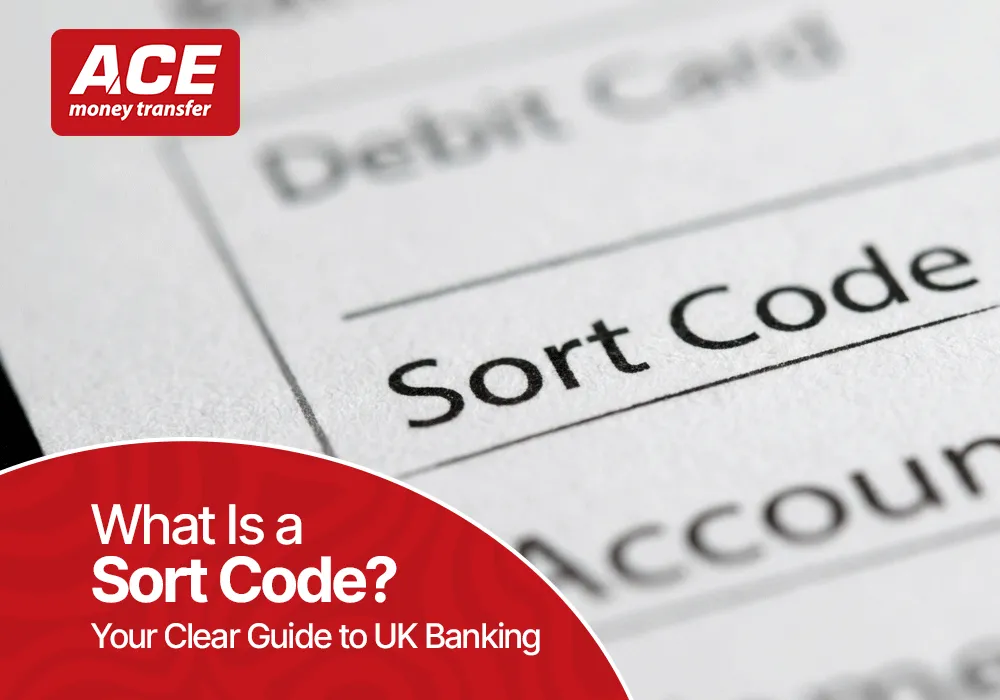
A sort code is a 6-digit number identifying a bank and its branch within the UK banking system. It's written as three pairs of numbers separated by hyphens - for example, 20-45-90 or 60-83-71.
Think of it as a postal code for your money. The first two digits identify the bank group, and the remaining four digits refer to the specific branch or centralised banking hub where your account is held. Sort codes ensure accurate routing of payments in the UK, directing funds to the correct bank or financial institution every time.
Every UK bank account is defined by the combination of its sort code and bank account number. Together, this code and account number pair acts as a unique address for your money. Without both pieces of information, domestic payment systems cannot route transfers accurately.
For example, a sort code like 60-83-71 is used by Starling Bank for its digital banking operations, while sort codes beginning with 20 fall within the Barclays range. Each code points to a specific place in the banking network.
It's worth noting that in Ireland, the same six-digit format exists and is called the National Sort Code (NSC). While Ireland has since moved to SEPA and IBAN-based payments for most transactions, the sort code structure persists in the underlying account data for Irish bank accounts.
Sort codes follow a consistent six-digit format across all UK bank accounts. This standardisation is what makes automated payments possible across the entire banking network.
The standard format displays three pairs of numbers separated by hyphens (e.g. 04-00-04). Some documents and systems show them as six digits without dashes (040004) or with spaces, but the meaning is identical. Sort codes are always six digits long in the UK - no more, no less.
Here's what each part of the structure typically tells you:
Some online-only or branchless banks use a single central sort code for all customer accounts rather than branch-specific codes. All customers of digital banks may share the same sort code. Starling Bank, for example, routes all its accounts through sort code 60-83-71, while a traditional high-street bank like Lloyds might use hundreds of different sort codes across its branch network.
This means that the sort code identifies the bank and its operational location, but it's the account number that distinguishes one customer from another within that same sort code.
Sort codes and bank account numbers work together to identify a specific bank account in the UK. Neither is useful on its own for making a payment - you always need both.
A bank account number is usually eight digits long and uniquely identifies an individual account within a bank or branch. Some legacy accounts originally had seven-digit numbers, but these are typically displayed with a leading zero to reach the standard eight digits required by modern systems.
The key difference in their roles is straightforward:
| Detail | Length | Purpose |
|---|---|---|
| Sort code | Six digits | Identifies the bank and branch |
| Account number | Eight digits | Identifies the individual account |
| Debit card number | 16 digits | Used for card payments (shops, online) |
Sort codes are six digits long, while account numbers are eight digits. A common mistake is confusing the 16-digit number on your debit card with your bank account number. Your card number is used for point-of-sale and internet payment transactions - not for bank transfers, standing orders, or direct debit instructions. When someone asks for your bank details to send you money, they need your sort code and account number, not your card number, card expiry date, or CVV.
You'll need to provide your sort code and account number together in a wide range of everyday financial transactions. Sort codes are essential for domestic UK bank transfers and help avoid cross-bank errors in money routing.
Here are the most common situations:
Sort codes are used for domestic transfers in the UK. For international transfers into a UK bank account, the sort code and account number are embedded within your IBAN, and the sending bank may also require a BIC code. Domestic payments between UK bank accounts do not need IBAN or SWIFT codes.
Most people don't memorise their bank account numbers and sort codes, and that's perfectly fine. These details are easy to retrieve from several sources.
Online banking and mobile apps - This is the quickest option. Most banks display your sort code and account number on the main account summary or "account details" screen. You can find your sort code in your online banking app within seconds.
Bank statements - Both paper and digital bank statements include your sort code and account number, usually printed near the top of the document. You can find your sort code on bank statements, whether they're monthly, quarterly, or annual.
Debit cards - Many UK debit cards have the sort code and account number printed on the front or back, separate from the 16-digit card number and expiry date. Sort codes are printed on the back of debit cards in most cases, though some newer or digital-first cards may omit them for design or security reasons.
Cheque books and paying-in slips - If you still use a cheque book, each cheque displays the sort code and account number along the bottom edge. Paying-in slips show the same details.
Official correspondence - Account opening letters, annual statements, and other documents from your bank will include these details.
If you can't find your sort code on your card or paperwork, logging into your banking app is the fastest and most reliable way to retrieve it.
One of the most common questions in UK banking is whether it's safe to hand over your sort code and account number. The short answer: yes, it's generally safe to share your sort code and account number.
It is generally safe to share your sort code and account number to receive payments. These details function like a mailing address for your money. Sort code and account number can only receive payments, not withdraw funds. Someone knowing your sort code and account number cannot use that information alone to take money from your account - they would also need your PIN, online banking credentials, or card details to do that.
That said, some sensible precautions apply:
Banks provide additional safeguards. The Direct Debit Guarantee protects you if a payment is taken incorrectly from your account, and services like Confirmation of Payee let you verify that the name on the receiving account matches before you send money. Still, monitor your bank account regularly for any unexpected activity.
Domestic and international bank transfers use different identification codes, and understanding the distinction saves time and avoids extra costs when sending money across borders.
Sort codes are used exclusively for domestic transfers within the UK. They are unique to the UK (and historically Ireland), and other countries have their own equivalents.
IBAN (International Bank Account Number) is a standardised format used for international payments. IBANs are used for international transfers and can be up to 34 characters long, depending on the country. A UK IBAN is 22 characters and follows this structure:
| Component | Example | What it represents |
|---|---|---|
| Country code | GB | United Kingdom |
| Check digits | 29 | Error detection |
| Bank identifier | NWBK | Bank identifier code (from BIC) |
| Sort code | 601234 | Six digits from the sort code |
| Account number | 12345678 | Eight digits from the account number |
So a UK IBAN like GB29NWBK60123412345678 embeds your sort code and account number directly within it.
BIC code (also known as a SWIFT code, managed by the Society for Worldwide Interbank Financial Telecommunication) is an 8 or 11 character alphanumeric identifier for a specific bank or financial institution. SWIFT codes identify banks for international transactions, unlike sort codes which handle domestic routing.
For UK-bound international payments, the sender typically needs your IBAN and BIC code. For domestic payments between UK bank accounts, only your sort code and account number are required. Sort codes are unique to the UK, while IBANs are used across Europe and beyond.
Sort codes weren't always the tidy six-digit system we use today. Their story is tied to the evolution of cheque clearing in the UK.
In the early 20th century, banks used shorter numeric identifiers - sometimes just one or two digits - to distinguish between institutions during manual cheque processing. As the volume of cheques grew, this system became a time consuming process that couldn't keep pace with demand.
Sort codes were introduced in the UK banking system in 1957, when the industry standardised on the six-digit format. The old single-digit bank codes were expanded into two-digit ranges (e.g., the digit "2" for Barclays became the "20" range), and four additional digits were added to identify individual branches.
The 1960s and 1970s brought automation. Magnetic ink character recognition (MICR) technology and computerised clearing systems required consistent, machine-readable codes on every cheque. The six-digit sort code format proved ideal for this purpose, and it became embedded in every corner of UK payment infrastructure.
More recently, pan-European standards like SEPA and the IBAN format have layered on top of domestic systems. In Ireland, SEPA adoption means the sort code is now embedded within IBANs rather than used directly. The creation of Pay.UK in 2018 unified governance of BACS, Faster Payments, and the cheque and credit clearing facility under one body.
Despite the rise of new payment technologies and digital banking, sort codes remain central to UK domestic bank transfers, direct debits, and the broader payments industry in 2026.
Entering an incorrect sort code or account number during a bank transfer can cause real headaches - from delayed salary payments to money landing in a stranger's wrong account.
Here are the most common issues and their consequences:
To protect yourself, take these precautions:
Ensuring payment efficiency starts with getting the details right at the point of entry.
Sort code validation helps confirm that a bank transfer can be processed successfully before you hit "send." Whether you're a personal customer or a business handling thousands of transactions, checking sort codes is a simple step that prevents costly errors.
Several tools are available:
You can check sort codes using an online sort code checker before making any transfer. For businesses, keeping up-to-date sort code and bank account data is essential to avoid rejected payments, reconciliation delays, and unhappy customers.
If you're paying a new supplier or contractor for the first time, always confirm their sort code and account number through a trusted channel - not just from an email, which could be compromised.
No. Sort codes are used in the UK and Ireland for domestic transfers, while routing numbers serve the same purpose in the United States. The key difference is format: US routing numbers are nine digits long, whereas UK sort codes are always six digits. When sending money between the UK and US or other countries, banks use IBAN (where applicable) and SWIFT/BIC codes to route international payments - not sort codes or routing numbers directly.
In normal circumstances, no. Someone cannot directly withdraw cash or make purchases using only your sort code and bank account number. These details are designed for bank transfers and direct debits, both of which have built-in safeguards and dispute processes. However, fraudsters may attempt scams by combining your bank details with other personal information gathered through phishing or social engineering. Never share your PINs, passwords, or full card details with anyone, and report any suspicious activity to your bank immediately.
Some banks - particularly digital-first or multi-currency providers - choose not to print sort codes and account numbers on their cards for design or security reasons. If these details aren't visible on your physical card, check your banking app or a recent statement. Remember, the 16-digit card number on your debit card is used for card-based payments at shops and online, not for bank transfers between individual accounts. You'll typically find your sort code and account number in your app's account details section.
Yes, though it's uncommon. Sort codes can change during bank mergers, branch closures, or when a bank migrates to a new platform. When this happens, most banks notify customers well in advance and may automatically redirect payments from the old sort code to the new one for a transitional period. If your sort code changes, update your bank details with employers, utility providers, and anyone who makes regular payments to you to avoid disruptions to important automated payments like salary deposits or savings and investment accounts contributions.
Absolutely. It's common to hold several bank accounts that all share the same sort code, especially with modern digital or branchless banks where every customer uses one central sort code. Each bank account will still have its own unique account number, even when the sort code is identical. If you hold multiple accounts - say a current account, a bills account, and investment accounts - label them clearly in your online banking to avoid confusion. Each individual account number ensures your money goes to the right place, even when the sort code is shared across thousands of customers.
Enjoy guaranteed competitive PKR exchange rates, ultra-fast transfers, and zero fee promotions directly to bank accounts and mobile wallets.