01 Sep 2025
Whether you need to reach family in Madrid, contact a hotel in Barcelona, or confirm a business appointment in Valencia, understanding how to dial Spanish numbers correctly is the first step. This guide covers everything you need to know about the Spain country code, number formats, area codes, and the most common mistakes people make when calling Spain from anywhere in the world.
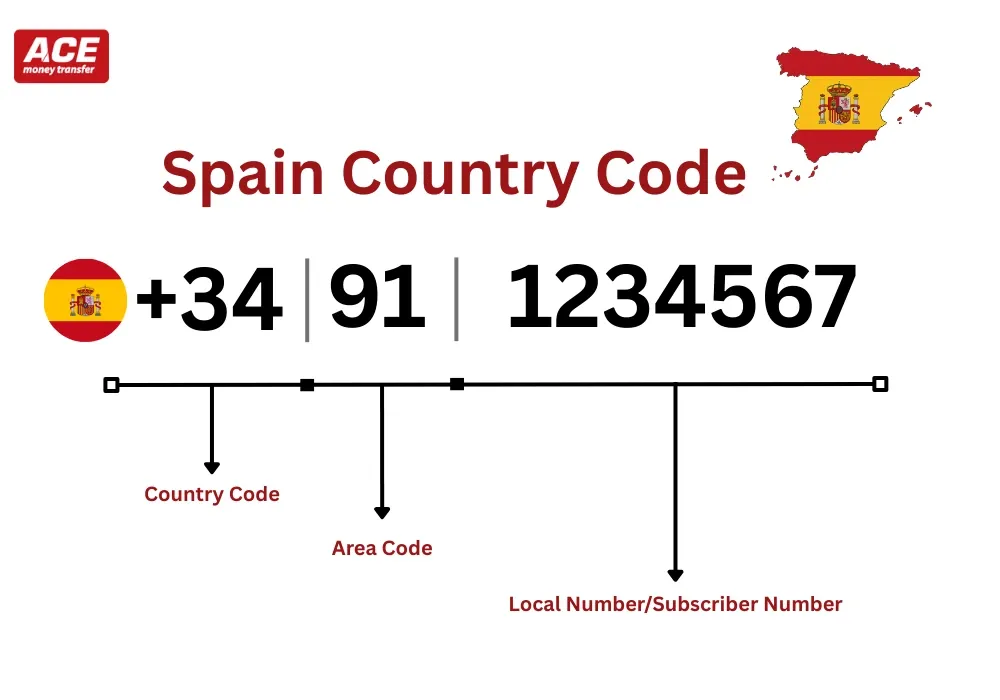
The country calling code for Spain is +34. This spain phone code is required before any 9-digit Spanish number when making international calls from abroad, whether you are calling a mobile phone or a landline.
You may see it written as "34", "+34", or "0034" depending on the context. All three refer to the same international prefix - the code for Spain used by phone networks worldwide. On a mobile device, the plus sign replaces whatever exit code your country uses, making "+34" the universal shorthand.
A quick note on other identifiers: Spain's ISO country code is "ES" (with the ISO Alpha-3 code being ESP), and its internet top-level domain is .es. These are separate from the telephone country code but sometimes cause confusion on forms.
Here is what correctly formatted Spanish numbers look like:
+34 612 345 678 - a mobile phone number
+34 91 234 5678 - a Madrid landline number
As long as you place +34 before the full 9-digit number, your call will route to Spain correctly.
Calling Spain from another country requires combining three parts: your international access code (also called the exit code), the Spain country code (+34), and the local 9-digit Spanish number. Here is how that breaks down:
Dial your international prefix. This varies by country.
Add 34 (the phone code for Spain).
Enter the full 9-digit Spanish number - do not add or remove any digits.
Common international access prefixes for major origins:
From the UK and most of Europe: dial 00
From the US and Canada: dial 011
From Australia: dial 0011
From any mobile phone: simply use the + sign, which automatically converts to the correct exit code
Concrete dialing examples:
From the UK to a Madrid landline: 00 34 91 xxx xxxx
From the US to a Barcelona mobile: 011 34 6xx xxx xxx
From any mobile worldwide: +34 7xx xxx xxx
Spanish numbers are already in their full form domestically. You simply add +34 in front for international calls. There is no leading "0" to drop - Spain does not use a domestic trunk prefix.
Save all Spanish contacts in your phone as "+34" followed by the 9 digits. This format works seamlessly for international calls, SMS, and apps like WhatsApp regardless of which country you are in.
Spain adopted a "closed numbering plan" on 4 April 1998. Under this system, every national phone number consists of exactly 9 digits. The old trunk prefix (the digit 9 that once preceded geographic numbers) was folded into the number itself, meaning there is no separate area code to add or remove.
The international format is straightforward: +34 + 9-digit national number. Networks do not require spaces or hyphens, but people typically group digits for readability.
Key number types by their leading digit:
Landlines (geographic numbers): numbers starting with 8 or 9 - for example, +34 9xx xxx xxx or +34 8xx xxx xxx
Mobiles: numbers starting with 6 or 7 - for example, +34 6xx xxx xxx or +34 7xx xxx xxx
Toll-free and special services: +34 800 xxx xxx, +34 900 xxx xxx, and similar 80x/90x ranges
Fixed-line numbers in Spain start with 9 or 8, while Spanish mobile numbers start with 6 or 7 followed by 8 additional digits, making every number exactly 9 digits long. Spanish phone numbers are formatted as +34 followed by those 9 digits - no more, no less.
Spain does not use a domestic trunk "0" before area codes. Unlike countries such as the UK or Italy, there is never a "0" to drop when adding +34. The trunk prefix "0" is not dropped in Spanish numbers because it simply does not exist.
Formatted examples showing typical spacing:
+34 91 234 5678 - Madrid fixed line
+34 93 765 4321 - Barcelona fixed line
+34 612 345 678 - mobile phone
Although Spain uses a closed plan where you always dial all 9 digits, the first 2 or 3 digits still identify the province or city. People often refer to these as area codes or geographic prefixes.
Geographic landline numbers usually begin with 9 (the original ranges) or 8 (newer ranges opened to expand capacity). Each province generally has both a 9-prefix and an 8-prefix range, so you may see unfamiliar "8" numbers from cities you know well - they are simply newer allocations for the same region.
Major city and province prefixes:
| City / Province | Primary Prefix | Expanded Prefix |
|---|---|---|
| Madrid | 91 | 81 |
| Barcelona | 93 | 83 |
| Valencia | 960–963 | 860–863 |
| Sevilla | 954 / 955 | - |
| Bilbao (Bizkaia) | 944 / 946 | - |
| Zaragoza | 976 | - |
| Murcia | 968 | - |
| Alicante | 965 / 966 | - |
| Las Palmas (Gran Canaria) | 928 | - |
| Lugo | 982 | - |
The Madrid area code is 91, the Barcelona area code is 93, Valencia area codes range from 960 to 963, Seville area codes are 954 and 955, and Bilbao area codes are 944 and 946. The addition of 8-prefix ranges (like 815 for Madrid) has been happening since the early 2020s as certain provinces approach exhaustion of their 9-prefix blocks.
When dialing from abroad, you do not add any extra city code. The geographic prefix is already embedded in the 9-digit number that follows +34. For example, to call a Madrid number you simply dial +34 91 234 5678 - the "91" is not a separate piece you handle differently.

Not all Spanish numbers are tied to a geographic location. Mobiles, toll-free lines, and premium services each follow their own prefix rules, and recognizing them can save you both confusion and money.
Mobile numbers:
Standard mobile numbers are 9 digits and usually start with 6 (for example, +34 612 345 678)
Additional ranges beginning with 7 (especially 71–74) were introduced from 2009 onward to increase capacity as demand for mobiles grew
Mobile prefixes are not tied to any particular city or region - a number starting with 6 could belong to someone in Zaragoza or Alicante
Mobile numbers in Spain start with 6 or 7, and are not geographically bound.
Toll-free numbers:
The 800 and 900 prefixes are used for Spanish toll-free services (for example, +34 900 123 456)
These are free to call from both landlines and mobiles within Spain
Often used for customer support and helplines, though international callers may still incur charges from their own carrier
Premium and special-rate numbers:
Some 80x and 90x prefixes (such as 803, 806, 807) are premium-rate lines for value-added content or services - these can be expensive
901 and 902 numbers are shared-cost or non-geographic service lines where callers may pay a higher rate than regular landline calls
Before calling any premium or special number, especially from abroad or while roaming, check your operator's tariff. The cost difference between a standard landline call and a premium 807 number can be significant.
Spain has changed its approach to regulating commercial calls and fraud prevention, with new rules taking effect on 7 March 2025 under Orden TDF/149/2025.
The most significant shift: unsolicited commercial calls from standard mobile numbers are no longer permitted. Businesses engaged in telemarketing must now use clearly identifiable numbering - specifically geographic prefixes or toll-free ranges like 800 and 900. This means that if you receive an unexpected call from a Spanish mobile number claiming to be a company, it may be violating current regulations.
What this means for people receiving calls from Spain:
Legitimate business calls should now come from recognizable geographic or toll-free prefixes
Toll-free numbers (800/900) can be returned at no cost within Spain
Suspicious unknown mobiles calling with commercial intent are more likely to be spam and can be safely blocked
Operators are now required to block calls using manipulated or unassigned caller IDs
In addition, the regulation mandates that telecom operators register caller aliases and block SMS or MMS messages from unregistered origins. If you are abroad and receive a call from a Spanish number, confirm whether it uses a known geographic or toll-free prefix before calling back. Be cautious with numbers that look like mobile ranges but behave like premium lines.
The single emergency number valid anywhere in Spain is 112. This covers mainland Spain, the Canary Islands, the Balearic Islands, Ceuta, and Melilla.
Calls to 112 are free of charge from any phone - landline, public payphone, or mobile phone. You can dial 112 even without credit on a prepaid SIM, and on many networks, even without a SIM card inserted.
The 112 service coordinates police, fire brigade, medical emergencies, and civil protection. While regional numbers like 061 (medical emergency in some autonomous communities), 091 (national police), and 062 (Civil Guard) still exist, 112 is the safest default for any visitor or rest of the world caller unfamiliar with local short codes.
Emergency numbers do not require the +34 country code. Whether you are a resident or roaming in Spain, simply dial 112 directly from your device.
The basic rule for calling Spain is universal - dial +34 followed by the full 9-digit number. What changes from one country to another is the international access code you press first.
From the UK: Dial 00 (the UK's international prefix), then 34, then the 9-digit Spanish number. For example, to call a Barcelona landline: 00 34 93 xxx xxxx. From a UK mobile, you can skip the "00" and use the plus sign instead: +34 93 xxx xxxx.
From the US or Canada: The exit code is 011. So a call to a Spanish mobile would look like: 011 34 6xx xxx xxx from a landline. From a US mobile, +34 6xx xxx xxx works just as well. The international access code for Spain from most European countries is 00, while from the US and Canada it is 011.
From the EU/EEA and the rest of the world: Most European countries also use 00 as their exit code, so the pattern is the same as the UK example. On any smartphone anywhere in the world, the plus sign automatically converts to your local exit code, making +34 the simplest universal format.
Check international rates with your own operator or VoIP provider before calling. Calls to mobiles, landlines, and special numbers may each carry different tariffs, and knowing the difference can help you save on your phone bill.
Most failed calls to Spain come down to small formatting errors rather than network problems. Avoiding these saves time and money.
The most frequent problems:
Forgetting the country code. When calling from abroad, you must add +34 before the 9-digit number. Without it, your call routes domestically in whatever country you are in.
Adding a non-existent leading "0." Some people dial 0 91 xxx xxxx because they are used to countries where you drop a trunk zero. Spain has no trunk 0, so do not drop the leading 0 when dialing Spain - because there is no leading 0 to drop in the first place.
Dropping digits. Spanish numbers must be exactly 9 digits after +34. A number with only 7 or 8 digits will not connect.
Misreading geographic prefixes. Confusing 93 (Barcelona) with 923 (Salamanca) sends your call to the wrong province entirely.
Confusing toll-free with premium numbers. The 800 and 900 ranges are free within Spain, but 803, 806, and 807 are premium-rate services with high per-minute charges.
Quick checklist for a correct Spanish number:
Must be exactly 9 digits long after +34
For mobiles, should begin with 6 or 7
For landlines, usually begins with 8 or 9
Written and saved as +34 xxx xxx xxx in your contacts
When in doubt, count the digits. If you have 9 digits after +34 and the first digit matches the expected range, your call should go through.
The same +34 country code is used beyond voice calls. It is how you verify Spanish mobile numbers in apps like WhatsApp, Signal, and Telegram, and how online banking and two-factor authentication services deliver SMS codes to your phone.
Most apps ask you to select "Spain (ES)" from a dropdown menu, which automatically fills in "+34." You then enter only your 9-digit national mobile number without any extra symbols or leading zeros. The org of the app handles the rest.
International money transfer platforms and e-commerce services also rely on the Spain country code to verify identity, send one-time passwords, or contact customers. If you use a Spanish number for these services while traveling abroad, always enter it in full international format (+34 6xx xxx xxx or +34 7xx xxx xxx) so that messages and verification codes reach you reliably.
On web forms with separate fields for "country code" and "phone number," put 34 in the country code box and the 9-digit number in the main field. Do not add a zero, a plus sign, or any other prefix in the phone number field - just the 9 raw digits. This is the meaning behind the split-field format: the form adds the international formatting for you.
Spain's country calling code is +34, and every Spanish number is dialed internationally as +34 followed by a full 9-digit national number. That rule applies whether you are calling from a landline in London, a mobile in New York, or a VoIP app halfway across the world.
The main number categories:
Landlines with geographic prefixes starting with 8 or 9
Mobile phone numbers starting with 6 or 7
Toll-free 800/900 numbers and various special-rate 80x/90x services
Spain's system uses no trunk "0," so you never remove or add a leading zero when calling from abroad. You simply prepend +34 to the existing 9 digits. Save all Spanish contacts in international format (+34 xxx xxx xxx) to ensure seamless international calls, messaging, and verification across borders.
As long as you use the correct exit code for your country, add +34, and dial all 9 digits, your call to Spain should connect without issues. Bookmark this page so you have the information handy next time you need it.