
ACE Money Transfer
ACE Money Transfer
29 Aug 2025
Whether you're dialing a business contact in Paris, reaching family on the Côte d'Azur, or contacting a hotel in southwest France, you need to know the correct phone code to connect. This guide breaks down everything about the France country code, French phone number formats, overseas territories, and the most common dialing mistakes people make.
The country code for France is +33. This is the code you need whenever you're calling France from abroad. Here's what you need to know at a glance:
The 33 country code is France's E.164 country calling code, assigned by the International Telecommunication Union. It uniquely identifies metropolitan France (including Corsica) in the global telephone system.
Both +33 and 0033 represent the country code of France. The +33 format is the universal international prefix, while 0033 uses the international exit code common in the UK and other European regions. On mobile phones and modern devices, +33 is preferred.
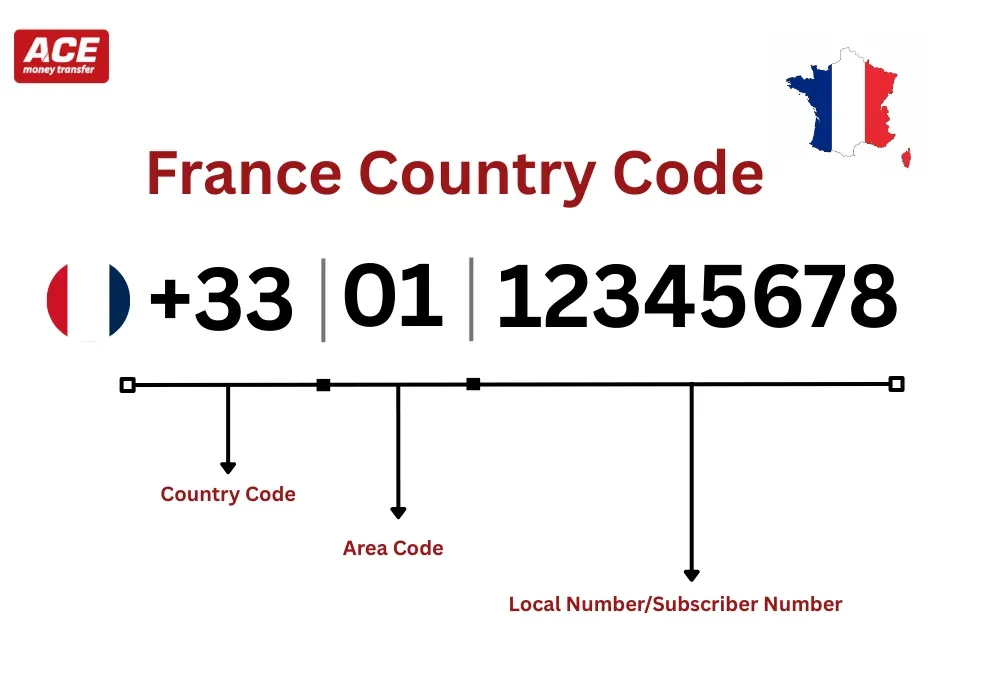
French phone numbers typically start with a 0 when dialed from within France, but this 0 must be omitted when calling from abroad. For example, a domestic number like 01 23 45 67 89 becomes +33 1 23 45 67 89 internationally.
France also has other standard codes: ISO 3166-1 alpha-2 "FR," alpha-3 "FRA," and the country top-level domain ".fr." However, the focus of this article is exclusively on telephone calling codes.
Country codes are numeric prefixes of one to three digits that identify a destination country in the global telephone numbering plan. They exist so international calls can be routed correctly across borders and networks.
To place international calls, you dial an international access code (such as +, 00, or 011 depending on your country) followed by the destination's country code, then the national number without the domestic trunk prefix.
France's country code 33 identifies the France country in the global numbering plan. It is separate from the area codes used inside France to distinguish regions or service types.
The global phone system follows ITU Recommendation E.164, and France's +33 has been part of this system since the late 20th century. The current French numbering plan with 10-digit numbers has been in effect since 1996.
There is a key distinction between the country code (+33) and internal French prefixes: digits 1–5 after the trunk zero designate geographic French landlines, 6–7 are for mobile networks, and 8–9 cover special services. These are area codes within the national plan, not separate country codes.
French overseas departments and territories such as French Guiana (+594), Guadeloupe (+590), and Réunion (+262) are politically part of France but use different country codes. You cannot reach them with +33.
This section explains how French landline and mobile numbers are structured and how area codes work within the French numbering plan.
French phone numbers consist of 10 digits, including a leading trunk code "0" that is only used for domestic calls. The standard format is written in pairs: 0X XX XX XX XX.
The first two digits indicate the type or region of service:
01: Paris and Île-de-France
02: Northwest France
03: Northeast France
04: Southeast France
05: Southwest France
06 and 07: Mobile phone numbers
08: Value added services, toll-free, and premium rate numbers
09: Non-geographic number services, often internet protocol (VoIP) lines
Mobile phone numbers in France typically start with the prefixes 06 or 07, followed by 8 more digits.
French landline numbers are divided into five geographic zones, each with a specific area code ranging from 01 to 05. For example, a number beginning with 01 is historically associated with the Île de France region, while 04 covers the southeast.
When dialing a French phone number from abroad, the leading 0 of the local number must be omitted, resulting in a total of 9 digits following the country code +33. So a local phone number like 01 23 45 67 89 becomes +33 1 23 45 67 89.
Since January 2023, ARCEP reforms mean geographic numbers starting with 01–05 no longer strictly tie a subscriber to their original registration zone. However, these area code prefixes still identify where the number was first assigned.
This section provides a universal template for calling France from any country. Country-specific examples follow in the next section.
When calling a French phone number from abroad, you must begin with the international access code, followed by the country code +33, and then the remaining 9 digits of the phone number.
On most cell phone devices, use the + sign instead of a numeric international exit code. Your call will look like +33 X XX XX XX XX.
When dialing from abroad, the leading 0 of the local French number should be replaced by the country code +33. For example, a landline in the southeast: domestic 04 76 12 34 56 becomes +33 4 76 12 34 56. A mobile 06 12 34 56 78 becomes +33 6 12 34 56 78.
All valid French numbers dialed from abroad should have exactly 9 digits after +33, regardless of whether they are French mobile numbers, French landlines, or non-geographic services.
Always check your carrier's international rates before calling France from abroad. Call costs for international calls vary significantly, and special 08/09 numbers may carry premium charges.
Here are the specific calling sequences for the most common origin countries. Each follows the same general pattern but uses a different international exit code specifically for that region.
From the United States: The exit code is 011. To call a Paris landline 01 23 45 67 89, dial 011 33 1 23 45 67 89. On a US cell phone, you can instead use +33 1 23 45 67 89.
From the UK: The international prefix is 00. To call a French mobile number 06 12 34 56 78, dial 00 33 6 12 34 56 78. From a UK mobile, +33 6 12 34 56 78 also works.
From Canada: Use 011 33 plus the 9 remaining digits, identical to the US pattern. For example, a southwest France landline: 011 33 5 12 34 56 78.
From Australia: The exit code is 0011. Dial 0011 33 followed by the French number without its leading 0. For example: 0011 33 4 76 12 34 56 for a southeast landline.
Using the wrong international access code can lead to connection failures. The UK uses 00, the US and Canada use 011, and Australia uses 0011, but France's country code (33) and removal of the leading 0 are always the same regardless of origin.
This section compares how to call French mobile phones and French landlines using the France phone code.
French mobile numbers start with 06 or 07 domestically. From abroad, they become +33 6 or +33 7 with 8 further digits.
To call a mobile phone in France from overseas, you need to dial +33 6 or +33 7, followed by the remaining 8 digits of the local number. For example: 06 12 34 56 78 in France becomes 00 33 6 12 34 56 78 or +33 6 12 34 56 78 when calling France from abroad.
French landlines start with 01–05. When dialing from abroad, to call a landline in Paris, you would dial +33 1 followed by the remaining 8 digits of the landline number.
Both mobile numbers and landlines end up with 9 digits after France's country code. You should never dial 0 and +33 together (e.g., +33 06 12 34 56 78 is incorrect).
French cell phone numbers usually support voice, SMS, and data. Saving a French contact in +33 international format ensures the number works while travelling, across mobile networks and messaging apps, regardless of which physical SIM card or country you're in.
Not all France phone codes behave the same way. Some number types have different costs and accessibility when dialed from outside France.
Toll-free numbers, known as "numéro vert" in France, typically start with 0800–0805. These are free for local calls inside France but may be unreachable or chargeable when dialing from abroad.
Shared-cost and premium rate numbers use prefixes such as 0810, 0820, or 0899. They can incur higher per-minute charges, especially from outside France.
Numbers starting with 09 are non-geographic number services, often used for VoIP or customer service lines. They behave like normal calls from many domestic plans but are dialed as +33 9 plus 8 more digits from abroad.
Always check your provider's tariff guide before dialing any 08 or 09 number in France from another country to avoid unexpected charges.
Emergency short numbers in France-15 (medical), 17 (police), 18 (fire brigade), 112 (EU emergency), and 114 (for hearing/speech impaired)-do not use the France country code. These are only valid inside France and cannot be reached from abroad.
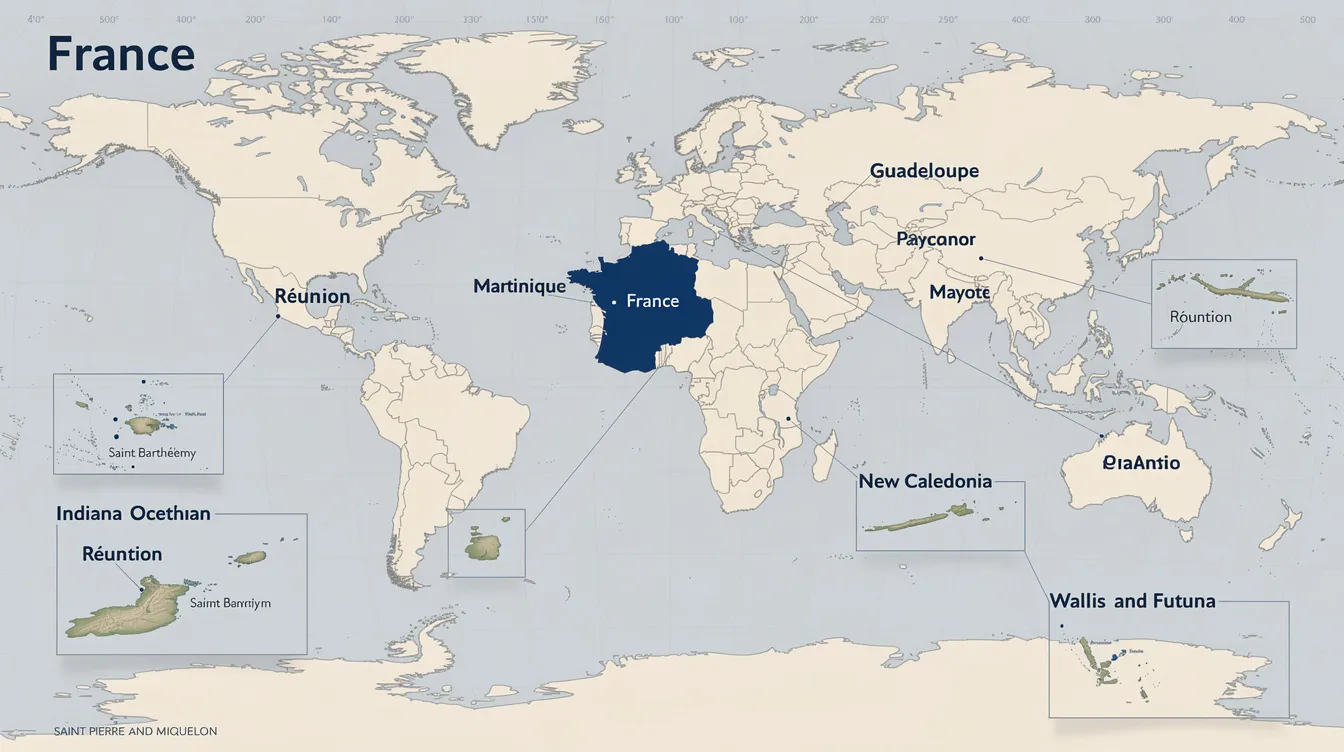
While France's country code is 33 for metropolitan France and Corsica, several French overseas regions use their own distinct codes.
French overseas territories have separate country codes. Departments like French Guiana, Guadeloupe, Martinique, Réunion, and Mayotte are part of France politically but have unique international calling codes.
Key examples: Guadeloupe, Saint Barthélemy, and Saint Martin use +590. French Guiana uses +594. Martinique uses +596. Réunion and Mayotte generally use +262.
From metropolitan France, calls to these overseas departments may be dialed as standard 10-digit numbers using the 0 trunk prefix. But from abroad, you must use each territory's specific country code-not +33. Using +33 will not connect.
Smaller collectivities also have their own codes: Saint-Pierre-et-Miquelon (+508), Polynésie française (+689), Nouvelle-Calédonie (+687), and Wallis-et-Futuna (+681). Travelers should confirm the correct code before calling.
The term "France's country code" refers specifically to +33 for mainland France. French overseas territories cannot be reached reliably with +33 alone.
Even experienced travelers make errors when dialing a French number from abroad. Here are the most frequent pitfalls.
One of the most common mistakes when dialing French numbers internationally is forgetting to drop the domestic trunk code 0, which should be replaced by the country code +33. For example, dialing +33 06 12 34 56 78 is incorrect; the correct format is +33 6 12 34 56 78.
Another frequent error is dialing an incorrect number of digits after the country code. French phone numbers should have exactly 9 digits following +33 when called from abroad-no more, no fewer.
Some callers confuse country codes and area codes, adding an extra 0 before the regional digit. Dialing +33 01 instead of +33 1 will fail.
Misusing exit codes causes issues too. Trying to dial 0033 from a country that uses a different international exit code (like 011 in the US or 0011 in Australia) will not connect. On mobile phones, the + symbol works universally.
To ensure successful international calls, it is recommended to save contacts in E.164 format, which includes the country code and omits the leading 0 from the local number. Storing numbers as +33 X XX XX XX XX means calling France from abroad works automatically from any cell phone.
Beyond using the correct France country code, smart callers also consider tariffs, internet alternatives, and time zones.
Per-minute charges for calling France vary widely by provider. Many carriers offer international add-on packages that significantly reduce call costs for frequent callers.
VoIP and messaging apps like Skype, WhatsApp, Facebook Messenger, and FaceTime provide low-cost or free voice calls to France over data or Wi-Fi. These apps still require your French contact's number to be stored in +33 format.
France sits in Central European Time (CET, UTC+1) during winter and Central European Summer Time (CEST, UTC+2) in summer. The time difference to the US East Coast is typically 6 hours, and to the UK it's 1 hour. Plan calls accordingly.
Typical French working hours are Monday to Friday, 9:00–17:00 or 9:00–18:00. Many offices pause around 12:00–14:00 for lunch, which can affect business calls.
Before you travel, save important telephone numbers-work contacts, family, hotels-in international format with +33. This way, you can stay connected through both regular calls and messaging apps regardless of which country's mobile networks or physical SIM card you're using.
Save your French contacts in +33 format now. When you land abroad, every call and message will just work-no fumbling with codes at the last minute.