
ACE Money Transfer
ACE Money Transfer
14 Sep 2026
Layer 1 refers to the main blockchain network; the primary blockchain that processes and finalizes transactions directly, without depending on another chain for settlement. These foundational networks are the base layer of every blockchain ecosystem, responsible for consensus, network security, and network integrity. Layer 1 blockchain networks serve various applications including decentralized finance and NFTs, and they are foundational for decentralized applications that run across various sectors.
Layer 2 solutions, by contrast, sit on top of a layer 1 to increase speed and reduce costs. But without a secure, reliable foundational layer beneath them, layer 2 solutions have nothing to build on. This ranking focuses on a mix of market cap, adoption, security, and developer activity as of mid-2025. Strong, fast base-layer networks also power real-world use cases like global remittances and cross-border payments, where transaction speed and low fees can save senders real money.

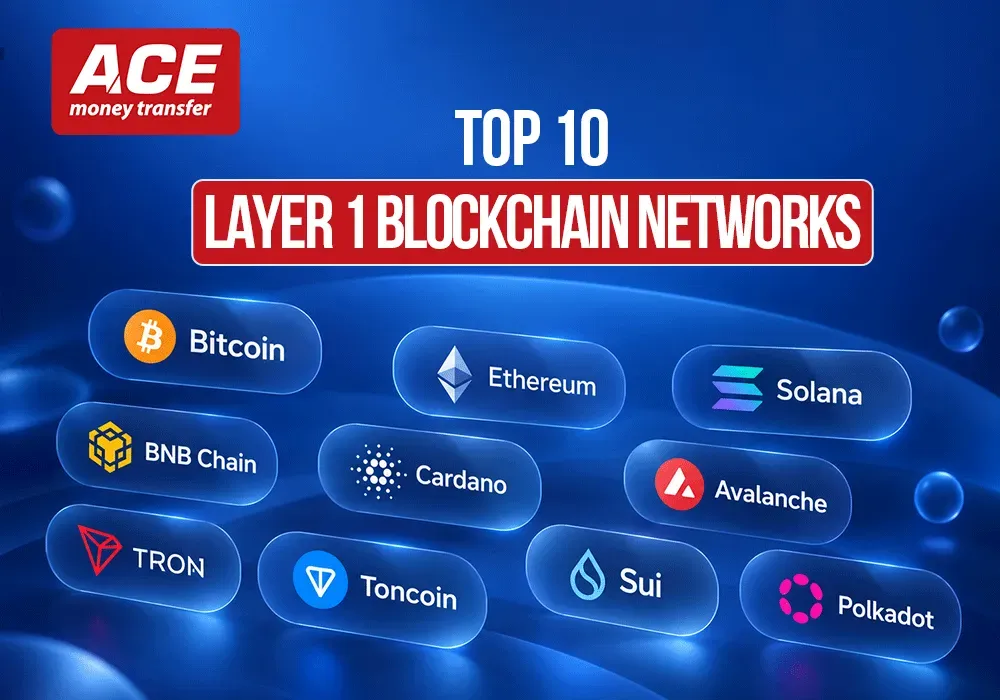
Here are the top 10 layer 1 blockchains ranked by approximate market capitalization as of June 2025. Each serves different functions within the broader digital economy.
Bitcoin (BTC); ~$2.1 trillion; store of value, settlement network
Ethereum (ETH) ; ~$310 billion; smart contract execution, DeFi, NFTs
XRP Ledger (XRP) ; ~$128 billion; cross-border payments, liquidity management
BNB Chain (BNB) ; ~$96 billion; high throughput DeFi, gaming, NFTs
Solana (SOL) ; ~$82 billion; high-performance DeFi, consumer apps, memecoins
TRON (TRX) ; ~$25 billion; stablecoin transfers, content, emerging-market payments
Cardano (ADA) ; ~$25 billion; peer-reviewed PoS, governance, DeFi
Avalanche (AVAX) ; ~$17 billion; enterprise tokenization, subnets, fast finality
Sui (SUI) ; ~$11 billion; gaming, consumer apps, parallel transaction processing
Polkadot (DOT) ; ~$7 billion; interoperability, shared security, custom blockchain networks
Rankings shift with market conditions. Market capitalization is just one metric; transaction throughput and finality times vary between these layer 1 blockchain networks, and on-chain activity often tells a more useful story than token price alone.
"Layers" describe how blockchain networks divide work. Layer 1 is the foundational infrastructure: the chain that runs its own consensus, maintains its own ledger, and provides final settlement. Layer 1 blockchains impact the execution model and governance of decentralized applications built on top of them. Layer 1 scaling solutions involve direct changes to the main blockchain itself.
All 10 projects listed above are independent layer 1 blockchains, not sidechains or layer 2 solutions. Here is how the two layers compare:
Layer 1: Handles consensus, transaction validation, and security. Finality happens here. Examples: Bitcoin, Ethereum, Solana.
Layer 2: Operates on top of layer 1 blockchains to offload transaction processing. Layer 2 solutions increase transaction speed and reduce costs. Examples: Lightning Network (Bitcoin), Arbitrum (Ethereum).
Several leading layer 1s, especially Ethereum, Bitcoin, and BNB Chain, rely on layer 2 solutions to handle demand and reduce transaction fees during periods of network congestion, which leads to slower transaction times if left unaddressed.
Bitcoin, established in 2009 by Satoshi Nakamoto, is the first layer 1 blockchain. It remains a foundational layer of the blockchain space.
Bitcoin uses a proof-of-work consensus mechanism with a hard supply cap of 21 million BTC. As a settlement and monetary network, the Bitcoin network focuses on security and reliability above all else. The Bitcoin blockchain processes roughly 7 transactions per second with block times around 10 minutes; this is slow compared to newer chains, but the trade-off is unmatched decentralized nature and resistance to censorship.
The Lightning Network is a layer 2 solution for Bitcoin that enables faster and cheaper transactions for micropayments and cross-border transfers. Institutional adoption has accelerated through spot BTC ETFs, corporate treasury holdings, and growing recognition of BTC as a macro asset. The Bitcoin network is essential infrastructure for the broader crypto economy, even if its transaction throughput is limited by design.
Ethereum, launched in 2015, supports smart contracts and dApps, making it the leading smart contract layer 1 blockchain. Its market capitalization hovered around $305-$330 billion in mid-2025, representing about 9-10% of the total crypto market.
Ethereum transitioned from proof-of-work to proof-of-stake in September 2022 through "The Merge." Ethereum's transition to proof-of-stake reduced energy consumption by over 99.95%. Consensus mechanisms affect the performance and capabilities of layer 1 networks, and this shift turned Ethereum into one of the most energy-efficient foundational networks in the blockchain space.
Ethereum is a layer 1 that relies on layer 2 solutions (rollups like Arbitrum and Optimism) for scaling. On its own, the base layer handles fewer daily transactions than chains like Solana or TRON, but it provides the security root and settlement finality that those rollups depend on. Ethereum's strengths are concrete: it has the largest developer community of any blockchain, the deepest composable DeFi protocols ecosystem, and a track record of enhancing security through continuous protocol upgrades.

BNB Chain (formerly known as Binance Smart Chain) is an EVM-compatible layer 1 built for speed and low fees. Its market capitalization was approximately $96.1 billion on June 1, 2025, placing it among the largest layer 1 blockchains.
The chain uses a dual chain architecture: BNB Beacon Chain handles governance and staking, while BNB Smart Chain runs smart contract execution and high-speed transactions. This separation enhances transaction speed for users alike across DeFi, NFT, and gaming applications. Tight integration with the Binance exchange provides liquidity and a direct onboarding path for more users entering crypto.
BNB Chain continues work on scaling solutions, including announced layer 2 solutions and cross-chain bridges, to reduce congestion and transaction costs further. PancakeSwap remains the dominant DeFi protocol, and the gaming ecosystem has attracted a vibrant community of developers building Web3 titles.
Solana employs a unique proof-of-history consensus mechanism combined with proof-of-stake, designed for high transaction throughput at low fees. Solana can process thousands of transactions per second with block times around 400-500 milliseconds, making it one of the fastest layer 1 blockchains in production. High-performance layer 1s like Solana are best suited for high-frequency applications with low costs.
As of June 1, 2025, Solana's market cap stood at roughly $81.9 billion. By late July 2025, the token surpassed $100 billion in market capitalization after a price rally to ~$191.52. Spot SOL ETF filings in H1 2025 signaled growing institutional adoption.
Solana's mobile-first strategy, including the Saga phone and mobile wallets, targets mass-market crypto adoption. Past network outages damaged confidence, but upgrades like the Firedancer validator client (developed by Jump Crypto) aim to improve reliability by introducing a second independent client implementation. Its DeFi, NFT, and memecoin ecosystems continue to attract developers who want to deploy applications without worrying about high transaction fees.
XRP Ledger is a purpose-built layer 1 blockchain optimized for fast, low-cost cross-border transfers and liquidity management. Its federated consensus mechanism (based on Unique Node Lists rather than mining) enables near-instant finality and low energy consumption, a sharp contrast to proof-of-work chains.
Market cap as of early June 2025: approximately $127.9 billion, placing XRP consistently near the top of layer 1 rankings. The RLUSD stablecoin issued on XRPL reached a market cap of ~$234.9 million by Q4 2025, up 164.2% quarter-over-quarter, reflecting growing adoption of the ledger for real-world asset issuance.
Greater regulatory clarity in key jurisdictions has increased institutional interest. Financial institutions use XRP Ledger infrastructure for executing transactions across borders in seconds rather than days. This is one of the clearest examples of how layer 1 blockchains can reduce costs imposed by traditional intermediaries.
Cardano takes a different path. Its development follows a peer-reviewed academic process, with each protocol change published and vetted before implementation. Cardano uses the Ouroboros proof-of-stake mechanism, a formally verified consensus protocol that prioritizes energy efficiency and ensuring security through mathematical proofs rather than computational brute force.
Market cap as of June 2025: approximately $24.8 billion. Cardano's Alonzo upgrade enabled full smart contract functionality in 2021, opening the chain to DeFi and NFT ecosystems that have grown steadily since. On-chain governance features allow ADA holders to vote on protocol changes, making it one of the more democratic decentralized systems in the blockchain universe.
Hydra is Cardano's own layer 2 scaling solution, designed to increase throughput by processing multiple transactions through off-chain "heads" while the main blockchain handles settlement and security. This approach aims at improving scalability without sacrificing decentralization, a crucial role in Cardano's design philosophy.
TRON runs on a delegated proof-of-stake model where 27 "super representatives" validate transactions. This design delivers high throughput and very low fees, making TRON a robust platform for stablecoin transfers. USDT on TRON carries a large share of global stablecoin transaction volume, particularly in emerging markets where users need cheap, fast value transfer.
With a market cap of approximately $25.2 billion in June 2025, TRON's on-chain activity consistently ranks among the highest of any layer 1 by daily active addresses. The network serves as essential infrastructure for content platforms, entertainment dApps, and Web3 services across Asia and other developing regions.
Low-fee TRON-based payments offer a natural fit for remittance services that prioritize cost-effective global transfers, allowing users to move value across borders for fractions of a cent per transaction.
Avalanche achieves sub-second transaction finality with its consensus protocol, a property that sets it apart from chains requiring multiple block confirmations. Its three-chain design separates different functions: X-Chain handles asset creation and transfers, C-Chain runs EVM-compatible smart contracts, and P-Chain coordinates validators and subnets.
Market cap as of mid-2025: approximately $17 billion. DeFi TVL on Avalanche sat around $1.53 billion as of May 2025, reflecting steady traction in decentralized finance.
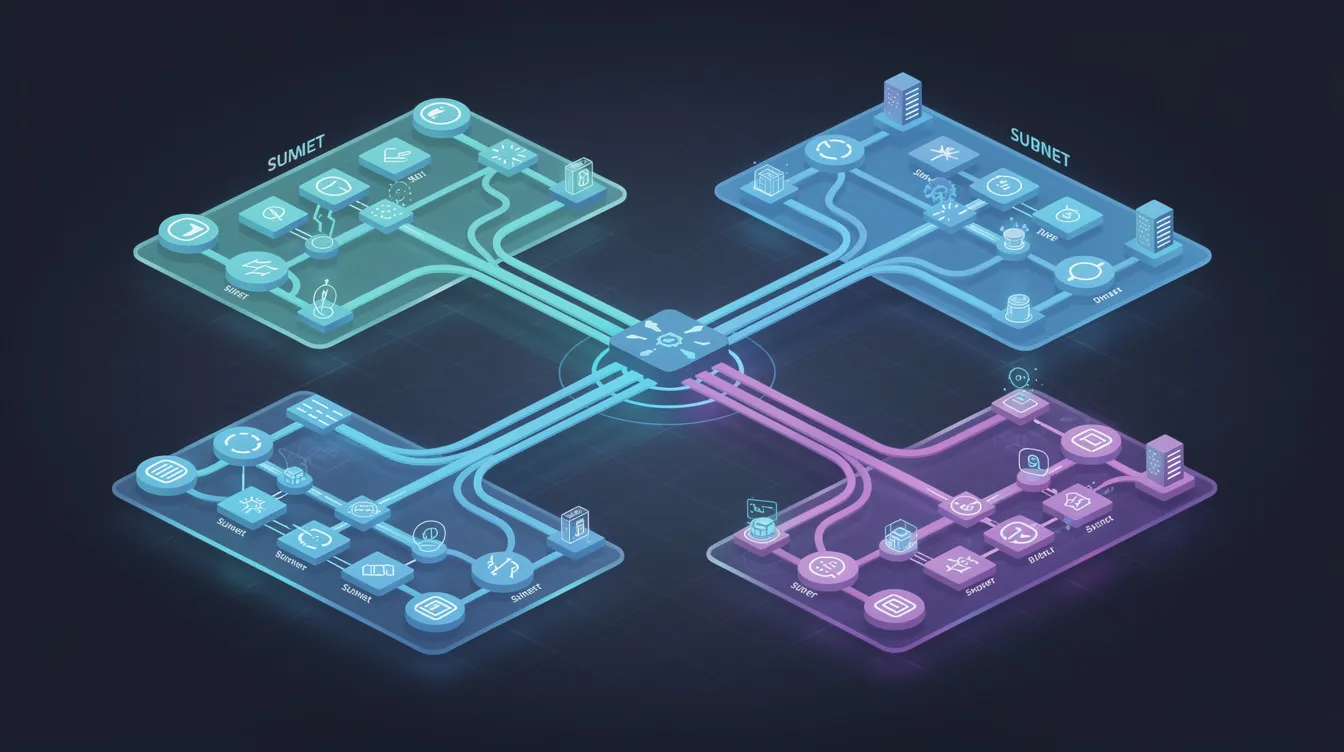
The subnet architecture is Avalanche's most distinctive feature. Avalanche allows for the creation of private or public subnets in enterprise settings, each with custom rules, native tokens, and validator sets. Financial institutions experimenting with tokenized assets have used subnets to build permissioned environments that still connect to the broader Avalanche network. This flexible foundation makes Avalanche a key player in enterprise blockchain adoption.
Interoperability-focused layer 1s allow specialized chains to connect and share security, and Polkadot is the clearest example of this design. Its relay chain provides shared consensus for connected parachains, each of which can be tailored to specific use cases: DeFi, identity, gaming, supply chain, and more.
Market cap as of mid-2025: approximately $7 billion. Polkadot uses Nominated Proof-of-Stake, where token holders nominate validators who secure the network. Parachain slot auctions and parathreads let teams launch custom blockchain networks without building their own validator sets from scratch.
Cross-chain messaging (XCM) enables seamless interactions between parachains within the Polkadot ecosystem. Polkadot 2.0 plans aim to replace fixed parachain slots with a more dynamic "coretime" model, improving scalability and developer experience. The network's value proposition rests on connecting disparate blockchain ecosystems under one security umbrella rather than competing on raw transaction speed.
Sui is built using the Move programming language and an object-centric data model that enables parallel transaction processing. Sui and Aptos are built using the Move programming language and support parallel execution, but Sui's object-based approach allows processing thousands of independent transactions simultaneously, delivering high throughput and predictable fees.
Market cap as of mid-2025: roughly $11 billion, with rapid growth in on-chain metrics. In the first half of 2025, Sui processed over 2.7 billion transactions, with peak daily counts exceeding 30 million. Active accounts surpassed 120 million by its second anniversary, a tenfold increase from the prior year.
Sui's delegated proof-of-stake model secures the network while its focus on gaming, consumer apps, and user-friendly wallet features (like zkLogin for passwordless onboarding) targets mainstream adoption. Developer activity is strong, with developers contributing across thousands of repositories within the ecosystem. For a chain barely two years old, these numbers make Sui one of the fastest-growing layer 1 blockchains in the space.
Market capitalization equals circulating token supply multiplied by current token price. A high market cap signals investor confidence and liquidity, but it does not always equal highest transaction throughput or best technology. TRON, for instance, processes far more daily transactions than several chains ranked above it by market cap.
Readers evaluating layer 1 blockchains should also weigh:
Daily active addresses as a proxy for real usage
Developer activity (commits, active contributors, new repositories)
TVL in DeFi protocols as a measure of economic activity
Stablecoin issuance on-chain, which reflects practical demand for the network
Some smaller-cap layer 1 networks like Sui are innovating rapidly and could move up the rankings. Growing adoption of a chain's native tokens and DeFi ecosystem often precedes market cap growth.
Leading layer 1 blockchains increasingly rely on layer 2 solutions and other scaling solutions (rollups, sidechains, state channels) to handle demand. Layer 1 blockchains require robust scaling solutions for increased demand because scalability is a significant challenge: increased user activity strains layer 1 processing capacity directly.
Layer 1 networks differ in trade-offs between decentralization, security, and scalability. Bitcoin and Ethereum prioritize decentralization and security. Solana and TRON prioritize throughput. Avalanche and Polkadot experiment with modular designs that blur the line between base layer and scaling solution.
Trends driving innovation include interoperability protocols, shared security models, and modular architectures that separate execution from settlement. End users mostly care about speed, reliability, and low fees, regardless of whether improvements come from layer 1 or layer 2 updates. The foundational networks that solve these problems without central authorities will remain the backbone of blockchain technology.

While blockchain networks are changing how digital transactions can work, international money transfers remain an important part of everyday financial activity. ACE Money Transfer provides a convenient way to send money internationally through supported corridors, with available delivery methods depending on the destination country.
Through the ACE website and mobile app, customers can set up transfers, review applicable fees and exchange rates, and select available delivery options before completing a transaction. Recipients can receive funds through supported methods such as bank deposits, cash pickup, and other country-specific options.
Whether sending money to family, managing regular financial commitments, or transferring funds across borders, ACE provides a separate, accessible channel for international remittances alongside the evolving digital financial landscape.
Rates and fees may vary, and exchange rates fluctuate, so the rate you receive may differ from any quoted rate. Always check the live rate at ACE Money Transfer before sending.
Fast, secure layer 1 blockchains can cut the cost and time of cross-border payments compared to traditional rails. A bank wire that takes 3-5 business days and charges $25-$50 in fees can be replaced by a blockchain-based transfer settling in seconds for under a dollar. Networks like XRP Ledger and TRON are already used for remittances and global transfers, with stablecoin-enabled layer 1s removing currency volatility from the equation.
ACE Money Transfer is one of the best money transfer apps for migrants and overseas workers sending money home. By offering competitive FX rates, low fees, and fast delivery times across many corridors, ACE Money Transfer gives senders transparency and quicker settlement compared to legacy bank wires. As blockchain rails continue to mature, services like Ace Money Transfer can pass savings from reduced transaction costs on to users, making cross-border payments cheaper and more accessible without requiring senders to understand the underlying blockchain technology.
Exchange rates fluctuate and the rate you receive may differ from any rates quoted. Always check the live rate at acemoneytransfer.com before sending.
There is no single "best" layer 1 blockchain. Bitcoin, Ethereum, BNB Chain, Solana, XRP, Cardano, TRON, Avalanche, Polkadot, and Sui each excel in different areas. An investor prioritizing security may favor Bitcoin. A developer building DeFi protocols will likely choose Ethereum or Solana. An enterprise exploring tokenization might pick Avalanche's subnets. Someone sending remittances benefits from XRP Ledger's speed or TRON's low fees.
Research the technology, ecosystem health, and real-world adoption behind each chain, not just the token price. As scaling solutions, interoperability standards, and regulation evolve, this top 10 list will change. But strong, secure layer 1 blockchains will remain the foundation of the crypto economy, driving innovation across every corner of the digital economy for years to come.
Disclaimer: This article is intended for general informational and educational purposes only and should not be construed as legal, regulatory, tax, business, or financial advice. While reasonable efforts have been made to ensure that all facts, figures, and data are accurate and valid as of the date of publication, no warranty or guarantee is given as to the ongoing completeness, accuracy, or currency of the information.
The content is based on information available at the time of publication. Regulations, government policies, market conditions, and service offerings may change over time and vary across jurisdictions and providers. As a result, some information may no longer be current or applicable. Readers should independently verify all information and consult qualified professional advisors before making any financial, legal, or business decisions.