ACE Money Transfer
ACE Money Transfer
17 Aug 2026
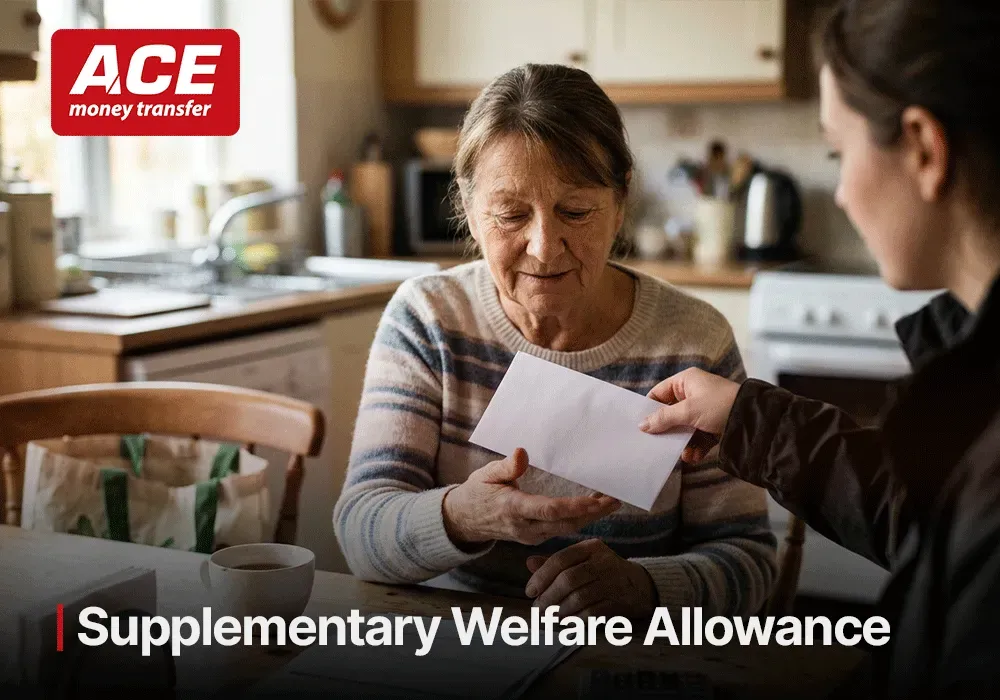
Supplementary Welfare Allowance (SWA) is a weekly means-tested payment provided through the Department of Social Protection under Community Welfare Services. It is designed for people who cannot meet ordinary living expenses from their own income, covering basic needs such as food, electricity, transport, and daily household costs.
SWA is a weekly payment made to people in Ireland whose income is not enough to meet their needs or the needs of their family. It acts as a financial floor. If your income falls below a set level, SWA tops you up to that minimum.
The payment is often temporary. It fills a gap when a person is waiting for another social welfare payment, appealing a decision, or dealing with an unexpected drop in income.
Basic eligibility conditions — you must generally:
• Be living in Ireland
• Pass the means test
• Have applied for any other social welfare payment you may be entitled to
• Be registered for work at your local Intreo Centre if of working age
• Meet the Habitual Residence Condition (HRC), unless an exemption applies
You will not normally qualify for basic SWA if you are in full-time work (30+ hours per week), in full-time education, or involved in a trade dispute.
Subject to change — verify current rates at gov.ie/en/publication/social-welfare-rates.
| Category | Maximum Personal Rate (subject to change) |
| Aged 25 and over | €252 per week |
| Aged 18–24, living independently with state housing support | €252 per week |
| Aged 18–24, not living independently | €163.70 per week |
Additional payments — Increase for Adult Dependant: €168.60. Increase for Child Dependant: €58 (child under 12) / €78 (child aged 12 or over). SWA is not a taxable source of income.
Subject to change — verify current rates at gov.ie/en/publication/social-welfare-rates.
SWA is means-tested. The Department of Social Protection looks at all sources of income before deciding how much you will receive. If you live with a spouse, partner, or cohabitant, their income is also included.
• First €5,000: Not taken into account
• Next €10,000: €1 per €1,000
• Next €25,000: €2 per €1,000
• Balance above €40,000: €4 per €1,000
The value of your own home is not included. You can earn up to €14,000 per year (€269.23 per week) from renting out a room in your own home without it affecting your SWA.
In addition to the basic payment, you may also be entitled to:
• Rent Supplement: helps with private rented accommodation costs
• Fuel Allowance: increased to €38 per week from January 2026 to help with heating costs
• Back to School Clothing and Footwear Allowance: helps with school uniforms and shoes
• Diet Supplement: for people with particular medical conditions
• Exceptional Needs Payment: a once-off payment for urgent or unforeseen expenses
Subject to change — verify current rates at gov.ie/en/publication/social-welfare-rates.
Apply through the Department of Social Protection's Community Welfare Service at your local Intreo Centre or Social Welfare Office.
Documents you will need:
• PPS numbers for yourself, your spouse/civil partner/cohabitant, and your children
• Proof of identity (passport, driving licence, Public Services Card, Irish Residence Permit, or work permit)
• Proof of residency in Ireland
• Proof of any household income (pay slips, tax statements, bank statements)
If you are in urgent need, tell the Community Welfare Officer when you apply. In cases of genuine emergency, same-day payments can sometimes be arranged.
If your application is refused or you disagree with the amount awarded, you have the right to appeal to the independent Social Welfare Appeals Office. The appeals process is free and does not require a solicitor or legal representation.
Supplementary Welfare Allowance is there for moments when life gets hard. If your income has dropped, your payment is delayed, or you are simply waiting to get back on your feet, do not hesitate to apply. Verify current rates at gov.ie/en/publication/social-welfare-rates before acting.
To send money home securely, visit acemoneytransfer.com or download the ACE Money Transfer app.
SWA is for people living in Ireland whose weekly income falls below the minimum level set for their family size. Verify current eligibility rules at citizensinformation.ie.
If you work 30 or more hours per week, you will not normally qualify for basic SWA. If you work fewer than 30 hours, your earnings are included in the means test.
There is no fixed time limit. It is designed as a temporary measure and is reviewed regularly.
EU, EEA, and Swiss nationals who have been working in Ireland and have the right to reside here can access SWA without meeting the HRC. If you are unsure about your eligibility, speak to a Community Welfare Officer at your local Intreo Cent
Disclaimer: This article is intended for general informational and educational purposes only and should not be construed as legal, regulatory, tax, business, or financial advice. While reasonable efforts have been made to ensure that all facts, figures, and data are accurate and valid as of the date of publication, no warranty or guarantee is given as to the ongoing completeness, accuracy, or currency of the information.
The content is based on information available at the time of publication. Regulations, government policies, market conditions, and service offerings may change over time and vary across jurisdictions and providers. As a result, some information may no longer be current or applicable. Readers should independently verify all information and consult qualified professional advisors before making any financial, legal, or business decisions.
Enjoy guaranteed competitive INR exchange rates, ultra-fast transfers, and zero fee promotions directly to bank accounts across India.
Ireland Employment & Schemes | Ireland Family & Allowances |