ACE Money Transfer
ACE Money Transfer
17 Aug 2026
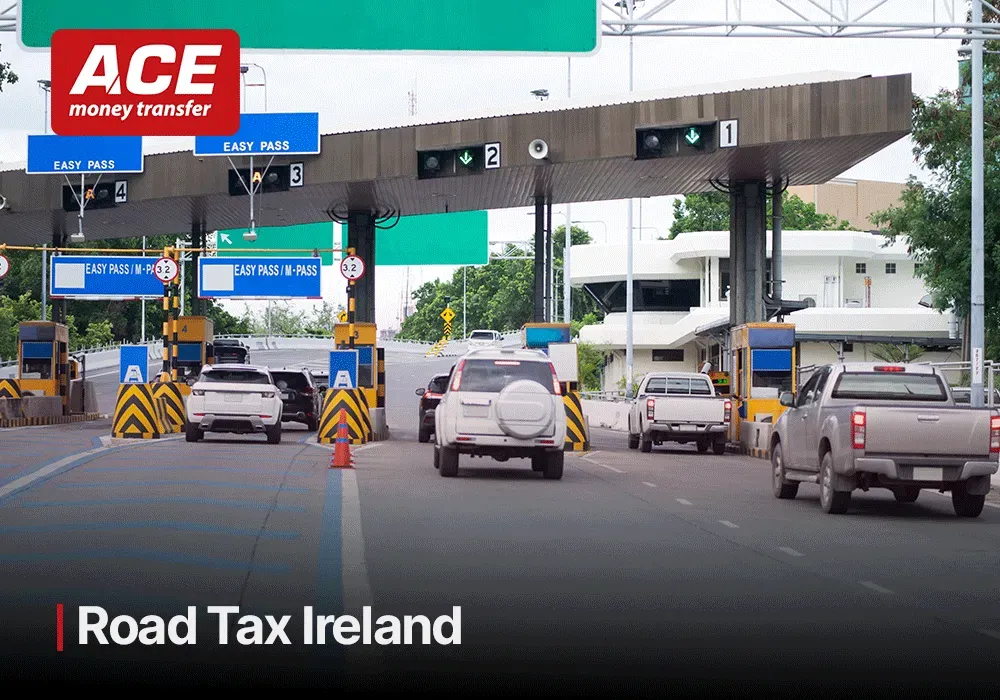
Road tax, officially known as motor tax, is a mandatory legal requirement for most vehicles used on public roads in Ireland. It is administered by local authorities and must be paid to legally operate a vehicle on Irish roads. The amount you pay depends on various factors including your vehicle's CO? emissions, engine size, registration date, weight, and classification. Understanding the motor tax system is essential for vehicle owners to remain compliant and avoid penalties.
Road tax, or motor tax, is an annual charge imposed on vehicle owners for the privilege of using public roads in Ireland. It applies to most registered vehicles, including private cars, motorcycles, vans, buses, commercial vehicles, and imported cars. A valid motor tax disc must be displayed clearly on the vehicle’s windscreen as proof of payment. Driving without a valid motor tax disc can result in a fine of €60 or more, with penalties increasing for non-payment or repeat offences (source: RedClick.ie).
For most modern vehicles registered on or after 1 July 2008, motor tax is generally calculated based on CO? emissions. This system encourages environmentally friendly driving by applying lower rates to vehicles with lower emissions. Vehicles registered on or after 1 January 2021 use the Worldwide Harmonised Light Vehicle Test Procedure (WLTP) emissions figures, which provide more accurate and typically higher CO? values than the previous New European Driving Cycle (NEDC) system (source: CitizensInformation.ie).
Older private vehicles registered before 1 January 2008 are taxed based on engine capacity (cc). Smaller engines generally attract lower motor tax rates. This method remains applicable for private goods vehicles such as vans under certain weight limits (source: RedClick.ie).
Commercial vehicles are taxed based on their unladen weight. For example, commercial vehicles with an unladen weight between 4,000 kg and 12,000 kg pay an annual motor tax of €500, while those over 12,000 kg pay €900 annually (source: RedClick.ie). Small goods vehicles (with unladen weight not exceeding 1,524 kg) used privately are taxed based on engine capacity.
Note: Rates are subject to change; always verify at motortax.ie.
| Vehicle Type | Annual Road Tax Rate |
|---|---|
| Battery Electric Vehicles (BEVs) | €120 (fixed annual rate) |
| Commercial Vehicles (4,000kg–12,000kg) | €500 |
| Commercial Vehicles (Over 12,000kg) | €900 |
| Vintage Vehicles (30+ years old) | €26 (concessionary rate) |
| Replacement Motor Tax Disc | €6 |
| Vehicle Registration Certificate Replacement | €12 |
These rates reflect the latest motor tax system and are generally calculated based on CO? emissions or engine capacity, depending on vehicle registration date and type (source: CitizensInformation.ie).
When you pay your motor tax, you receive a motor tax disc which must be displayed on the inside of your vehicle’s windscreen. This disc shows the tax status and expiry date. Failure to display the disc can result in fines even if the tax has been paid (source: RedClick.ie).
The easiest and most popular way to pay motor tax is online at motortax.ie. To pay or renew motor tax online, you need your vehicle registration number and a personal identification number (PIN). For new vehicles, the PIN is the last six characters of the vehicle's chassis number (VIN) as printed on the Vehicle Registration Certificate or Form RF100. Renewing online is convenient, and the motor tax disc is usually posted within four working days after payment (source: Gov.ie).
You can also apply in person at your local motor tax office. First-time taxation requires Form RF100. Renewals can be done using Form RF100A (manual renewal) or RF100B (computer-printed form sent before expiry). Payment must be accompanied by the appropriate fee and supporting documents where applicable (source: CitizensInformation.ie).
Postal applications are accepted by sending the completed form, fee, and any required documentation to your local motor tax office. Allow up to 10 working days for processing and receipt of your tax disc (source: CitizensInformation.ie).
To tax a new or imported vehicle, you must have a Vehicle Registration Certificate (VRC). If you purchase a new car from a registered dealer, the dealer usually handles registration and provides the VRC. For second-hand cars bought in private sales, the seller must complete the ownership section on the VRC to transfer ownership. Without the VRC in your name, you cannot tax the vehicle (source: RedClick.ie).
Electric vehicles (EVs), including Battery Electric Vehicles (BEVs), benefit from a fixed annual motor tax rate of €120, making them one of the most economical options for road tax in Ireland. This rate is designed to encourage the adoption of low-emission vehicles (source: CitizensInformation.ie).
Certain vehicles and circumstances qualify for full or partial exemptions from motor tax:
Disabled Persons’ Vehicles: Vehicles adapted for drivers or passengers with a physical disability, including disabled persons SPSV vehicles, may be exempt from motor tax if the engine capacity does not exceed 2,000 cc. A certificate of approval from Revenue is required (source: Gov.ie).
Vintage Vehicles: Vehicles over 30 years old qualify for a concessionary motor tax rate of €26 per year. Proof of age via chassis number and vehicle registration certificate is necessary (source: CitizensInformation.ie).
Offshore Island Vehicles: Vehicles kept and used exclusively on certain offshore islands may qualify for reduced motor tax rates. These vehicles cannot be taxed online and must be processed at local motor tax offices (source: CitizensInformation.ie).
Statutory Off-Road Declaration: If a vehicle will not be used on public roads for 3 to 12 months, owners can declare it off the road by submitting Form RF150 online or in person, avoiding motor tax charges during that period (source: Gov.ie).
State Owned Vehicles: Certain state-owned vehicles, defence forces vehicles, and vehicles like agricultural tractors, forklifts, hearses, vintage cars, and off-road dumpers may be exempt or subject to special motor tax treatment (source: Gov.ie).
Driving without valid motor tax is a serious offence in Ireland. Penalties include:
On-the-spot fines starting at €60
Increased fines and possible court prosecution
Vehicle clamping or seizure by Gardaí
Requirement to pay backdated tax, including arrears
It is illegal to drive a vehicle without a valid motor tax disc displayed. Gardaí can also verify motor tax status using Automatic Number Plate Recognition (ANPR) technology (source: RedClick.ie).
You may be eligible for a refund if you have stopped using your vehicle, or if it has been scrapped, stolen, or permanently exported. To apply, complete Form RF120, have it witnessed and stamped by a member of An Garda Síochána, and submit it with supporting documentation to your local motor tax office. Refunds are generally calculated from the first of the month after the tax disc is surrendered, and a minimum of three full months of unexpired tax must remain on the disc at surrender (source: Gov.ie).
You can check your vehicle’s motor tax status and expiry date online at motortax.ie. However, Ireland does not provide a free public tool to check the full motor tax history or current tax validity for vehicles not owned by you. Services like MotorCheck provide detailed motor tax history reports including tax validity, expiry dates, and any gaps in tax payment, which can be valuable when buying a used car (source: MotorCheck.ie).
Keeping your motor tax current is essential to avoid fines and legal trouble. Motor tax revenue is used to maintain and improve the Irish public road network, supporting safe and efficient travel for all road users (source: Department of Transport).
Road tax in Ireland is a legal obligation for vehicle owners and is calculated based on engine size, CO? emissions, vehicle type, and weight. It can be paid online, in person, or by post, with motor tax discs issued for 3, 6, or 12 months. Electric vehicles benefit from reduced rates, while certain vehicles such as vintage cars and disabled persons’ vehicles may qualify for exemptions or concessions. Failure to pay motor tax results in fines and other penalties. Always ensure your vehicle is taxed and that your vehicle registration certificate and ownership details are up to date.
Citizens Information. Motor Tax Rates. https://www.citizensinformation.ie/en/travel-and-recreation/motoring/motor-tax-and-insurance/motor-tax-rates
RedClick. Understanding Motor Tax Ireland. https://www.redclick.ie/content-hub/understanding-motor-tax-ireland
Government of Ireland. Motor Tax Payments, Renewals and Refund Information. https://www.gov.ie/en/department-of-transport/publications/motortax-payments-rnewals-and-refund-information
MotorCheck. Can You Check Its Motor Tax Status? https://www.motorcheck.ie/faqs/can-you-check-its-motor-tax-status
Department of Transport, Ireland. https://www.gov.ie/en/department-of-transport/
For the latest rates and regulations, always consult the official motor tax website at motortax.ie.
Disclaimer: This article is intended for general informational and educational purposes only and should not be construed as legal, regulatory, tax, business, or financial advice. While reasonable efforts have been made to ensure that all facts, figures, and data are accurate and valid as of the date of publication, no warranty or guarantee is given as to the ongoing completeness, accuracy, or currency of the information
The content is based on information available at the time of publication. Regulations, government policies, market conditions, and service offerings may change over time and vary across jurisdictions and providers. As a result, some information may no longer be current or applicable. Readers should independently verify all information and consult qualified professional advisors before making any financial, legal, or business decisions.
Enjoy guaranteed competitive INR exchange rates, ultra-fast transfers, and zero fee promotions directly to bank accounts across India.
Ireland Employment & Schemes | Ireland Family & Allowances |