ACE Money Transfer
ACE Money Transfer
21 May 2026
If you need to send or receive money internationally through The Royal Bank of Scotland, you will need the correct SWIFT code for international money transfers. Getting it wrong can delay your transfer — or worse, send it to the wrong place. This guide covers everything you need to know about The Royal Bank of Scotland SWIFT codes, how they work, and how to use them safely for international payments, also known as business identifier codes.
A SWIFT code, also known as a BIC (Bank Identifier Code), is one of the standard identifier codes used by financial institutions worldwide to recognise each other during international transactions. When money is sent across borders, the SWIFT network, short for the Society for worldwide interbank financial telecommunication, uses this code to route the payment to the correct financial institution. Without a valid SWIFT code, the sending bank would not be able to determine the correct destination for the funds.
The Royal Bank of Scotland (RBS) is one of the largest and most established banks in the United Kingdom, serving over 3.3 million personal customers. It is headquartered at 36 St Andrew Square, Edinburgh, Scotland. As a major financial institution, RBS is a full member of the SWIFT network and uses multiple SWIFT codes depending on the type of service or branch involved.
The main SWIFT/BIC code for The Royal Bank of Scotland is:
RBOSGB2LXXX
This is the head office code, for the bank name The Royal Bank of Scotland, registered at 36 St Andrew Square in the city of Edinburgh, United Kingdom. You may also see it written as RBOSGB2L (the 8-character version without the branch suffix). Both refer to the same head office and are accepted for most international transfers.
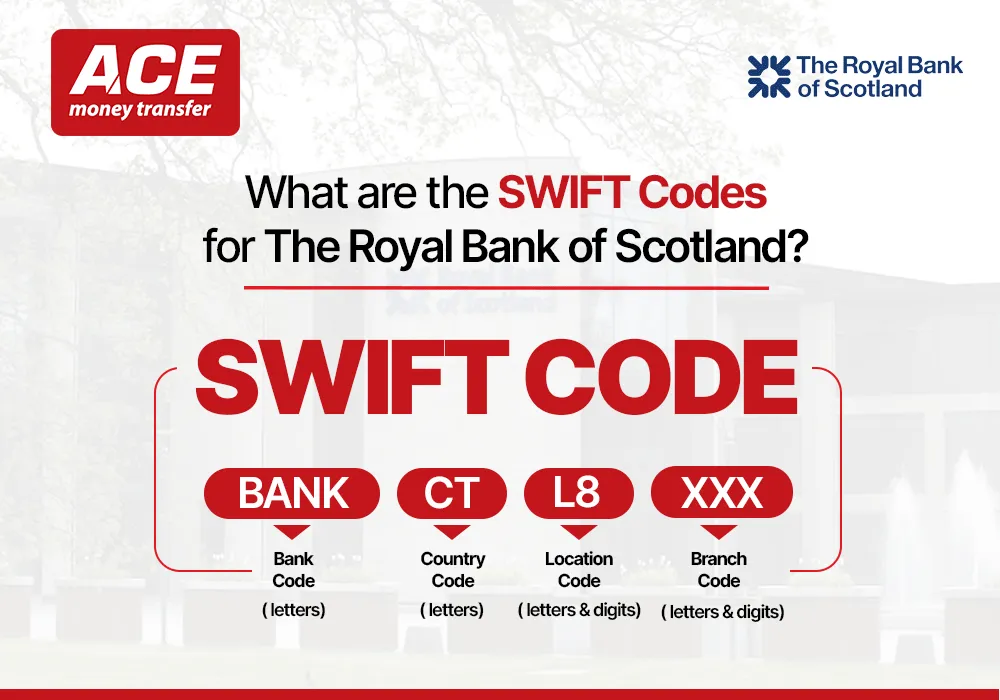
Here is a quick breakdown of this code:
| Component | Characters | Meaning |
|---|---|---|
| Bank Code | RBOS | Identifies The Royal Bank of Scotland |
| Country Code | GB | United Kingdom |
| Location Code | 2L | Identifies the Edinburgh location |
| Branch Code | XXX | Head office (primary) |
If you are not sure which code to use for a specific branch, you can safely use RBOSGB2LXXX as the primary office code when a specific branch code is not available, and your payment will be routed through the bank’s central system to the correct account.Want to know how quickly your money reaches abroad and what affects transfer times? Read our guide on Understanding How Long Does it Take to International Money Transfer.
All SWIFT codes follow a standard format set by the International Organization for Standardization (ISO). They are either 8 or 11 characters long.
An 8-character code refers to the bank's head office. An 11-character code includes an extra 3-character suffix that identifies a specific branch. If that suffix is "XXX", it still points to the head office.
Here is how the format looks for RBS:
R B O S – G B – 2 L – X X X
RBOS = Bank identifier (Royal Bank of Scotland)
GB = Country code (Great Britain / United Kingdom)
2L = Location code (Edinburgh)
XXX = Branch code (head office)
When a branch has its own code, the last three characters will be different — for example, numbers or unique letters that represent that specific location.
The Royal Bank of Scotland uses different SWIFT codes for different services and departments. Here are some of the known codes:
SWIFT Code | Branch / Department | Location |
| RBOSGB2LXXX | Head Office (Primary) | Edinburgh |
| RBOSGB2L | Head Office (8-char version) | Edinburgh |
| RBOSGB2LCBB | Corporate Banking Branch | Edinburgh |
| RBOSGB2LGLO | Global Operations | Edinburgh |
| RBOSGB2LLIQ | Liquidity Management | Edinburgh |
| RBOSGB2LSSD | Specialist Services | Edinburgh |
| RBOSGB2LTSY | Treasury | Edinburgh |
| RBOSGB2LTCM | Transaction & Cash Mgmt | Edinburgh |
| RBOSGB2M | Secondary Code | Edinburgh |
| RBOSGB2S | Secondary Code | Edinburgh |
| RBOSGB55 | Secondary Code | United Kingdom |
For most personal international transfers, RBOSGB2LXXX is the correct code to use. For corporate or specialist transactions, confirm the exact code with the recipient or directly with the bank.
When someone wants to send money to your RBS account from outside the UK, they will need to provide the following details to their bank:
Your full name (as it appears on the account)
Your IBAN (International Bank Account Number), sometimes called your iban number
The RBS SWIFT/BIC code: RBOSGB2LXXX
The bank’s full name: The Royal Bank of Scotland PLC, the Scotland PLC bank name used for international payments
The bank’s address: 36 St Andrew Square, Edinburgh, EH2 2YB, UK
Double check all account and bank details before sharing them with the sender.
Your IBAN for RBS is 22 characters long and begins with the country prefix “GB”. You can find your IBAN on your bank statement, through the RBS online banking portal, or by using the RBS mobile app. With SWIFT gpi, more than 50% of international payments are credited within 30 minutes.
RBS offers two ways to make international electronic payments: standard international transfers via the SWIFT network, and SEPA Credit Transfers for euro payments within the SEPA zone.
For a standard international transfer, when transferring money abroad you will need the recipient’s IBAN or account number and the SWIFT/BIC code for the recipient's bank. Some banks use their own swift codes for specific branches or departments. You also need your card reader (for new payees) and any country-specific payment requirements. You can set up the transfer online, via the RBS mobile app, or by calling into a branch. Global remittances reached approximately $860 billion in 2023. This reflects how millions of people send money across borders for family support, salaries, and business — all requiring SWIFT codes like RBS’s RBOSGB2LXXX to route a swift payment correctly.
For SEPA payments, the process is simpler and faster. SEPA covers euro payments across participating European countries. You only need the recipient’s IBAN and BIC — similar to how Royal Bank of Scotland SWIFT codes are used for identifying banks in international transfers — and there is no need for a purpose-of-payment code. Payments made before 2:00pm typically reach the recipient the same working day.
An IBAN for RBS consists of exactly 22 characters. Here is the structure:
GB + 2 check digits + 4-character sort code + 8-digit account number
Example format: GB29 RBOS 6016 1331 9268 19
The "GB" prefix confirms the account is held in the United Kingdom. The check digits help validate the number before a transfer is processed. Using the wrong IBAN can cause your payment to be returned or sent to an incorrect account, so always verify directly with the account holder or through RBS online banking.
You will need the RBS SWIFT code in the following situations:
When receiving money from abroad: If a person or business outside the UK wants to send you money, they will ask for your IBAN and SWIFT/BIC code. You should give them RBOSGB2LXXX along with your IBAN. Do not give out your regular account number or sort code for international payments — it can cause delays.
When sending money abroad from RBS: When you set up a new international payee through RBS online banking or the mobile app, you will be asked to enter the recipient's SWIFT code. This tells the RBS system which bank to route the payment to.
For SEPA payments: Even though SEPA payments primarily use IBAN, it is still best practice to include the BIC code. RBS confirms that while a BIC may not be mandatory for all SEPA transfers, including it speeds up processing.
For business invoices: RBS recommends that businesses print their IBAN and BIC on invoices sent to clients outside the UK. This removes any confusion and helps ensure payments arrive in the correct account without delay.
UK banks like RBS use IBANs for international and European payments, just like banks across the EU and EEA. However, the UK's own domestic system still relies on sort codes and account numbers for payments within the country. When making international payments, always use the IBAN — not the sort code and account number. Certain countries, including the US, Canada, China, and Australia, do not use IBANs and instead rely on their own account and routing number systems.
In the United States, banks use routing numbers (ABA numbers) to identify institutions for domestic transfers, similar to how UK banks use sort codes. However, for international wire transfers, US banks also use SWIFT codes. So if someone in the US wants to send money to your RBS account, they will use a SWIFT transfer — not a routing number system — and they will need RBOSGB2LXXX.
India uses the Indian Financial System Code (IFSC) for domestic bank transfers within India. It is an 11-character code assigned to each bank branch by the Reserve Bank of India. When sending money from India to an RBS account in the UK, the IFSC is not used. Instead, the sender uses the SWIFT system, entering the RBS SWIFT code on their end.
There are several easy ways to find swift code details for your RBS account:
Bank Statement: Your SWIFT code and IBAN are printed on your RBS paper or digital bank statement. This is the most reliable place to check.
RBS Online Banking: Log into your RBS digital banking portal, go to account details, and you will find your IBAN and BIC listed there.
RBS Mobile App: Open the app, tap on your account, and look under “Account Details” or “International Payments” for your BIC/SWIFT code and IBAN.
Ask Your Branch: If you are unsure, you can call or visit one of the local branches and ask a member of staff to confirm your correct SWIFT code.
SWIFT Code Lookup Tools: Various trusted financial websites maintain SWIFT code databases and may provide detailed information. However, always cross-check any code you find online with your bank statement or online banking, or contact Royal Bank of Scotland directly if you are unsure, before using it in a transaction.
Common Error | Solution |
| Using the wrong SWIFT code for specialist services | Royal Bank of Scotland uses different SWIFT codes for departments like treasury, liquidity, and corporate banking. For personal transfers, always use RBOSGB2LXXX unless instructed otherwise by your bank or recipient. |
| Mixing up IBAN and SWIFT | IBAN identifies your specific account, while the SWIFT code identifies the bank. For international transfers, both are usually required to ensure correct routing. |
| Using sort code and account number for international payments | Sort code and account number are only for UK domestic transfers. For international payments, always use the full IBAN. |
| Ignoring country-specific requirements | Some countries require extra details (e.g., purpose codes or local identifiers). Always check destination country requirements before sending money. |
| Typing errors in SWIFT code | Even one incorrect character can cause delays or failed transfers. Carefully verify all SWIFT code details before confirming the transaction. |
Yes — it is generally safe to share your SWIFT code and IBAN with people or businesses that need to send you money. These codes are designed to be shared. They only allow money to be deposited into your account, not withdrawn from it.UK banking fraud losses were over £1.17 billion in 2023. This highlights why users must be careful when sharing SWIFT codes, IBANs, and other banking details. While SWIFT codes are safe, sensitive login credentials must never be shared.
That said, you should always be cautious about who you share your details with, especially when dealing with Royal Bank of Scotland SWIFT codes or any other banking identifiers. Only give your IBAN and SWIFT code to trusted contacts or legitimate businesses. Never share your online banking password, one-time passcodes (OTPs), or card reader codes with anyone — these are the credentials that protect your account from unauthorised access.
The primary SWIFT/BIC code for The Royal Bank of Scotland is RBOSGB2LXXX. This is the head office code and is suitable for most personal and business international transfers. The 8-character version, RBOSGB2L, is also valid and refers to the same office.
Yes. RBS uses IBAN for international transfers. Your RBS IBAN is 22 characters long and starts with "GB". You can find it on your bank statement or in the account details section of your RBS online banking or mobile app.
Yes. Anyone sending you money from outside the UK will need your IBAN and the RBS SWIFT code RBOSGB2LXXX. Without the SWIFT code, the sending bank cannot route the payment to RBS correctly.
Not always. RBS assigns unique SWIFT codes to some branches and departments. For most personal transfers, the head office code RBOSGB2LXXX works fine. If you are unsure which code applies to your branch, check your bank statement or contact RBS directly.
Using an incorrect SWIFT code can cause your payment to be delayed, returned, or in some cases sent to the wrong institution. If you realise you have entered the wrong code after sending a transfer, contact your bank immediately. They may be able to intercept the payment, though this is not always guaranteed.
For international wire transfers, no — a SWIFT code is required. However, if you are making payments within the UK in pound sterling, you only need the sort code and account number. For euro payments within the SEPA zone, you need an IBAN and BIC.
If you need to send money to the UK — whether to a Royal Bank of Scotland account or any other UK bank — understanding Royal Bank of Scotland SWIFT codes is essential for smooth international transfers. In this case, ACE Money Transfer makes the process simple, fast, and affordable. ACE supports transfers to the UK from dozens of countries around the world, with competitive exchange rates and low fees, helping you avoid hidden fees.
When sending to an RBS account through ACE, you will typically need the recipient’s full name, their bank details, their 22-character IBAN, and the RBS SWIFT code RBOSGB2LXXX. ACE Money Transfer is rated 4.7 on Trustpilot, reflecting its commitment to secure and reliable service for customers sending money across borders.
Whether you are supporting family, paying for goods and services, or managing business payments, ACE gives you a straightforward way to move money internationally — without the high fees or slow processing times often associated with traditional bank transfers.