
18 Sep 2025
When it comes to global tech giants, Nvidia (NASDAQ: NVDA) has become a household name. With its leadership in graphics chips and AI processors, every earnings report and share price move attracts worldwide attention—including from investors in Australia.
Here’s a closer look at the Nvidia share price, its earnings drivers, AI’s links to the Australian economy, and how Australians can gain exposure to the world’s hottest chipmaker.
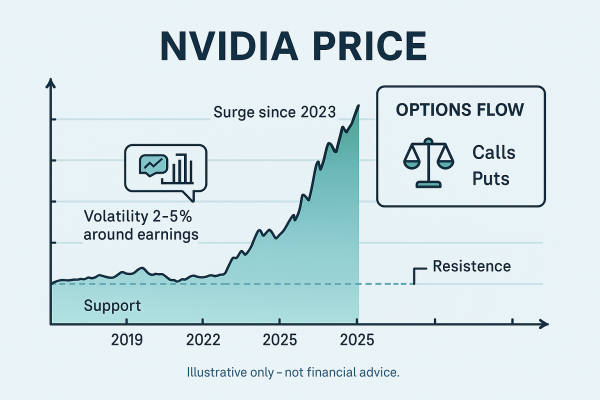
Nvidia stock has surged in recent years, making it one of the world’s most valuable companies.
Nvidia’s price chart shows a meteoric rise, especially post-2023, as AI adoption accelerated. Volatility remains high, with intraday swings of 2–5% common around earnings releases.
As of recent trading sessions, Nvidia’s support levels are being tested near recent lows, while resistance sits closer to record highs. Moves beyond these zones often drive sharp momentum.
Nvidia also dominates options markets, with heavy flows in both calls and puts. Options activity provides insights into institutional positioning and market sentiment ahead of earnings.
Earnings remain the biggest catalyst for Nvidia’s share price.
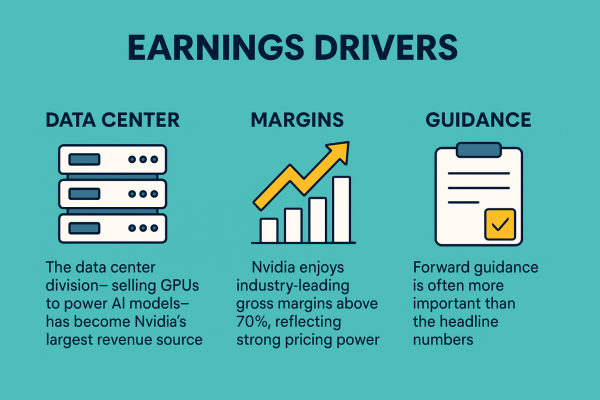
The data center division—selling GPUs to power AI models—has become Nvidia’s largest revenue source. Demand from hyperscalers like Microsoft, Amazon, and Google drives record growth.
Nvidia enjoys industry-leading gross margins above 70%, reflecting strong pricing power. Investors closely watch whether new competition could pressure profitability.
Forward guidance is often more important than the headline numbers. Nvidia’s projections for AI chip demand, supply chain capacity, and new product launches play a central role in share price movements.
While Nvidia is a US company, its AI supply chain has strong ties to Australia.
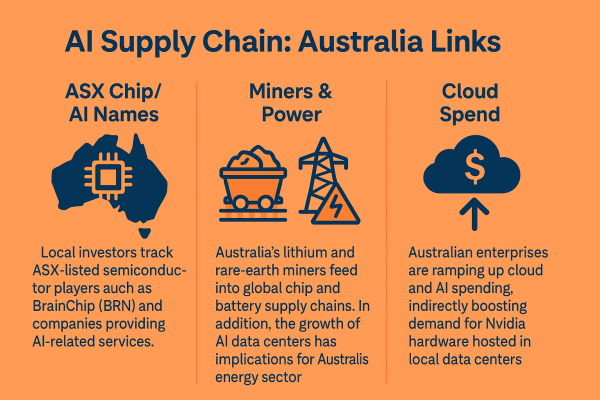
Local investors track ASX-listed semiconductor players such as BrainChip (BRN) and companies providing AI-related services. While smaller in scale, they offer thematic exposure.
Australia’s lithium and rare-earth miners feed into global chip and battery supply chains. In addition, the growth of AI data centers has implications for Australia’s energy sector, as data processing requires enormous power.
Australian enterprises are ramping up cloud and AI spending, indirectly boosting demand for Nvidia hardware hosted in local data centers. This ripple effect makes NVDA earnings globally relevant.
For Australians, getting exposure to Nvidia stock involves several pathways.
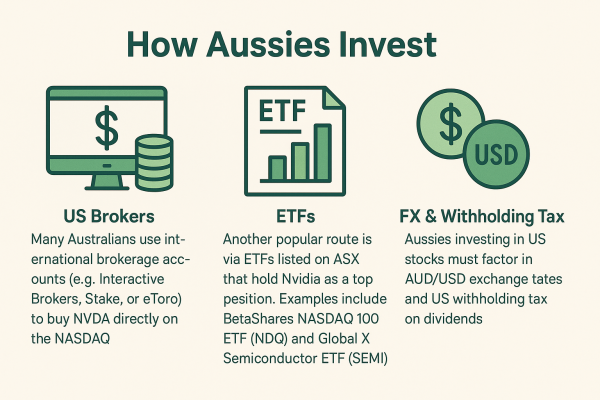
Many Australians use international brokerage accounts (e.g., Interactive Brokers, Stake, or eToro) to buy NVDA directly on the NASDAQ.
Another popular route is via ETFs listed on the ASX that hold Nvidia as a top position. Examples include BetaShares NASDAQ 100 ETF (NDQ) and Global X Semiconductor ETF (SEMI).
Aussies investing in US stocks must factor in AUD/USD exchange rates and US withholding tax on dividends. For expats sending money across borders, services like ACE Money Transfer help manage foreign exchange more efficiently than traditional banks.
Global tech trends affect more than investors. Nvidia’s rise in AI influences job opportunities, global remittance flows, and even technology costs worldwide. For Australians living abroad or international students in Australia, watching Nvidia and the AI sector helps understand future career and financial opportunities. With ACE Money Transfer, managing cross-border finances becomes seamless in a fast-changing global market.
Nvidia trades on the NASDAQ under the ticker NVDA, and its share price changes daily with market activity. Investors should track live charts for the latest updates, especially during earnings season.
The biggest drivers are AI-driven demand for data center chips, gaming GPUs, and automotive solutions. Strong margins and forward guidance also play a crucial role in shaping investor sentiment.
Yes, Australians can invest in Nvidia through international brokers like Stake or eToro. They can also gain exposure indirectly via ASX-listed ETFs that hold NVDA in their portfolios.
Nvidia chips power AI, gaming, and cloud platforms that many Australian businesses, startups, and universities rely on. This makes the company’s success relevant to local innovation and economic growth.
Nvidia faces risks from supply chain constraints, regulatory scrutiny, and intensifying competition from rivals like AMD. Market volatility in the AI sector can also lead to sharp swings in NVDA’s share price.