ACE Money Transfer
ACE Money Transfer
14 Sep 2026
Digital banks have changed how people manage money with app-driven features, real-time tracking, and lower costs. Whether you need a primary current account, a travel-friendly multi currency wallet, or a business account for your side project, the right banking app can replace a trip to the branch entirely.
This guide breaks down the top 10 digital banks in 2026, compares their key features, and helps you decide which app based bank accounts actually deserve your attention.
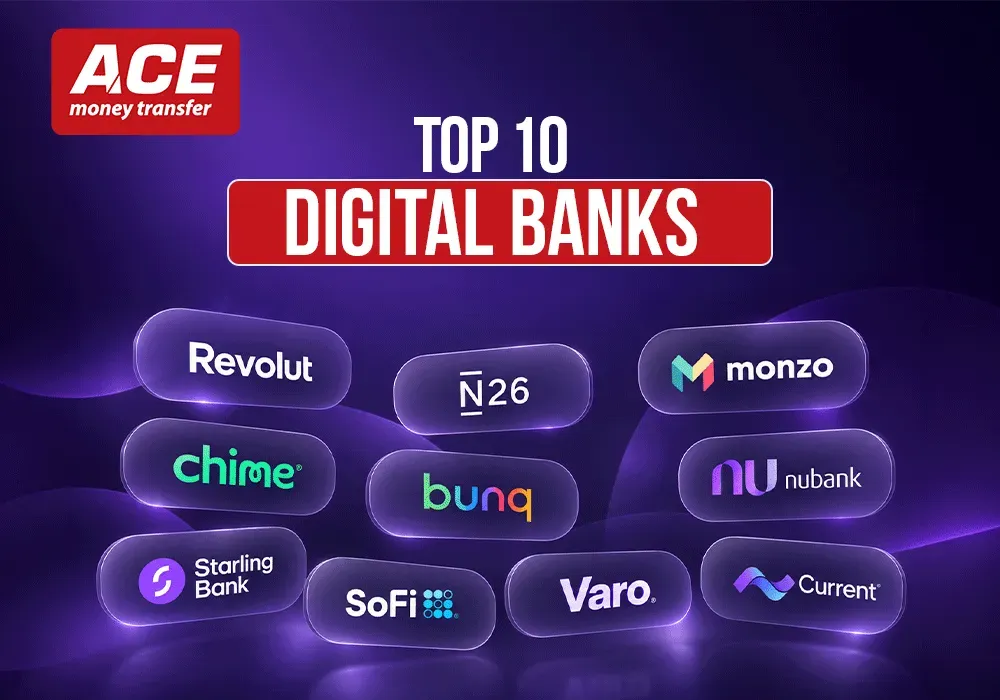
Here are the leading digital banks for 2026, covering everyday current accounts, app only bank account options, and digital banking features across personal and business banking.
Revolut – Global, 40+ markets – Best for multi currency accounts, travel, and app-based investing
Monzo – UK – Best for everyday budgeting tools and spending insights
Starling Bank – UK – Best for fee free current accounts and business banking
N26 – Eurozone – Best for minimalist mobile banking across Europe
bunq – EU-wide – Best for eco-conscious users and multiple sub-accounts
Nubank – Latin America – Best for low cost digital banking and financial inclusion
WeBank – China – Best for AI-powered microloans and scale
Ally Bank – US – Best for high-yield savings accounts and branchless banking
MYBank – China – Best for SME lending and rural financial inclusion
Chase UK – UK – Best for cashback rewards and a slick app only bank account
All 10 are digital banks with strong banking apps. Both personal and business banking options are covered in the individual reviews below. The most highly regarded digital banks stand out through distinctive innovative features - read on to find your best fit.

A digital bank is an online- or app-only bank account provider where you manage money primarily via a smartphone banking app or web interface, without relying on high street branches. Account management is available without visiting a branch - everything from opening an account to transferring money happens on your phone.
Core elements of digital banking include:
Opening current accounts on your phone - onboarding typically takes minutes, with ID verification done via selfie and photo of your document.
Instant notifications - real-time notifications alert users instantly on money entering or leaving their accounts.
In-app card controls - freeze your debit card, set spending limits, or toggle contactless and online card payments on and off.
Budgeting tools - many apps provide budgeting tools like savings pots and spending insights to help track spending habits.
Digital payments - features like bill pay, mobile deposits, P2P payments, Apple Pay and Google Pay come standard with most providers.
Some digital banks hold full banking licences (with deposit protection such as the Financial Services Compensation Scheme in the UK, FDIC in the US, or European schemes), while others operate as e-money or payment institutions with different safeguards. Digital banks provide 24/7 mobile access compared to traditional banks, and they provide broad digital capabilities which are more streamlined than traditional banks. Challenger banks operate with modern technology through smartphone apps, often charging fewer hidden fees due to lower overhead costs. Digital banks can be a good alternative to traditional banks for users valuing convenience.
Rankings are based on publicly available data and product features as of mid-2026. Rates, fees and features change - always check each bank's site for up to date information before opening an account.
Key criteria:
Quality and stability of the banking app (app store ratings, feature depth)
Range of current accounts, bank accounts, and account types
Account fees, monthly fees, and FX charges
Savings and fixed saver options, including annual equivalent rate
Budgeting tools, spending notifications, and analytics
Business banking availability and marketplace integrations
Safety, regulation, and deposit protection
Profitability and customer growth were considered, but user experience and value for money mattered more than sheer size. This list is global - a bank may not be available in your country. Cross-check eligibility and residency rules before applying.
Revolut, founded in London in 2015, has grown into one of the best digital bank options worldwide. Revolut has around 65 million customers globally, with the platform surpassing 70 million by May 2026. It operates in more than 40 countries with regulatory licensing across over 30 markets.
Account types: Personal current accounts, app based bank accounts for daily use, junior accounts, and business banking solutions for freelancers, sole traders, and small businesses.
Standout features: Multi currency wallets (40+ currencies) where users can hold and exchange multiple currencies with competitive rates. Cryptocurrency and stock investing, vaults for saving, automatic spending categorisation, and disposable virtual cards for added security.
Pricing tiers: Standard plan (free), Plus, Premium, Metal, and Ultra. Higher paid plans unlock additional features like travel insurance, airport lounge access, and higher savings rates. Plan fees and limits vary by region - fees apply on certain transactions depending on your tier.
Safety: Regional licensing includes a full UK banking licence secured in 2026, plus a French banking licence. In-app freeze/unfreeze, single-use card numbers, and the Revolut app's "Street Mode" add layers of protection. Always check your local deposit protection rules.
Digital banks reduce foreign exchange friction compared to traditional banks, and Revolut is the poster child for fee free spending abroad. Best for: frequent travellers, digital nomads, and anyone wanting an all-in-one banking app with advanced features in one app.

Monzo launched in 2015 and has built a loyal UK following. Monzo has about 13 million customers in the UK, with total customers reaching 15.2 million and revenue hitting £1.7 billion in FY2026.
Core products: Personal current accounts, joint accounts, app only bank account options, business account for sole traders and limited companies, overdrafts, and loans.
Budgeting tools: Automatic spending categorisation (mobile banking apps allow users to categorize their spending automatically), instant notifications, savings pots that allow users to separate money for different goals, round-up saving, and salary sorting on payday. Monzo provides instant notifications for spending to detect fraud.
Paid plans: Monzo Extra, Perks, and Max offer enhanced interest rates, credit score monitoring, and insurance. About 45% of active users pay for a subscription tier.
Safety: Monzo deposits are protected by the Services Compensation Scheme FSCS up to £85,000 per eligible person (app-based banking accounts are protected up to £85,000 by FSCS), making it a secure choice for salary payments and direct debits.
Best for: UK customers wanting a primary bank account with spending insights, strong budgeting tools, and clear visibility over everyday banking.
Starling Bank, founded in 2014 with its app launching in 2017, is one of the first UK challenger banks. Starling Bank has approximately 4.6 million customers in the UK, with platform accounts growing to 6.2 million and profit before tax of £217 million in FY2026.
Personal accounts: No monthly fees, interest on balances, linked Easy Saver or fixed saver accounts (Fixed Saver at ~3.70% AER; Easy Saver at ~4.00%), real time notifications, and spending insights. Savings accounts at digital banks frequently feature competitive interest rates, and Starling delivers here.
Business banking: Full business current accounts, euro and USD accounts, integrations with accounting tools like Xero and QuickBooks, and a wider marketplace of connected apps. Ideal for tracking business expenses and managing cash flow for small businesses.
Tech features: Robust banking app with card controls, fee free spending abroad in many situations, fast account opening, and cash deposits at the Post Office. AI-powered features include "Spending Intelligence," "Scam Intelligence," and "Starling Assistant." Starling Bank claims to have world-class security features.
Safety: FSCS-protected eligible deposits up to standard limits. Past awards include Best British Bank and Best Current Account.
Best for: UK users wanting a simple digital bank for their main current account and SME owners seeking strong app-based business banking.
N26 is a Berlin-based fully licensed bank operating across the Eurozone with more than 8 million customers by 2026.
Bank accounts: Free and premium personal current accounts, app based bank accounts for freelancers, and card options including virtual cards and physical debit cards.
Features: Real-time push notifications (app-based banks offer real-time spending notifications), Spaces (sub-accounts) for budgeting and goal tracking, automatic categorisation, and in-app card controls. Digital banks often feature zero monthly maintenance fees and attractive overseas spending - N26's standard plan has zero fees.
Deposit protection: Covered under the German bank guarantee scheme up to €100,000 per customer.
Travel: Competitive fee structures for ATM withdrawals, FX, and card payments in foreign currencies within Europe.
Best for: Eurozone residents wanting a clean, minimalist banking app and flexible current accounts for everyday banking.
bunq is a Dutch digital bank offering mobile-first banking services across much of the European Economic Area. Its features cover everyday banking, savings, budgeting and spending management, alongside sustainability-focused initiatives.
Account types: Easy Bank, Easy Money, Easy Green, multi currency current accounts, and plans for digital nomads and business account holders.
App features: Multiple IBANs, dozens of sub-accounts, advanced budgeting tools, automatic bill splitting, and easy separation of spending categories. Request money from friends and split bills in-app.
Sustainability: Tree-planting linked to card usage, CO? tracking, and eco-focused branding - sustainable growth with purpose. Appeals to environmentally conscious customers.
Cross-border: European IBANs, support for travellers and remote workers within the EU, and multi currency flexibility.
Best for: users wanting granular control over multiple bank accounts in one app and those prioritising environmental impact.
São Paulo-based Nubank, founded in 2013, has become the largest digital bank in Latin America. Nubank is the largest digital bank in Latin America with 123 million customers, and by December 2025 it had surpassed 131 million across Brazil, Mexico and Colombia - covering roughly 62% of Brazil's adult population.
Products: No-fee credit cards, digital current accounts, savings products, personal loans, investments, and SME offerings, all in a highly rated banking app. Nubank pioneered low cost access to financial services for millions in Latin America.
Financial inclusion: Nubank's digital banking model reduces fees and complexity for previously underserved customers, bringing millions into the formal financial system. Digital payments via PIX integration are central to the experience.
UX: Simple, transparent pricing, instant notifications, spending insights, and in-app support in Portuguese and Spanish.
Growth: ROE at ~33%, cost to serve per active customer under $1, and net income of ~$895 million in FY2025.
Best for: customers in Latin America seeking a low fee digital bank as their main bank account, with modern app features and wide acceptance.

WeBank, launched by Tencent in 2014, is a digital-only bank that provides banking and financial services through digital channels. It uses technology and AI across areas such as lending, risk management and customer services, serving a large customer base in China.
Ecosystem: Deeply integrated with WeChat and Tencent platforms, offering frictionless digital banking, digital payments, and credit products.
AI and tech: Uses AI, big data, and blockchain for secure, low cost lending - particularly microloans to individuals and microbusinesses. Many digital bank apps include integrated AI-driven insights for managing finances, and WeBank is a leader here.
Products: Current account equivalents, small-ticket loans, SME lending, and wealth-management products - all delivered fully online.
Scope: Primarily focused on China. Its technology and scale make it a global benchmark for digital banking innovation.
Best for: a financial inclusion powerhouse and case study for investors and fintech observers, even if not accessible to most overseas customers.
Ally Bank is a US digital bank with no physical branches, having evolved from an auto-finance specialist into a full-service online bank. Ally Bank serves around 11 million customers in the US.
Products: Interest-bearing checking (current accounts), online savings, money market accounts, certificates of deposit (CDs as fixed saver equivalents), mortgages, auto loans, and investment accounts. Online accounts and best online accounts rankings often feature Ally near the top.
Rates: Known for competitive savings rates, clear fee structures, and 24/7 support via a mature banking app and web platform.
Safety: Deposits are FDIC-insured up to standard US limits.
Best for: US savers and investors who value a single account digital bank for both cash and investments, with no monthly fees.
MYBank, launched in 2015 under Ant Group, is a major Chinese digital bank dedicated to serving SMEs, microbusinesses, and rural customers with no branch network.
Technology: Uses alternative data, AI risk models, and cloud infrastructure to provide fast digital lending and app based bank accounts to small businesses that online banks and traditional banks often overlook.
Products: Small-ticket working capital loans, digital merchant accounts, QR-code payments, and integrated tools for managing cash flow via mobile. Faster payments and low cost lending are central.
Ecosystem: Integrates with platforms like Alipay, central to China's financial inclusion and e-commerce ecosystem.
Best for: a valuable case study for policymakers, investors, and fintech professionals interested in business banking innovation.
Chase UK is JPMorgan Chase's digital bank, launched in the UK in 2021 as an app only bank account provider with no branches. Digital banks often provide cashback options on everyday purchases, and Chase UK leads the pack here.
Products: Personal current accounts, linked saver accounts (easy-access and fixed saver options), cashback offers, and in-app card management.
Features: Chase offers a numberless debit card for enhanced security, competitive cashback on everyday spending categories, round-up savings at boosted rates (e.g. 5% on round-ups), and fee free spending abroad within certain limits. Supports Apple Pay and Google Pay.
Safety: FCA-regulated, FSCS deposit protection up to £120,000 per depositor (shared with JPMorgan's UK operations). High app store ratings on Google Play and the App Store.
Best for: UK customers who want a secondary or main current account with strong rewards, a licensed bank backing, and a slick app-only experience.
Beyond the top 10, many digital banks and app only bank account providers are worth watching:
Chime – Major US neobank, fee free checking and automatic savings, popular with younger Americans
Hello Bank – BNP Paribas' digital arm in parts of Europe, bridging traditional banks and online banks
Rebellion Pay – Spain-focused, targeting Gen Z with zero fees and social features
Valyuz – Baltic-focused EMI for international businesses and freelancers
Tandem – UK green-lending focused bank, offering eco-friendly savings and lending products
Availability, licensing and features vary significantly. Research local regulation and deposit protection before choosing any bank account. Many of these providers specialise in niches: travel, student accounts, crypto-friendly digital banking, or business banking for startups.
The best digital bank depends on how you use your current accounts: everyday spending, saving, travel, or running a business. Digital banks generally excel at providing budgeting tools not matched by traditional banks, and digital banks offer features like spending insights and budgeting help that make a real difference.
Compare these factors:
Monthly fees, account fees, and FX charges - digital banks typically offer lower fees than traditional high-street institutions
ATM withdrawals limits and withdrawing cash policies
Interest rates on savings and fixed saver accounts (annual equivalent rate matters)
In-app budgeting tools, spending notifications, and analytics for tracking spending habits
International payments and multi currency support - international transfers should be fast and transparent
Business banking availability, including marketplace integrations for tracking business expenses
Customer support options and response times
Local deposit protection: FSCS, FDIC, European schemes
The banking app itself matters: stability, ease of use, security features (biometrics, 3-D Secure), and app store ratings. Many people keep their salary and direct debits with one digital bank and use another app-based bank account purely for travel or budgeting. Make a short checklist of "must have" vs "nice to have" features before opening a new digital bank account.
Leading digital banks use strong encryption, biometric authentication, and real-time fraud monitoring comparable to - or exceeding - traditional banks. Digital banks use encryption and biometric authentication for security across the board. Mobile banking apps provide real-time spending notifications, which double as a fraud-detection tool.
Key safety points:
Check that a digital bank is authorised in your country - most major licensed digital providers feature official deposit protection schemes
Verify if deposits are covered by schemes like the FSCS, FDIC, or European deposit insurance. Your money is protected up to £85,000 by FSCS in the UK for most licensed banks. Digital banks are often regulated and protected by official deposit protection schemes.
Understand the difference between a fully licensed bank and an e-money institution - the protections are different
Users can freeze their debit cards instantly via banking apps if a card is lost or compromised
Use strong passwords, enable two-factor authentication, keep the banking app updated, and only download official apps from Google Play or Apple's App Store
In the UK, Authorised Push Payment (APP) scam rules add further consumer protections; chargeback rights apply for card payments
Review each bank's security and fraud policies before making it your main bank account.

ACE Money Transfer is a specialised international remittance provider offering a digital way to send money across borders. Its services support transfers to various destinations through available bank, cash pickup, wallet and other country-specific delivery options. If you're transferring money internationally - whether to family, for tuition, or to move freelance earnings - ACE Money Transfer is purpose-built for the job.
While ACE Money Transfer is not a digital bank, it complements digital banking by allowing users to send money quickly and securely to bank accounts, mobile wallets, and sometimes cash pick-up locations in 100+ countries.
Competitive FX rates across major currency corridors, with low transparent fees
Fast delivery - often minutes for supported routes, with real-time tracking in-app
Use cases: Expatriates funding relatives' digital bank accounts abroad, students paying tuition into overseas bank accounts, and freelancers withdrawing platform earnings into their own app-based bank accounts
Security and compliance: Licensed in the jurisdictions where it operates, with robust KYC/AML checks and encryption to protect customer data and transfers
Exchange rates fluctuate, and the rate applicable to your transfer may differ from rates shown at another time. Check the current rate atacemoneytransfer.combefore sending.
Best for: readers who already use digital banks and need a reliable, low cost app to move money internationally - with zero fees on select corridors and transparent pricing throughout.
Opening an app only bank account can often be completed in minutes using just your smartphone. Onboarding with digital banks often occurs entirely via smartphone within minutes. Digital banks allow fast account opening without cumbersome paperwork, and digital banks typically allow instant account onboarding and rapid access to financial tools.
Steps:
Download the chosen banking app from Google Play or the App Store
Confirm eligibility (age, residency)
Submit ID and a selfie for verification
Pass any required credit or soft checks
Activate your virtual or physical debit card
To make it your main bank:
Set up salary payments via faster payments or bank transfer
Move direct debits and standing orders - use official switching services where available (e.g. UK Current Account Switch Service)
Start using Google Pay or Apple Pay for contactless card payments
Many people start with a digital bank as a secondary account for travel or budgeting tools before fully switching their primary current account. Test the banking app's usability, support response times, and features with small balances before moving all your money.
Digital banking has transformed personal finance with app-first experiences and real-time tracking, and the pace isn't slowing. Digital banks are moving towards super-apps that combine current accounts, lending, investing, insurance, and lifestyle services in a single banking app.
Key trends to watch:
AI-driven financial coaching - personalised budgeting tools and automated spending insights will get sharper. Many digital bank apps include integrated AI-driven insights for managing finances.
Embedded finance and banking-as-a-service - expect more non-bank apps to offer banking features powered by licensed bank partners
Stronger open banking integrations - linking multiple bank accounts and financial products in one app for a complete picture
Growth in emerging markets - further expansion of app only bank account providers in Latin America, Africa, and Southeast Asia
Regulatory focus - increased consumer protection rules around digital payments, profitability requirements, and deposit safety
Convergence - traditional banks are upgrading their apps while challengers add complex products like mortgages and wealth management. The gap is narrowing.
Cross-border payments and remittances - partnerships between digital banks and money transfer apps like Ace Money Transfer will become more common, making international payments faster and cheaper
Review your digital banking setup at least once a year. New products, better rates, and shifting plan fees mean the best digital bank for you today might not be the best choice twelve months from now. Start by downloading one or two banking apps, test them with small balances, and switch when you're confident.
Disclaimer: This article is intended for general informational and educational purposes only and should not be construed as legal, regulatory, tax, business, or financial advice. While reasonable efforts have been made to ensure that all facts, figures, and data are accurate and valid as of the date of publication, no warranty or guarantee is given as to the ongoing completeness, accuracy, or currency of the information.
The content is based on information available at the time of publication. Regulations, government policies, market conditions, and service offerings may change over time and vary across jurisdictions and providers. As a result, some information may no longer be current or applicable. Readers should independently verify all information and consult qualified professional advisors before making any financial, legal, or business decisions.