ACE Money Transfer
ACE Money Transfer
11 Sep 2026
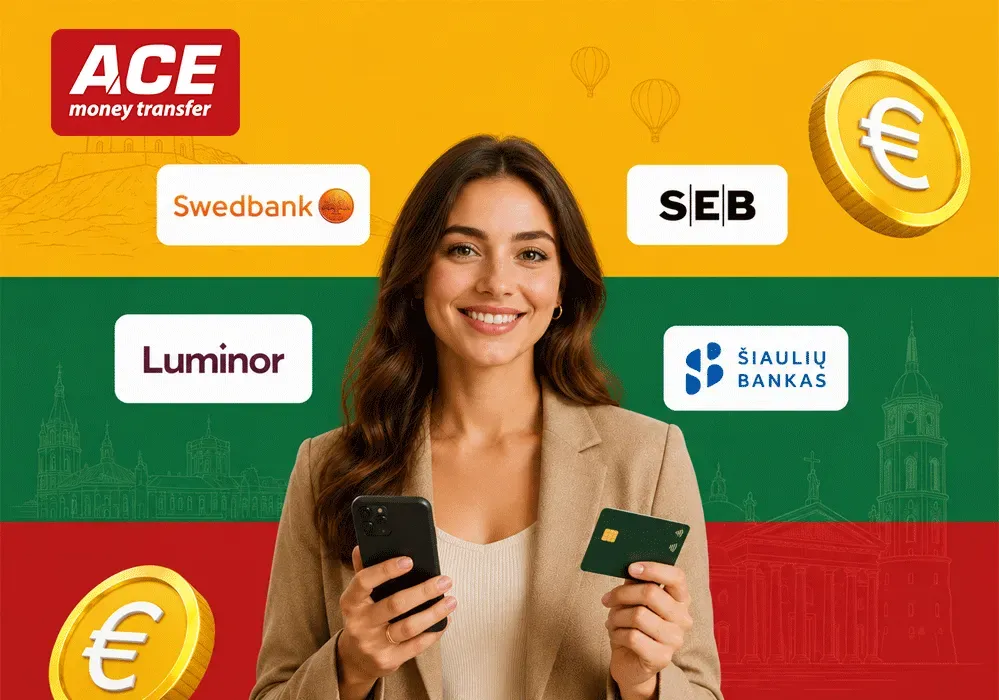
Lithuania has one of the fastest-growing and most innovative banking sectors in Europe. As a member of the European Union and the Eurozone, the country benefits from a highly regulated financial environment, modern banking infrastructure, and seamless integration with European financial markets. The Bank of Lithuania oversees the banking sector, ensuring stability, transparency, and consumer protection. Over the past decade, Lithuania has become a major fintech hub in Europe, attracting digital banks, payment providers, and financial technology companies from around the world. Traditional banks continue to play a crucial role in personal and business banking, while digital-first institutions are transforming how customers access financial services. This guide explores the best banks in Lithuania in 2026 and compares their services, strengths, and international reach.
Choosing the right bank in Lithuania is important because financial institutions differ in account fees, lending products, customer support, digital capabilities, and international banking services. Their daily banking services and low fees can also vary significantly by bank. The Bank of Lithuania provides an official tool to compare bank fees and services. Some banks specialise in retail banking and mortgages, while others focus on business banking, investments, or digital financial solutions. A suitable banking partner can help you manage your money efficiently, access credit when needed, and enjoy smooth domestic and international transactions. Banks in Lithuania must also offer a basic payment account capped at €1 per month.
Lithuania is one of Europe's leaders in digital financial services. Most banks offer highly advanced online banking platforms, mobile applications, instant payments, and digital account management tools that allow customers to complete most banking activities remotely.
As an export-oriented economy and a member of the European Union, Lithuania relies heavily on international banking services. Businesses frequently conduct cross-border transactions, while many Lithuanians living abroad regularly send money home, making efficient international payment services increasingly important. International users should compare how they pay, transfer charges, and ATM cash withdrawal limits across other banks.
Swedbank Lithuania, established in the country in 2005 through the acquisition of local banking operations, is one of the largest banks in Lithuania; it is part of Swedbank, which is headquartered in Sweden, and as of 2025 holds a 36.40% market share in Lithuania.
Broad retail banking services combined with digital banking through its mobile app and internet bank, supporting everyday payments, account management, and other banking needs.
Excellent mobile banking platform
Extensive ATM network
Strong mortgage products
High customer trust
Some premium services involve additional fees
Branch visits may require appointments
Swedbank operates across Sweden, Estonia, Latvia, and Lithuania, serving millions of customers. It is best for families, professionals, homeowners, and customers seeking everyday banking and savings accounts.
SEB Bank Lithuania, founded in 1990 through the establishment of local operations and later integration into Sweden's SEB Group, operates as AB seb bankas, a subsidiary of the Swedish SEB Group, ranks as the third largest bank in Lithuania, and provides financial advisory and liquidity management services.
Strong balance as a universal bank with retail, private, and corporate banking capabilities, alongside investment services.
Advanced digital banking tools
Strong business banking solutions for business customers
Reliable customer support and liquidity management services
Comprehensive investment products with financial advisory
Some service charges can be higher
Mortgage approval processes can take time
SEB operates across the Nordic and Baltic regions and serves customers throughout Europe. It is best for businesses, investors, professionals, and those focused on entrepreneurship who need long term financing solutions.
Šiauli? Bankas, founded in 1992, is the largest Lithuanian-owned commercial bank and one of the top banks among Lithuanian banks, with total assets of about EUR 4.6 billion.
Strong local expertise and customer-focused banking services.
Strong local market knowledge
Competitive savings products
Reliable customer service
Growing digital banking capabilities
Smaller international network
Fewer branches than major Nordic banks
The bank primarily operates in Lithuania with international correspondent banking partnerships. It is best for local customers, including families and SMEs looking for loans and deposit products.
Luminor Bank, founded in 2017 through the merger of Nordea and DNB Baltic operations, is one of the largest banks in the Baltic region.
Strong regional banking expertise with modern financial solutions.
Excellent digital banking platform
Strong mortgage services
Competitive lending products
Reliable customer support
Limited branch network
Some premium services carry higher fees
Luminor operates across Lithuania, Latvia, and Estonia. It is best for homeowners, professionals, and businesses operating in the Baltic region.
Revolut Bank, founded in 2015 and licensed in Lithuania since 2018, has become one of the country's most recognised digital banking institutions.
Digital-first banking with multi-currency accounts, low fees for currency exchange, and affordable international spending.
Easy account opening
Excellent mobile app
Multi-currency support
Low-cost international transfers
No traditional branch network
Limited face-to-face customer support
Revolut serves customers across more than 35 countries worldwide. It is best for travellers, expatriates, freelancers, and digital banking users who want to start managing money across borders with fewer challenges.
Citadele Bank, founded in 2010 following the restructuring of Parex Bank, has expanded its operations throughout the Baltic region.
Customer-focused banking with innovative digital services.
User-friendly banking app
Fast account opening process
Competitive lending products
Strong customer service
Smaller market share
Limited branch network
Citadele operates across Latvia, Lithuania, and Estonia. It is best for young professionals, entrepreneurs who need short-term financing solutions, and retail banking customers.
Medicinos Bankas, founded in 1992, is one of Lithuania's oldest privately owned, Lithuania-based banks.
Flexible banking solutions with strong customer relationships.
Personalised customer service
Competitive financial products
Strong local expertise
Growing digital capabilities
Smaller national footprint
Limited international operations
The bank primarily operates within Lithuania while maintaining international banking partnerships. It is best for individuals and small businesses seeking a broad range of local banking products.
Urbo Bankas, originally founded in 1992 and formerly known as Medicinos Bankas before its rebranding, is a growing local banking institution.
Modern local banking with customer-focused financial services.
Personalised banking approach
Flexible financing solutions
Improving digital services
Strong customer support
Smaller branch network
Limited international reach
Urbo Bankas primarily serves Lithuanian customers while maintaining international payment capabilities. It is best for SMEs looking for short term banking support and local customers who need daily banking services.
European Merchant Bank, founded in 2018, is a specialised digital bank with an offering focused on business clients rather than retail users.
Digital banking solutions specifically designed for businesses.
Business-focused banking services
Strong digital platform
Fast account management
International payment capabilities
Limited retail banking services
Smaller customer base
EMBank serves clients across the European Economic Area. It is best for startups, SMEs, and international businesses.
Paysera, founded in 2004 and later obtaining a banking licence through its financial-services expansion, is one of Lithuania's most successful fintech institutions.
Low-cost payments and international money transfer solutions with low fees to pay and send transfers across borders.
Affordable transfer fees
Excellent payment solutions
User-friendly mobile app
Strong fintech innovation
Limited traditional banking services
No extensive branch network
Paysera serves customers in more than 180 countries through its payment network. It is best for freelancers, online businesses, and international payment users.
Lithuania continues to strengthen its position as one of Europe's leading fintech and digital banking hubs. Banks are investing heavily in innovation, cybersecurity, and customer-focused digital solutions to remain competitive in a rapidly evolving financial environment. This overview reflects how commercial banks and fintech institutions are both shaping the sector.
According to the Bank of Lithuania, the country’s central bank, Lithuania remains one of Europe's most attractive destinations for fintech companies due to its supportive regulatory environment and efficient banking licence framework. This has encouraged the growth of digital banks and payment providers across the country.
Digital payments continue to expand rapidly throughout Lithuania, with consumers increasingly using mobile wallets, instant payments, and online banking platforms. Open banking initiatives are also enabling customers to access more integrated and personalised financial services.
International money transfers remain important for Lithuanian families, expatriates, students, and professionals working abroad. Reliable remittance services help ensure funds reach recipients quickly and securely.
ACE Money Transfer enables customers to send money to Lithuania quickly and securely through trusted payment channels and banking networks, helping recipients receive funds without unnecessary delays.
Through its easy-to-use website and mobile application, ACE Money Transfer allows users to send money anytime and from anywhere, making international transfers more convenient than traditional methods.
Lithuania's banking sector offers an excellent combination of stability, innovation, and international connectivity. Swedbank Lithuania and SEB Bank Lithuania continue to dominate the market through their strong financial foundations and comprehensive service offerings, while Šiauli? Bankas provides a strong local alternative. The best choice depends on the range of products you need, from insurance and pensions to business banking. Digital institutions such as Revolut and Paysera are reshaping the banking landscape with innovative technology-driven solutions, while traditional providers may appeal more to readers comparing banks in Lithuania with other banks on branch access and broader in-person service. As digital banking adoption continues to accelerate and international financial connectivity becomes increasingly important, selecting the best bank in Lithuania can help you enjoy better financial management, enhanced convenience, and more efficient cross-border transactions.
Swedbank Lithuania is commonly regarded as one of the best banks in Lithuania due to its large customer base, strong digital banking platform, and comprehensive financial services.
Revolut Bank, Swedbank Lithuania, SEB Bank Lithuania, and Paysera are among the leaders in digital banking innovation and mobile financial services.
SEB Bank Lithuania, Luminor Bank, and European Merchant Bank are strong choices for businesses because of their corporate banking and international payment solutions. Some banks also support business customers with liquidity management services, loans, and longer-term growth needs.
Swedbank, SEB Bank, Revolut Bank, and Paysera offer strong international banking and cross-border transaction capabilities.
Yes, most banking institutions in Lithuania allow EU and non-EU residents to open accounts by providing valid identification documents, proof of address, and any additional documentation required under Lithuanian and EU banking regulations. Banks will verify your identity with valid ID and, for non-residents, a valid visa or residence permit. A taxpayer identification number may also be required for account registration. Proof of employment or income is often requested by banks. The EU deposit guarantee scheme protects eligible deposits up to €100,000 per account holder.
This information is correct as of the time of publication and is subject to change.
Disclaimer: This article is intended for general informational and educational purposes only and should not be construed as legal, regulatory, tax, business, or financial advice. While reasonable efforts have been made to ensure that all facts, figures, and data are accurate and valid as of the date of publication, no warranty or guarantee is given as to the ongoing completeness, accuracy, or currency of the information.
The content is based on information available at the time of publication. Regulations, government policies, market conditions, and service offerings may change over time and vary across jurisdictions and providers. As a result, some information may no longer be current or applicable. Readers should independently verify all information and consult qualified professional advisors before making any financial, legal, or business decisions.