24 Oct 2025
If you’re living in the UK or have loved ones in India, understanding the time difference between India and the UK is crucial, especially when it comes to scheduling phone calls, meetings, or managing international transactions. Whether you're an expat in the UK, working remotely, or sending money to India, knowing the local time and time zone differences can save you from delays and confusion. The Indian Standard Time (IST) operates without any daylight saving adjustments, which sets India apart from countries like the UK, where time shifts between standard time (GMT) and daylight saving time (BST).
Here, we’ll dive deep into the time zone differences, remittance timing, and how you can efficiently manage cross-border transactions or daily activities with a clear understanding of India’s local time.
India follows Indian Standard Time (IST), which is UTC +5:30 year-round. Unlike the UK, which alternates between Greenwich Mean Time (GMT) in the winter and British Summer Time (BST, UTC +1) during the summer months, India maintains a constant time zone.
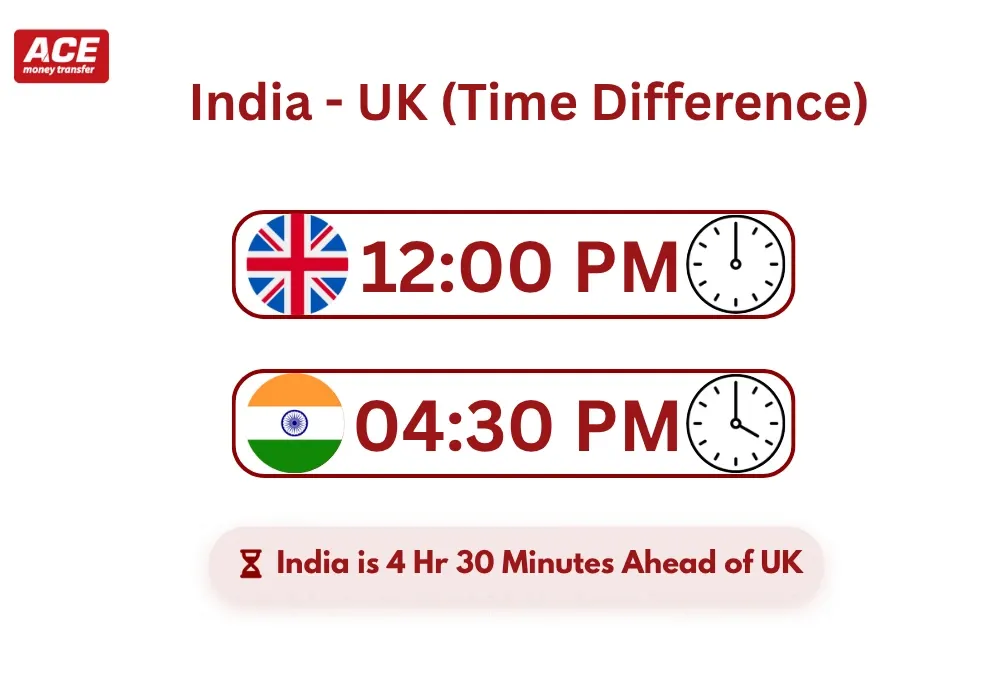
India’s time zone, IST, is 5 hours and 30 minutes ahead of GMT, and during the UK’s daylight saving period, IST becomes 4 hours and 30 minutes ahead of BST. This time difference may not seem huge, but it can affect your ability to coordinate with family, business partners, or when you’re sending remittances across borders.
Here’s a simple breakdown of the time difference between India and the UK:
| Country | Time Difference with India | Local Time in India (IST) | |
UK | UTC -5.5 hours | 12:00 PM | 6:30 AM (in winter) |
UK (Summer) | UTC -4.5 hours | 12:00 PM | 7:30 AM (BST) |
Australia | UTC +4.5 hours | 12:00 PM | 7:30 AM (previous day) |
Germany | UTC +4.5 hours | 12:00 PM | 7:30 AM (CET) |
France | UTC +4.5 hours | 12:00 PM | 7:30 AM (CET) |
Italy | UTC +4.5 hours | 12:00 PM | 7:30 AM (CET) |
Understanding the difference in time between India and the UK is essential when managing remittances. Time plays a significant role in the processing speed of money transfers, as different service providers have varying operating hours.
Here are some important factors to consider when sending money to India from the UK:
According to the Reserve Bank of India, remittances in India are processed efficiently during working hours, and delays are common when transactions happen outside these times.
To avoid delays in your money transfer, always initiate the transfer well before the closing hours in the UK, and check with your service provider regarding their cutoff times.
India’s unique approach of using a single time zone, Indian Standard Time (IST), across the entire country simplifies the scheduling process. Whether you’re in Bangalore, Mumbai, or Goa, the current time in India will be the same, unlike larger countries like the USA or Russia, which have multiple time zones.
This consistency across India makes managing schedules and remittances far simpler. However, there are a few other factors to consider:
To make sure your money is transferred efficiently, here’s a quick guide on the best time to send money from the UK to India:
For example, if it's 11:00 AM GMT in the UK, it will be 4:30 PM IST in India, which is a good time to initiate transactions so that the receiving bank or service provider can process them promptly.
A time zone calculator can be an invaluable tool for expats and anyone coordinating activities between the UK and India. By simply entering your current location and the destination (India), you can instantly calculate the exact time in both places. This tool can help you:
Understanding India’s time zone and time difference with the UK helps expats, business people, and anyone involved in international transactions make more informed decisions. Whether you’re sending money, scheduling meetings, or planning vacations, knowing when and how the time zones differ can make a huge difference in efficiency.
Invite friends to use ACE and get rewarded every time they send home. It’s free, instant, and boosts your earnings while helping others.
India follows Indian Standard Time (IST), which is UTC +5:30, and it does not observe daylight saving time.
India is 5 hours and 30 minutes ahead of the UK during standard time (GMT) and 4 hours and 30 minutes ahead when the UK follows British Summer Time (BST).
It’s best to initiate your transfer early in the UK’s business day, ideally before 3:00 PM GMT, so it can be processed during Indian working hours.
India uses Indian Standard Time (IST) throughout the entire country, despite its vast geographical spread, to maintain consistency and avoid confusion.
The time in Mumbai and Goa is the same as the rest of India since the whole country follows Indian Standard Time (IST).
With this understanding of India’s time zone and the time difference with the UK, you can better coordinate your calls, business transactions, and remittances. By planning your actions according to Indian Standard Time, you can avoid confusion and delays.