
ACE Money Transfer
ACE Money Transfer
05 Sep 2025
Whether you are booking a seaside hotel in Santorini, confirming a business meeting in Thessaloniki, or reaching family in Athens, knowing the correct greece area code and dialing format saves you from failed calls and frustrating dead ends. This guide covers everything you need: the country code, geographic and mobile prefixes, regional breakdowns, and formatting tips that work from anywhere in the world.
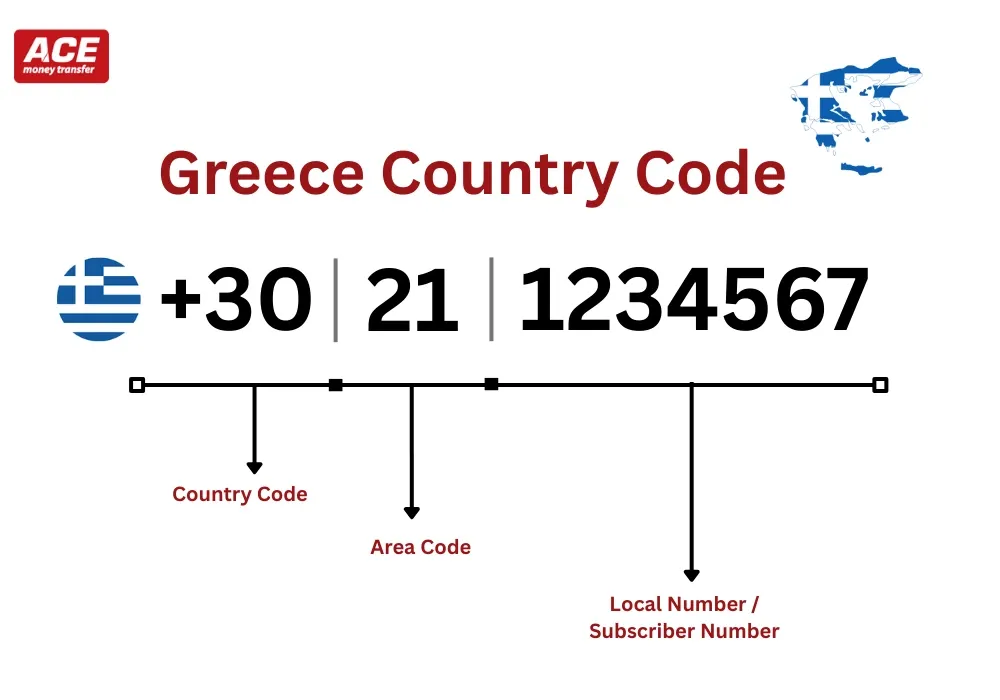
Greece's country code is +30, while GR is the correct ISO country code for Greece and EL is commonly used as the Greek language code rather than a country code. All standard Greek phone numbers are 10 digits long after the country code, and the country uses a closed dialing plan, meaning there is no leading "0" to add or remove. Here are the essentials:
The greece country code = +30 (or 30 after an exit code).
No leading "0" is used in Greek numbers (Greece uses a closed dialing plan).
Landlines: +30 + area code (2–4 digits) + local number (remaining digits, total = 10).
Mobiles: +30 69x xxx xxxx (always 10 digits after +30).
Common major city area codes: Athens uses the area code 21, Thessaloniki has the area code 231, Patras is assigned the area code 261, and Heraklion in Crete uses the area code 281.
Using EL instead of GR in a country field can trigger a validation error because that value is not the expected ISO country code.
Example from abroad: To call an Athens landline from Europe, dial 00 30 21 xxxxxxxx. From the US, dial 011 30 21 xxxxxxxx. To reach a Greek mobile from any country, dial +30 69x xxx xxxx.
The rest of this page explains exit codes, geographic numbers, toll free lines, regional area codes, and mobile prefixes in full detail.
Greece adopted a closed national numbering plan in the early 2000s, standardizing all telephone numbers around a fixed 10-digit format. This replaced the older open system where local calls used shorter numbers and a trunk prefix "0" was needed for long-distance dialing.
Here is what "closed dialing plan" means in practice:
All domestic calls use the full 10-digit number, including the area code, even for local calls.
No domestic trunk prefix "0" is required; numbers are dialed the same way across the country.
The basic structure breaks down as follows:
International format: +30 + 10-digit national number.
National format: 10 digits, beginning with a geographic or mobile prefix (2–4 digits for area codes, 3 digits for mobiles starting with 69x).
Greek phone numbers are 10 digits long after +30, and they fall into clear categories:
Geographic numbers (fixed lines tied to a city or region) always start with the digit 2.
Non-geographic numbers (toll free, shared cost, premium, and short codes) start with other digits, primarily 8 or 9.
Geographic landline numbers in Greece begin with a 2. For example, an Athens landline in international format looks like +30 21 0XXXXXXX (country code + area code 21 + 8-digit subscriber number), while a mobile number appears as +30 693 XXX XXXX (country code + mobile prefix + 7-digit subscriber number).
To make international calls to Greece, the sequence is straightforward: dial your country's exit code, then the greece country code (+30), Greece's international dialing code, then the area code or mobile prefix, and finally the local number.
The exit code is the international access code used to leave the originating country's network. Common examples include:
00 - most of Europe, including Finland, India, Pakistan, Bangladesh, and Nepal. French and German callers also use 00.
011 - United States and Canada.
0011 - Australia.
010 - Japan.
Follow these step-by-step examples:
From Finland, India, Pakistan, Bangladesh, or Nepal to an Athens landline: 00 30 21 xxxxxxxx.
From the US to a Thessaloniki landline: 011 30 231 xxxxxxx. Dial 011 before +30 when calling from the US.
From the UK to a Greek mobile: 00 30 69x xxx xxxx or +30 69x xxx xxxx.
On mobile phones, you can usually replace the exit code with "+", with the plus sign serving as the sign used in place of the exit code on most smartphones, so calling becomes +30 21 xxxxxxxx (Athens) or +30 69x xxx xxxx (mobile).
When calling from abroad, do not add a leading zero to Greek numbers. Dialing +30 021… will fail.
VoIP and messaging apps typically require the full international format (+30 + 10 digits) when adding contacts.
Different countries use different exit codes, but the country code remains +30 everywhere. Here is how to dial Greece from major origins:
United States / Canada: dial 011 30 + area code + local number.
United Kingdom / Ireland: dial 00 30 + area code + local number.
Australia: dial 0011 30 + area code + local number.
Germany / France / Italy / Spain: dial 00 30 + area code + local number.
Fully written examples:
From the US to Heraklion: 011 30 281 xxxxxx.
From the UK to Patras: 00 30 261 xxxxxx.
From Australia to Corfu: 0011 30 2661 xxxxxx.
When using "+" on smartphones, the dialing pattern becomes identical regardless of origin: +30 + the Greek number. This is the simplest approach for people who travel frequently.
International call charges - not numbering - are what differ by carrier and country. Check with your local telecom provider for current per-minute rates to Greece before making extended calls.
In Greece, geographic numbers are landline phone numbers whose prefix identifies a specific city or region. Regional area codes in Greece range from 2 to 4 digits long, and the length follows a clear logic:
Athens is the only 2-digit geographic area code (21), followed by an 8-digit subscriber number.
Other major cities use three digit codes (e.g., 231, 241, 261) with 7-digit subscriber numbers.
Smaller towns and rural areas generally have four digit codes with 6-digit subscriber numbers.
Regardless of the pattern, the total length after +30 is always 10 digits for geographic numbers.
Greek area codes roughly follow administrative regions and prefectures: Attica (Athens and suburbs), Central Macedonia (Thessaloniki and surrounding areas), Thessaly, Peloponnese, Aegean Islands, Ionian Islands, Epirus, Crete, and others.
Knowing the area code helps identify where a call originates or is destined, which is useful for travelers booking accommodation and for verifying contacts when sending money or reserving ferries. In every case, Greek geographic numbers start with 2 (landlines), while mobiles start with 69x.
This section lists the most commonly dialed Greek area codes for travelers, expats, and businesses. Examples of area codes in Greece include 210 for Athens and 2310 for Thessaloniki - though technically 21 and 231 are the area codes, with the following digit being the start of the subscriber number.
Mainland cities:
Athens metro (Greater Athens and much of Attica): area code 21; international format: +30 21 xxxxxxxx.
Thessaloniki (Central Macedonia): area code 231; format: +30 231 xxxxxxx.
Patras (West Greece): area code 261; format: +30 261 xxxxxxx.
Larissa has the area code 241 (Thessaly); format: +30 241 xxxxxxx.
Crete cities:
Heraklion: 281 xxxxxx.
Chania: 2821 xxxxxx.
Rethymno: 2831 xxxxxx.
Popular islands:
Rhodes: 2241 xxxxxx.
Kos: 2242 xxxxxx.
Santorini (Thira): 2286 xxxxxx.
Mykonos: 2289 xxxxxx.
Corfu (Kerkyra): 2661 xxxxxx.
Zakynthos: 2695 xxxxxx.
A simple table of major city and island prefixes can also help readers scan this reference more quickly.
All of the above accept the same international pattern: +30 + listed prefix + remaining digits, with no leading 0. Business directories and operators in english or greek may still reference broader regional groupings (Peloponnese, Central Greece, Ionian Islands), but it is the area code that matters for dialing.
Beyond the main tourist destinations, Greek area codes are organized by wider regions covering multiple prefectures. Here is a summary of how the major area code blocks correspond to specific zones:
Central Greece and Aegean Islands: 22xx codes (e.g., 223x for Evrytania and Phthiotis, 225x for Lesbos and Lemnos, 227x for Chios, Samos, and Icaria, 229x for parts of Attica outside the 21 zone).
Central Macedonia and Florina: 23xx codes (e.g., 232x Serres, 233x Imathia, 235x Pieria, 237x Chalkidiki, 238x Pella and Florina, 239x parts of Chalkidiki and Thessaloniki).
Thessaly and West Macedonia: 24xx codes (e.g., 242x Magnesia and Northern Sporades, 243x Trikala, 246x West Macedonia except Florina, 249x rural Larissa).
East Macedonia and Thrace: 25xx (e.g., 252x Drama, 253x Rhodope, 254x Xanthi, 255x Evros, 259x rural Kavala).
West Greece, Ionian Islands, and Epirus: 26xx (e.g., 261 Patras, 262x Ilia, 264x Aetolia–Acarnania and Lefkada, 266x Corfu and Thesprotia, 268x Arta and Preveza, 269x Achaea and Zakynthos).
Peloponnese and Crete: 27xx–28xx (e.g., 271 Tripoli area, 272x Messenia, 273x Laconia and Kythera, 281 Heraklion, 282x Chania, 283x Rethymno, 289x rest of Heraklion prefecture).
Travelers rarely need to memorize the entire mapping, but businesses and logistics providers may find region-based area code knowledge essential. Some numeric blocks within these ranges are intentionally unused, which is common in national numbering plans worldwide.
Greek landline numbers start with 2, but non-geographic numbers use different leading digits - primarily 6, 8, and 9.
Mobile numbers in Greece start with 69x (e.g., 690, 693, 694, 697, 698, 699). They consist of 10 digits after +30: +30 69x xxx xxxx. Due to number portability, the exact 69x prefix no longer guarantees which mobile network or carrier is used. People can switch providers and keep the same number. Wind Hellas is one of the better-known mobile operators in Greece. Wind is also among the established providers in the market.
Toll free and shared-cost numbers follow their own patterns:
Toll free numbers use the 800 prefix inside Greece (e.g., 800 xxx xxxx). Callers usually dial them only domestically, not from abroad.
Shared-cost numbers start with 801. The caller pays roughly the equivalent of a local call, while the business absorbs the rest.
Premium-rate numbers often start with 90x or other 80x ranges; callers may pay higher per-minute fees.
Short codes and special services use much shorter numbers:
Historical examples include 104 (ELPA roadside assistance) and 131 (OTE directory), though many older short codes were replaced or migrated to standard national numbers after around 2002.
Modern emergency short numbers such as 112 (EU-wide emergency), 100 (police), and 166 (ambulance) are dialed without +30 or any area code.
Most non-geographic numbers are intended for use within Greece. Calling them from abroad may not work or may incur unusual charges.
Accurate greece area code and country code usage is important beyond just making a call - it directly affects payments, bookings, and security. Here is why it matters:
Many financial and fintech platforms use a verified phone number as part of account security. Entering a Greek number in the wrong format (missing +30, wrong area code, extra leading zero) can delay identity checks or SMS confirmations.
Hotels, car rentals, and ferry operators in Greece often require a mobile or landline contact number. Using the correct area code ensures foreign agencies and local partners can reach you without failed calls.
Recognizing that a number is genuinely Greek (starting with 2 or 69 after +30) helps users identify suspicious contacts. Cross-checking the area code with the claimed location - for example, Mykonos (2289) versus Athens (21) - can flag inconsistencies in a listing or message.
Best practices to follow:
Always store Greek contacts in full international format (+30 + 10 digits).
Double-check that no trunk "0" is saved before the area code.
For business contacts, verify that the area code matches the company's published office location.
Clear, consistent formatting reduces misdials and problems with online forms. Many people find that saving numbers in a standard pattern avoids confusion when switching between domestic and international calling.
Concrete formatting recommendations:
Always include +30 when you store or share a Greek number internationally.
Write numbers in clean blocks separated by spaces: +30 21 xxxxxxxx (Athens), +30 231 xxxxxxx (Thessaloniki), +30 69x xxx xxxx (mobiles).
Avoid parentheses around area codes and avoid slashes, dashes, or local punctuation that some web forms may reject.
When filling out online forms, the typical expectation is:
Country field set to "Greece (+30)", followed by a 10-digit national number without the leading +30; some systems also expect the country value GR and may return an error if EL is entered instead.
No additional 0 at the start of the 10 digits. For instance, entering "0210…" is incorrect. The correct entry is "21…" plus the rest, totaling 10 digits.
Greece's closed dialing plan simplifies life for expats:
The same 10-digit national number works from anywhere inside Greece, without thinking about local vs. long-distance dialing.
Saving every number in international format future-proofs your contacts if you travel or change SIM cards.
At the end of the day, the key is simple: +30, correct area code, total of 10 digits, no leading zero.
Below are answers to the most common questions about calling Greece and using the correct code.
What is the country code for Greece? The country code is +30. It must precede every Greek number when you dial from abroad.
Do I ever dial a leading "0" for Greece? No. Greece has no national trunk prefix for domestic dialing, so there is no 0 to omit or add. To call Greece, dial your country's exit code followed by +30 and the local number - nothing more.
How many digits does a Greek phone number have? Standard Greek landline and mobile numbers have 10 digits domestically, and 12–13 digits when written in international format including +30.
How can I tell if a number is mobile or landline? Landlines start with 2 (after +30), mobiles start with 69x, and toll free and special services generally begin with 8 or 9.
Can I call Greek toll free numbers from outside Greece? In many cases, Greek toll free and short codes work only domestically. From abroad, they may not connect or may incur normal or higher charges.
Always use +30, verify the area code, and check with your carrier for international calling rates before placing your call. Bookmark this page so you can quickly find the right code next time you need to reach someone in Greece.