ACE Money Transfer
ACE Money Transfer
21 May 2026
Sending money to a Raiffeisen Bank account should be a three-minute task, not a scavenger hunt through bank websites and support lines. The only thing standing between you and a smooth transfer is the right Raiffeisen Bank SWIFT Codes — and they vary depending on which country the recipient’s account is based in. This guide gives you every active Raiffeisen SWIFT code across Central and Eastern Europe, explains exactly how each code works, and shows you how to use the information correctly for fast, accurate international transfers.
Raiffeisen Bank is not a single bank in the conventional sense. Raiffeisen Bank International AG (RBI), headquartered in Vienna, Austria, is the parent holding company — but beneath it sit entirely separate legal entities registered in each country: Raiffeisen Bank S.A. in Romania, Raiffeisen Banka a.d. in Serbia, Raiffeisenbank a.s. in Czech Republic, and so on.
Each subsidiary is incorporated under national law, regulated by a national central bank, and registered independently on the SWIFT network with its own BIC. As of 2025, RBI's network covers Austria and 11 CEE markets, holding a top-5 market position in 9 of those countries and serving approximately 18 million customers. Every one of those 12 markets carries a different SWIFT code.
This is the source of the most common error people make: using the Austrian head office code — RZBAATWWXXX — for a transfer intended for a Romanian or Serbian recipient. The Austrian code is valid, but it will not reach a Raiffeisen Romania or Raiffeisen Serbia account. Always match the code to the country, not just the brand.
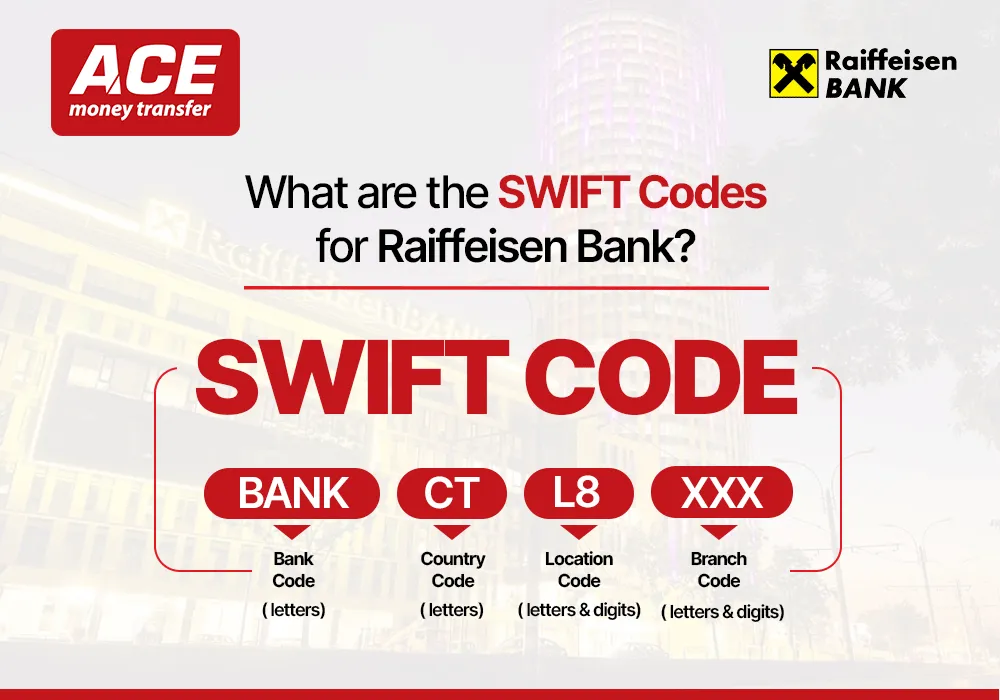
Every SWIFT/BIC code — no matter which bank issues it — follows the same ISO 9362 format. Here is how Raiffeisen's codes break down in practice:
| Character Position | Length | Meaning | Raiffeisen Romania Example |
|---|---|---|---|
| 1 – 4 | 4 letters | Bank identifier (institution code) | RZBR |
| 5 – 6 | 2 letters | Country (ISO 3166-1 alpha-2) | RO = Romania |
| 7 – 8 | 2 alphanumeric | Location / city code | BU = Bucharest |
| 9 – 11 | 3 characters (optional) | Branch code (XXX = head office) | XXX |
Putting it together: RZBRROBUXXX = RZBR (Raiffeisen Romania) + RO (Romania) + BU (Bucharest) + XXX (head office). An 8-character code without a branch suffix — written as RZBRROBU — means exactly the same thing. When uncertain, always use the head office code ending in XXX, as it routes successfully to any standard account within that subsidiary.
The table below covers every RBI network country currently operating under the Raiffeisen brand, drawn from the official SWIFT BIC directory and RBI's published unit addresses. Verify any code with the recipient or Raiffeisen directly before sending a large or time-sensitive payment.
| Country | Legal Entity | SWIFT/BIC | Registered City |
|---|---|---|---|
| Austria | Raiffeisen Bank International AG (Head Office) | RZBAATWWXXX | Vienna — Am Stadtpark 9 |
| Austria | RBI AG (Payments Operations) | RZBAATWWPOP | Vienna |
| Czech Republic | Raiffeisenbank a.s. | RZBCCZPPXXX | Prague — Hvezdova 1716 |
| Hungary | Raiffeisen Bank Zrt. | UBRTHUHBXXX | Budapest — Vaci út 116–118 |
| Slovakia | Tatra Banka a.s. (RBI subsidiary) | TATRSKBXXXX | Bratislava — Hodzovo Namestie 3 |
| Poland | Raiffeisen Bank Polska S.A. | RCBWPLPWXXX | Warsaw |
| Country | Legal Entity | SWIFT/BIC | Registered City |
|---|---|---|---|
| Romania | Raiffeisen Bank S.A. | RZBRROBUXXX | Bucharest — Calea Floreasca 246C |
| Serbia | Raiffeisen Banka a.d. | RZBSRSBGXXX | Belgrade — Djordja Stanojevica 16 |
| Croatia | Raiffeisenbank Austria d.d. | RZBHHR2XXXX | Zagreb — Magazinska cesta 69 |
| Bosnia & Herzegovina | Raiffeisen Bank d.d. BIH | RZBABA2SXXX | Sarajevo — Zmaja od Bosne bb |
| Bulgaria | Raiffeisen Bank (Bulgaria) EAD | RZBBBGSFXXX | Sofia |
| Albania | Raiffeisen Bank Sh.A. | SGSBALTXXXX | Tirana — Rruga Tish Daija |
| Kosovo | Raiffeisen Bank Kosovo J.S.C. | RBKOXKPRXXX | Pristina — Robert Doll St. 99 |
Romania is one of the highest remittance-receiving nations in the EU. In 2024 alone, Romanians abroad sent approximately EUR 6.7 billion back home — close to 2% of Romania's GDP, and roughly two and a half times the figure recorded a decade ago. Nearly half of all those transfers originated from the UK and Germany.
Romania had the highest share of emigrants among all EU states in 2024, with 4.6 million people — 24% of the population — living abroad. A significant share of those diaspora transfers land in Raiffeisen Bank Romania accounts, making RZBRROBUXXX one of the most frequently needed SWIFT codes in the UK remittance corridor.
| Transfer Detail | Information |
|---|---|
| SWIFT/BIC Code | RZBRROBUXXX |
| Full Legal Name | Raiffeisen Bank S.A. |
| Head Office Address | Sky Tower Building, Calea Floreasca 246C, Sector 1, Bucharest |
| Country ISO Code | RO (Romania) |
| IBAN Format | RO + 2 check digits + RZBR + 16 alphanumeric digits |
| IBAN Example | RO41RZBR0000060025458857 |
| EU / SEPA Member | Yes — IBAN mandatory for all euro transfers |
| Moody's Credit Rating | Baa1 (stable) |
| 2024 Market Position | 5th largest bank in Romania by total assets |
| 2024 Total Assets | 96,609 million RON (approx. €19 billion) |
Global Finance Magazine named Raiffeisen Bank Romania's Best Bank in 2025, recognising its asset growth of 10% through Q3 2024 to €14.9 billion and its fivefold increase in digitally acquired customers following the launch of its improved remote onboarding platform.
Most people treat a SWIFT transfer like sending an email: type in the details and click send. What actually happens behind the scenes is more involved, and understanding it helps you diagnose delays before they become headaches. Correct SWIFT routing also helps funds reach the correct international bank destination accurately and securely.
Understanding that process also matters because SWIFT codes help verify recipient institutions and reduce lost or misdirected international wires.
Your bank cross-references Raiffeisen Bank SWIFT Codes such as RZBRROBUXXX against the live global BIC directory before processing the payment. If the code is inactive, invalid, or entered incorrectly, the transfer will usually be rejected before it even leaves your bank.
Your bank creates a standardised payment instruction message containing your details, the recipient's IBAN, the amount, the currency, and the routing information. This message travels encrypted across the SWIFT network.
If your bank and Raiffeisen Bank do not hold accounts with each other directly, the payment routes through one or more correspondent banks — intermediaries that maintain accounts with both sides. Each correspondent takes the payment one step closer to Raiffeisen Bank.
Raiffeisen Bank's system receives the MT103 message, validates that the IBAN matches an active account, applies any required compliance checks, and credits the funds to the recipient. The recipient receives a notification and the transaction appears in their account.
If you are sending money to a Raiffeisen account in any EU country, you will almost certainly need both. They answer different questions:
| Question | The Code That Answers It | Example for Raiffeisen Romania |
|---|---|---|
| Which bank is receiving this money? | SWIFT/BIC Code | RZBRROBUXXX |
| Which account should the money go to? | IBAN | RO41RZBR0000060025458857 |
| What country is the bank in? | Encoded in both (country code in chars 5–6 of SWIFT; country prefix of IBAN) | RO in both |
| Is this within the SEPA zone? | Determines whether IBAN is mandatory | Yes — Romania is in SEPA |
A common misconception is that providing the IBAN alone is sufficient for international transfers to Romania. Within SEPA, IBAN is enough for euro payments between EU banks — but for transfers originating from outside the EU (the UK, Canada, Australia, the US), the receiving bank almost always requires the SWIFT code alongside the IBAN to complete the routing. When in doubt, include both.
Raiffeisen Bank issues both 8-character head office codes and 11-character branch-specific codes. For the vast majority of personal and business transfers, the head office code works perfectly. Here is a straightforward guide:
| Transfer Type | Recommended Code | Reason |
|---|---|---|
| Sending to a standard Raiffeisen Romania retail account | RZBRROBUXXX (head office) | Works for all standard accounts; branch is resolved via IBAN |
| Sending to Raiffeisen Serbia | RZBSRSBGXXX (Serbia head office) | Separate legal entity — Austrian or Romanian code will not work |
| Raiffeisen wholesale / treasury payments (corporate) | Confirm the specific service code with RBI directly | Some divisions use department-level codes (e.g. RZBAATWWPOP) |
| Recipient has given you an 11-character code | Use exactly what the recipient has provided | Their bank has confirmed the correct code for their specific account |
| You only have the account number, not the branch | Use the 8-character head office code | SWIFT routes via IBAN regardless of branch |
Romanians working abroad sent around EUR 60 billion back home over the twelve years from 2013 to mid-2025 — more than twice the initially agreed value of Romania's National Recovery and Resilience Plan (PNRR). That staggering figure is driven by one of the most significant diaspora populations in Europe.
In 2025, Raiffeisen Bank Romania surpassed 2.33 million retail and corporate customers, with the number of individual clients growing at an accelerated pace throughout the year — 22% more new clients chose Raiffeisen Bank in 2025 compared to 2024. And 78% of those new clients opened their account entirely digitally — meaning a growing share of transfer recipients are mobile-first, digitally enrolled account holders.
This context matters for anyone sending money into Romania. The recipient is increasingly likely to be notified instantly on a mobile app, track the incoming transfer in real time, and use digital payment methods immediately upon receipt. Getting the SWIFT code right means the money arrives fast; getting it wrong means a 5–10 business day recall process while the diaspora member waits.
Yes, without hesitation. A SWIFT code is publicly listed information — Raiffeisen Bank International AG publishes its primary code RZBAATWW directly on its official legal documentation and corporate website. The SWIFT directory is open to any registered financial institution in the world.
A Raiffeisen Bank SWIFT Code identifies the bank, not you personally. It cannot be used to withdraw funds, access your account, or authorise outbound transactions. The only purpose of Raiffeisen Bank SWIFT codes is to direct international payments to the correct banking institution — exactly why they are meant to be shared with people sending you money.
What remains genuinely sensitive is your IBAN, online banking credentials, PINs, and one-time authentication codes. Those should never be shared carelessly. Raiffeisen Bank SWIFT codes: safe to share. Login credentials: always protect.
Bank-to-bank SWIFT transfers work reliably, but they come with costs that add up: flat transfer fees, exchange rate markups applied by intermediary banks, and settlement times of one to three business days. For anyone sending money to Romania regularly — whether to family, to a landlord, or to a business partner — those costs compound over time, and if the sender is wiring from a separate German Raiffeisen entity, RAEEDE31XXX is the SWIFT code for Raiffeisenbank EG in Germany. To understand the transfer landscape from the sender's side, the ACE Money Transfer blog article How to Send Money to Romania Online Safely covers the full picture: what information your recipient needs, how long transfers take through different channels, and how to compare costs before committing to a method.
ACE Money Transfer is an FCA-regulated payment institution serving over 1.3 million users across the UK, Europe, Canada, and Australia, with transfers to Romania available via bank deposit, cash pickup, and mobile wallet. Transfers are tracked in real time and fees are displayed upfront before you confirm — no hidden markups discovered after the fact, and current account funding may also depend on the currency offered, including GBP.
Raiffeisen Bank S.A. in Romania operates primarily under RZBRROBUXXX (head office). The bank may use service-specific branch codes for particular departments or transaction types, but for standard retail and corporate account transfers, RZBRROBUXXX is the correct code to use. If you have been given an 11-character code by your recipient, use that — it specifies a branch that their bank has confirmed for their account.
The three most common causes are: (1) the SWIFT code used belongs to a different Raiffeisen subsidiary (e.g. the Austrian code instead of the Romanian one); (2) the IBAN provided does not match an active account at Raiffeisen Romania; or (3) the recipient name does not match the IBAN under the Verification of Payee rules introduced in October 2025. Contact your sending bank first — they can provide the exact reason the transfer was returned, which speeds up any correction.
Technically, some banks will process a transfer using just a local account number and the SWIFT code. In practice, Raiffeisen Romania requires the IBAN for inbound international payments, and many sending banks outside the EU also require it. Providing the IBAN eliminates ambiguity and prevents delays. Your recipient can find their IBAN in the Raiffeisen Smart Mobile app or on their statement.
Yes. Tatra Banka a.s. (SWIFT: TATRSKBXXXX, Bratislava) operates as the RBI subsidiary in Slovakia. It trades under the Tatra Banka name rather than the Raiffeisen name in the Slovak market, but it is wholly owned by Raiffeisen Bank International AG. If you are sending to a Slovak Raiffeisen entity, TATRSKBXXXX is the correct code.
Ask your recipient to open their Raiffeisen app or log into online banking — the IBAN is displayed prominently in the account details section. Alternatively, they can find it on any account statement. Do not attempt to construct the IBAN manually from the account number: the format includes check digits that are calculated from the account number and country code, and a single error will cause the transfer to fail or be returned.
Disclaimer: This article is intended for general informational and educational purposes only and should not be construed as legal, regulatory, tax, business, or financial advice. The views expressed are those of the author and do not necessarily reflect the views or positions of ACE Money Transfer. While reasonable efforts have been made to ensure accuracy, no warranty is given as to the completeness, accuracy, or currency of the information. Services and practices mentioned may vary by provider and jurisdiction. Readers should consult qualified professional advisors before making any financial or business decisions.
Enjoy guaranteed competitive PKR exchange rates, ultra-fast transfers, and zero fee promotions directly to bank accounts and mobile wallets.