21 Oct 2025
Time zones can be tricky, especially when you’re living in one country and sending money to another. If you’re an expat in the UK, you may often ask, “What time is it at Canada?” to make sure your calls, business meetings, or remittances are at the right time. Canada spans several time zones, and understanding the present time in Canada now is crucial for staying connected with family or managing international transactions efficiently.
In this blog, we’ll dive into the time difference between the UK and Canada, provide insights on managing remittances, and offer a comprehensive breakdown of time across Canada’s major cities.
Knowing the time difference between the UK and Canada, especially for cities like Toronto, Vancouver, and Ottawa, helps expats effectively plan calls, business operations, and money transfers. Also time difference is important for south asian countries like Pakistan, India, and Nepal.
Canada’s vast geographical size means it spans six distinct time zones, from the Pacific coast to the Atlantic Ocean. Each of these time zones plays a vital role in the daily activities of people living in different parts of the country. Canada’s multiple time zones are essential for organizing work, communication, and even remittance services.
Here are the six primary time zones in Canada:
While the time differences can be significant between major cities, the Eastern Standard Time (EST) zone, which includes cities like Toronto, Ottawa, and Montreal, is most commonly referenced for international transactions and communication with the UK.
According to the Government of Canada, Canada’s vast landmass requires the use of multiple time zones, making time coordination essential for both local and international activities. For example, Toronto is 5 hours behind London (UK) during standard time.
Understanding the time difference between the UK and Canada is key for expats when scheduling calls, meetings, and money transfers. The time gap varies depending on whether the UK is on Greenwich Mean Time (GMT) or British Summer Time (BST), and Canada observes Daylight Saving Time (DST).
Here’s how the time difference works:
For example, if it’s 12:00 PM (noon) in London, it’s:
When the UK switches to British Summer Time (BST), the time difference reduces by one hour:
So, when it’s 12:00 PM (noon) in London during BST, it’s:
Here’s a city-specific table to clearly understand the time difference:
| City | Time Zone | Offset from GMT | |
Toronto | Eastern Standard Time (EST) | UTC -5 | 7:00 AM (Winter), 8:00 AM (Summer) |
Vancouver | Pacific Standard Time (PST) | UTC -8 | 4:00 AM (Winter), 5:00 AM (Summer) |
Ottawa | Eastern Standard Time (EST) | UTC -5 | 7:00 AM (Winter), 8:00 AM (Summer) |
Montreal | Eastern Standard Time (EST) | UTC -5 | 7:00 AM (Winter), 8:00 AM (Summer) |
Calgary | Mountain Standard Time (MST) | UTC -7 | 5:00 AM (Winter), 6:00 AM (Summer) |
Halifax | Atlantic Standard Time (AST) | UTC -4 | 8:00 AM (Winter), 9:00 AM (Summer) |
St. John's | Newfoundland Standard Time (NST) | UTC -3:30 | 8:30 AM (Winter), 9:30 AM (Summer) |
By understanding the present time in Canada now, you can easily schedule business calls, arrange family catch-ups, or send money at the right time.
Canada observes Daylight Saving Time (DST), which begins in mid-March and ends in early November. When DST starts, the clocks move forward by one hour. For example, when the UK moves to British Summer Time (BST) in late March, Canada also shifts its clocks ahead. This reduces the time difference by one hour, making it 4 hours between London and Toronto during summer months instead of 5 hours during winter.
Understanding these shifts helps ensure that you don’t miss an important call or transfer, especially if you’re working or sending remittances.
When you’re sending money from Canada to Pakistan, India, or Nepal, knowing the time difference helps ensure your transfer is processed faster and your loved ones receive funds when they need them most.
Time zones can affect bank processing hours, customer service availability, and even exchange rate updates — so timing your transfer wisely is key.
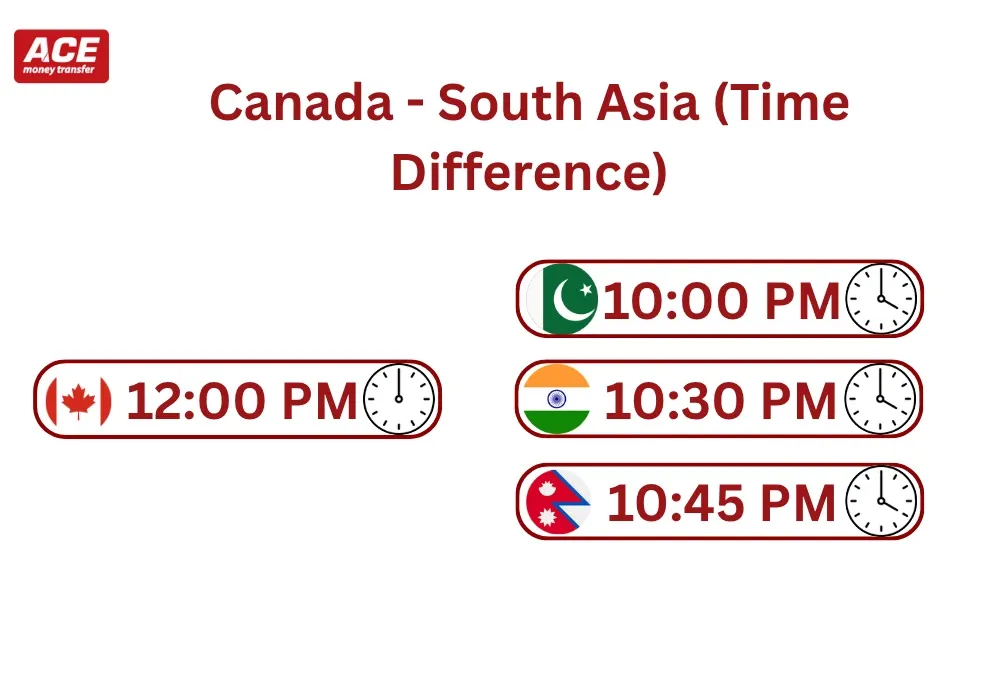
Below is the average time difference when sending money from Canada (Eastern Time) to Pakistan, India, and Nepal.
| Country | Time Zone | Time Difference from Canada (EST) | Example: When it’s 9:00 AM in Canada | |
Pakistan | Pakistan Standard Time (UTC +5) | +10 hours | 9:00 AM Canada | 7:00 PM Pakistan |
India | India Standard Time (UTC +5:30) | +10 hours 30 min | 9:00 AM Canada | 7:30 PM India |
Nepal | Nepal Standard Time (UTC +5:45) | +10 hours 45 min | 9:00 AM Canada | 7:45 PM Nepal |
Note: During Canadian Daylight Saving Time (March–November), clocks move forward by one hour (UTC −4), which shortens the time gap by one hour for all three countries.
Visit:
Send Money to Pakistan
Timing can make a real difference in how quickly your transfer is received — especially when banking systems or payout partners have specific working hours.
Most financial networks and money transfer systems process transactions during business hours.
Because of the 10–11-hour time gap, 9 AM in Canada equals 7–8 PM in Pakistan, India, and Nepal.
That’s when families are usually home and can confirm receipt instantly via wallet apps or SMS notifications.
If you send before noon (12 PM) Canada time, it’ll likely arrive same-day evening for your recipients.
Transfers sent after 6 PM Canada time usually arrive overnight (next morning) in South Asia.
This isn’t a problem for 24/7 services like ACE Money Transfer, but bank-linked transfers might experience a one-day delay.
| Tip | Why It Matters |
Send before 12 PM Canada time | Ensures your transaction hits daytime hours in South Asia for same-day delivery. |
Use ACE’s 24/7 platform | Avoids delays caused by banking hours — transfers can process instantly anytime. |
Track real-time rates | Currency values shift through the day. Morning hours often see steadier exchange rates. |
Avoid weekends/public holidays | Banks in Pakistan, India, and Nepal may not process on Saturdays/Sundays. |
Enable notifications | Get instant updates when your family receives money, no matter the time difference. |
If you send money from Toronto at 10:00 AM, your loved ones will likely receive it:
But if you send at 8:00 PM Canada time, it’s 6:00 AM in South Asia. Meaning recipients might not see the funds until later in the day or next morning.
Managing time zones isn’t just about remittances — it’s essential for business communication and personal calls. Whether you’re managing remote teams or keeping in touch with family, knowing the correct time in Canada will help you stay organized:
By staying informed about the time in Ontario, Canada, or the time of Montreal, you can avoid misunderstandings and delays.
Time management is critical, especially when you live in the UK and work with family or businesses in Canada. Understanding the time difference between the UK and Canada ensures smoother communication, faster money transfers, and better scheduling for your personal or professional needs.
With a clearer understanding of Canada time now, expats in the UK can optimize their activities without worrying about missing important deadlines or events.
Managing the time difference between the UK and Canada is essential for expats to stay efficient in managing remittances, work, and personal communications.
Yes, Canada is generally behind the UK by 4 to 8 hours, depending on the Canadian time zone and daylight saving time.
Yes, Canada observes daylight saving time (DST), but it begins and ends at different times than the UK.
During DST, the time difference is 1 hour less, so the UK and Canada are closer in time, with the gap being 4 hours between London and Toronto during the summer months.
The best time to send money from Canada to Pakistan, India, or Nepal is between 8:00 AM and 12:00 PM Canada time, which aligns with evening hours in those countries—ensuring same-day processing and faster recipient access.
Use world clock apps or time zone converters to check the live time in Canada and plan your transfers accordingly.
Between 8:00 AM and 12:00 PM Canada time, which is 5:00 PM to 9:00 PM in Pakistan.
Send between 8:00 AM and 12:00 PM Canada time to match 5:30 PM to 9:30 PM in India.
Send between 8:00 AM and 12:00 PM Canada time, which is 6:45 PM to 10:45 PM in Nepal.