
ACE Money Transfer
ACE Money Transfer
14 Sep 2026
The global banking industry is shaped by a handful of institutions so massive that their decisions ripple through every corner of the financial world. This article ranks the top 10 banks in the world by market capitalization as of mid-2026, focusing on publicly traded institutions whose stock prices and outstanding shares determine their value in the eyes of institutional investors and retail traders alike.
U.S. and Chinese giants dominate this ranking. JPMorgan Chase leads by a wide margin, followed by Bank of America, while Industrial and Commercial Bank of China, Agricultural Bank of China, and China Construction Bank represent the strength of state-linked lenders. The largest banks are dominated by Chinese state-owned lenders when measured by total assets, but American banks lead when the metric shifts to market cap. Systemically Important Banks are designated by the Financial Stability Board, and most of the names on this list carry that designation.
These top banks mix commercial bank services like loans, deposits, and credit cards with investment banking, wealth management, brokerage services, and corporate advisory. They serve millions of customers across dozens of countries and employ hundreds of thousands of employees worldwide.
Key takeaways:
The top 10 banks are mainly from the U.S. and China, with one major UK-based global player
Rankings use latest available market cap data converted to USD from major stock exchanges
Market capitalization reflects investor expectations for future earnings, not just total assets or deposits
Macroeconomic factors influence a bank's overall performance and ranking
For individuals looking to send money internationally without the high fees and slow processing of traditional banks.
This ranking is based on market capitalization-share price multiplied by outstanding shares-using data from major exchanges and financial reports as of Q2–Q3 2026. Market capitalization reflects the value of a bank's outstanding shares at any given moment. Only publicly traded banks or bank holding companies are included, with all figures converted into U.S. dollars for comparability.
It's important to distinguish between "largest by market cap" and "largest by total assets." Total asset volume is the primary metric for ranking global banks in many industry reports, and global bank rankings are often determined by total consolidated assets. By that measure, Industrial and Commercial Bank of China leads. By market cap, JPMorgan Chase sits firmly at the top.
Key methodology points:
Data sources: Stock exchanges, annual reports, ADRs (American Depositary Receipts) for banks listed primarily outside North America
Conversion: All values converted to USD at prevailing exchange rates; exchange rate movements can change banks' rankings in global comparisons
Banks utilize total assets, market capitalization, and lending behavior for evaluation
Rankings shift frequently with market volatility, regulatory developments, and economic cycles
Notable banks just outside this list include the Royal Bank of Canada, Toronto Dominion Bank, and European heavyweights like BNP Paribas (founded on May 23, 1848) and Citigroup (established in 1812 as City Bank of New York).
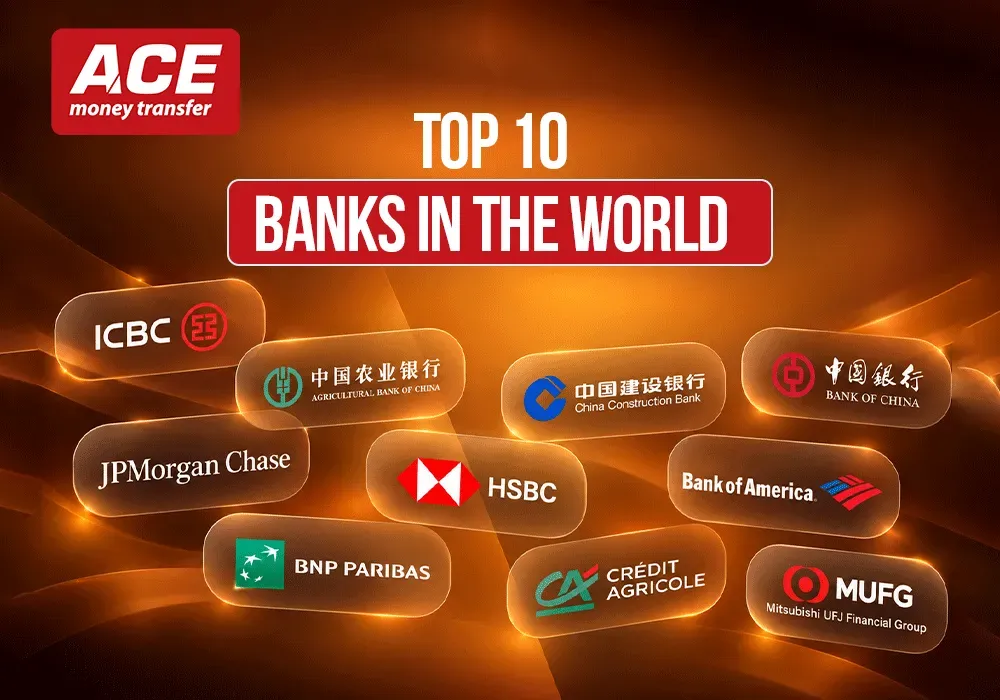
Here's a fast snapshot of the world's largest banks by market cap before the detailed profiles below:
#1 JPMorgan Chase & Co. (U.S.) - Largest U.S. bank by revenue and market cap, with diversified consumer, corporate, and investment banking operations
#2 Bank of America Corp. (U.S.) - Second-largest U.S. bank, strong in retail banking and wealth management via Merrill
#3 Industrial and Commercial Bank of China (China) - The largest bank globally by total assets, serving industrial and retail customers across 49 countries
#4 Agricultural Bank of China (China) - State-owned lender with the country's largest rural branch network
#5 China Construction Bank (China) - Originally an infrastructure-focused lender, now a full universal bank
#6 Bank of China (China) - China's most internationally oriented bank and a central player in trade finance
#7 Wells Fargo & Co. (U.S.) - One of America's oldest and largest retail and commercial banks
#8 Morgan Stanley (U.S.) - A global leader in investment banking and wealth management
#9 Goldman Sachs Group Inc. (U.S.) - Premier advisory and trading firm since 1869
#10 HSBC Holdings plc (U.K./global) - Global universal bank with a unique position bridging Asia and the West
U.S. and Chinese institutions clearly dominate. European banks like HSBC still play a critical cross-border role, but few match the valuations of the American and Chinese leaders. Mergers and acquisitions can shift bank rankings by altering their asset base, so this landscape evolves continuously.

JPMorgan Chase (ticker: JPM) is the largest bank in the world by market capitalization in 2026, with a valuation of over $888 billion-reaching toward the $960 billion mark by mid-August. JPMorgan Chase consistently ranks as the most valuable bank by market capitalization. The company reported over US$177 billion in 2024 revenue and recorded $58 billion in annual profits that same year.
JPMorgan Chase offers consumer, commercial, and investment banking services across four segments: Consumer & Community Banking, Corporate & Investment Banking, Commercial Banking, and Asset & Wealth Management. This scale lets it serve everyone from personal savings customers to governments and large corporations.
Under CEO Jamie Dimon, the bank has led heavy investment in technology and artificial intelligence to power its digital platforms. Key challenges include regulatory scrutiny in the USA, cybersecurity threats, competition from fintechs, and the need to manage capital and liquidity under evolving Basel rules.
The remaining American banks on this list illustrate how diversified the U.S. banking sector is-spanning retail operations, commercial lending, and pure-play investment banking. These institutions maintain diversified revenue streams and compete fiercely for corporate and retail customers.
Bank of America is one of the major U.S. banking institutions, serving individuals, small businesses, and large corporations. Its services span retail banking, credit cards, commercial banking, and wealth management through Merrill, alongside digital banking tools such as its AI-powered virtual assistant, Erica.
Wells Fargo (WFC) was founded in 1852 during California's gold rush and remains one of the top retail and commercial banks in the world, with over US$82 billion in annual revenue. Wells Fargo's market capitalization is over $302 billion. The company has been streamlining operations and rebuilding trust after its 2016 accounts scandal, with executives focused on strengthening risk management and simplifying its business.
Morgan Stanley (MS) is a global financial services and investment banking powerhouse, particularly strong in wealth management and institutional securities. Mergers and acquisitions like the E*TRADE and Eaton Vance deals expanded its asset management footprint, demonstrating how M&A activity can reshape a bank's value and ranking.
Goldman Sachs (GS) has been a leading global investment bank since 1869, with strengths in advisory, underwriting, trading, and asset management. Its recent strategic shift moved the company away from mass-market consumer banking back toward its core institutional and wealth businesses, a move led by its senior executives.
These four state-linked institutions dominate China's banking system and rank among the largest banks in the world by both assets and market cap. Chinese banks lead by total assets due to state-backed financing of infrastructure projects, and high domestic savings and government policy support develop large banking systems like China's.

Industrial and Commercial Bank of China (ICBC) is the largest bank globally by total assets-nearly 49 trillion yuan as of end-2024. Founded in 1984, ICBC serves corporate, industrial, and retail clients across about 49 countries. Industrial and Commercial Bank of China had revenue of ¥881.6 billion in FY 2024, with a net profit of roughly ¥367 billion.
Agricultural Bank of China began with a focus on rural development and the agricultural sector but is now a full-service commercial bank. Agricultural Bank of China has a market capitalization of over $377 billion. Notably, Agricultural Bank of China issues over 2 trillion yuan in new loans annually, supporting sectors from farming to urban commerce. Its vast rural branch network gives it reach that few competitors can match.
China Construction Bank (CCB) was originally focused on infrastructure and construction financing but now offers retail, corporate, and investment banking services as one of China's largest universal banks. China Construction Bank's revenue is ¥607.8 billion for FY 2024, and its innovation in smart banking and automation continues to grow.
Bank of China (BOC) was established in 1912 as China's oldest bank and remains the country's most internationally oriented lender. Bank of China reported revenue of ¥768.2 billion in FY 2024, and it plays a central role in trade finance, foreign exchange, and cross-border payments. Its contributions to the Belt and Road Initiative and its branches across Asia, Europe, Africa, and the Americas make it a key commercial bank of China.
Government influence, real-estate exposure, and non-performing loans in troubled sectors remain the primary risk factors shaping these Chinese giants' profiles. Central banks and regulators in China continue to balance growth with stability.
HSBC was founded in 1865 to finance trade between Asia and the West, and today it holds a unique position as one of the world's largest banks by total assets. Headquartered in London with deep roots in Hong Kong, HSBC provides retail, commercial, and investment banking services globally across 50+ countries.
Recent strategy has involved scaling back less profitable retail operations in the U.S. and parts of Europe to redeploy capital toward Asia's faster-growing markets. HSBC's strengths in cross-border trade finance, FX services, and corporate banking support multinationals operating across continents. Global banks operate across many markets to enhance their assets and influence, and HSBC is a prime example of this approach.
Key challenges include navigating geopolitical tensions between China, the U.K., and the U.S., managing complex regulation across jurisdictions, and facing competition from regional and digital banks. Banks with enormous lending operations and large investment portfolios rank higher, and HSBC's communications around its Asia-first strategy aim to reassure investors of long-term value.
Despite their size, the world's largest banks rely on a few core revenue engines:
Net interest income: Taking deposits at lower rates and issuing loans at higher rates to consumers, businesses, and governments. This underpins commercial bank and retail operating models.
Non-interest income: Fees and commissions from investment banking (advisory, underwriting), asset and wealth management, payment processing, brokerage services, and account services across multiple sectors.
Trading and treasury: Profits from market-making, derivatives, foreign exchange, and balance sheet management.
Technology and digital channels: Investments in artificial intelligence, online banking, and mobile apps lower operating costs and drive efficiency, but require significant upfront capital and heighten cybersecurity risks.
Top global banks maintain diversified revenue streams across various sectors, reducing dependence on any single income source. The importance of this diversification grows as interest rate cycles, credit conditions, and regulatory landscapes shift.
The global reach of these top banks powers international settlements, trade finance, and corporate flows worth trillions. But for personal remittances-sending money to family in another country, for example-traditional bank wires can be slow, expensive, and loaded with hidden fees.
This is where ACE Money Transfer occupies a standout role. As a specialized digital platform, ACE Money Transfer complements traditional banking by offering fast, secure, and low-fee money transfers to many countries worldwide. Users can link their bank accounts, cards, or local payment methods, then send funds internationally with real-time tracking and competitive FX rates. The platform's focus on speed, transparency, and customer experience makes it the best app for anyone regularly sending money abroad.
Exchange rates fluctuate, and the rate applicable to your transfer may differ from rates shown at another time. Check the current rate atacemoneytransfer.combefore sending.
Giant banks provide the stability and infrastructure that underpin global banking. Agile fintech solutions like Ace Money Transfer focus on what matters most to everyday customers: lower transfer costs, faster delivery, and a user-friendly experience. Together, they form a financial ecosystem that serves everyone-from large corporations managing cross-border treasury operations to individuals supporting families across borders.

Disclaimer: This article is intended for general informational and educational purposes only and should not be construed as legal, regulatory, tax, business, or financial advice. While reasonable efforts have been made to ensure that all facts, figures, and data are accurate and valid as of the date of publication, no warranty or guarantee is given as to the ongoing completeness, accuracy, or currency of the information.
The content is based on information available at the time of publication. Regulations, government policies, market conditions, and service offerings may change over time and vary across jurisdictions and providers. As a result, some information may no longer be current or applicable. Readers should independently verify all information and consult qualified professional advisors before making any financial, legal, or business decisions.