ACE Money Transfer
ACE Money Transfer
16 Sep 2026
Neobanks operate entirely online with no physical branches, and by mid-2026, a small group of them has moved from fintech curiosity to full-scale banking. The global neobanking market was valued at $211.2 billion in 2025. Mobile-first behaviors drive demand for these banks and their frictionless user experiences: customers can onboard in under five minutes, manage spending, borrow, invest, and send money from one app. Profitability remains a challenge for many neobanks, despite strong customer and revenue growth.
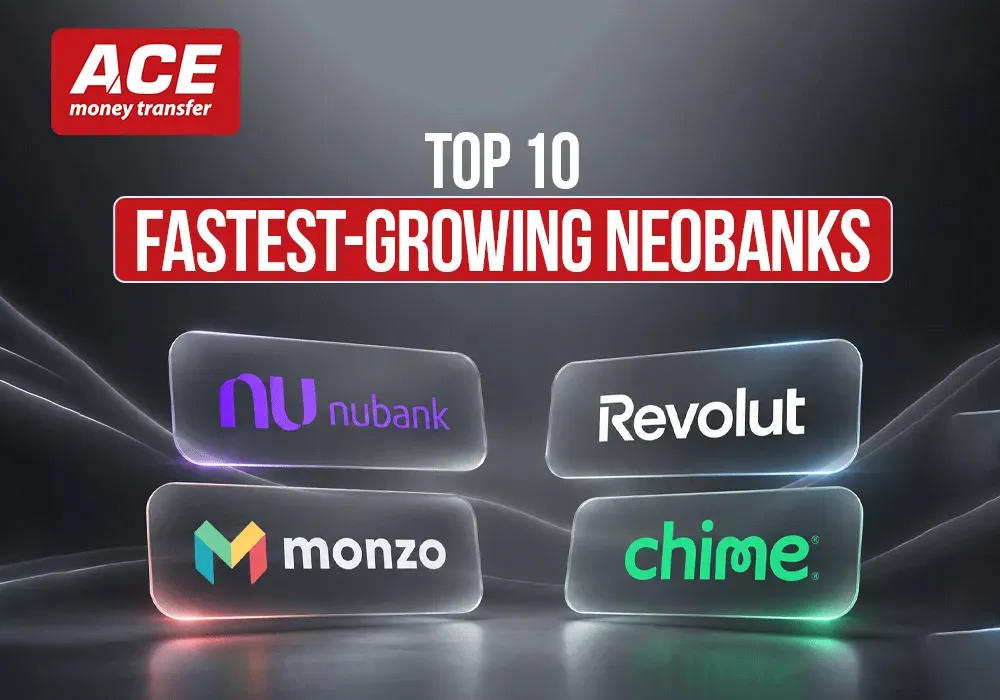
This article lists the top 10 fastest growing neobanks, then unpacks the specific product, technology, and geographic choices behind their growth. The selection spans Latin America, North America, Europe, the UK, and selected APAC markets. Each bank is measured by customer growth, revenue growth, profitability milestones, and regional expansion rather than absolute size alone.
Modern neobanks are evolving into financial ecosystems rather than simple checking account providers. For international users who pair a neobank with cross-border remittances.

We screened neobanks globally using the following criteria:
Public financial data from FY 2024 through H1 2026: customer numbers, year-over-year revenue growth, net income or pre-tax profit, and deposit/lending volumes.
Geographic scope: Latin America, North America, Europe, the UK, and selected APAC markets where leading digital banks are scaling.
Growth rate over absolute size: a neobank adding 2 million customers from a base of 5 million ranks higher than one adding 3 million from a base of 100 million.
Licensing models vary: some hold a full banking license or national bank charter; others use banking as a service via partner banks like Bancorp Bank. Both routes appear on this list.
All ten are app-based and branchless, though their business models differ: mass market retail, SME specialist, green lender, or financial super-app.
Nubank (Nu Holdings) is one of the world's largest digital banks measured by customers. Nubank serves over 100 million customers across Latin America; by December 2025, the count reached131 million across Brazil, Mexico, and Colombia, adding roughly 17 million in a single year.
Revenue hit approximately US$16.3 billion in FY 2025, a 45% year-over-year increase. Nubank reported that Q4 2025 alone produced US$895 million in net income at a return on equity near 33%. The credit portfolio grew about 40% year-over-year. Nubank offers no-fee credit cards to an underbanked population, and its financial inclusion model keeps the cost-to-serve ratio at roughly 19.9%.
Growth levers include expansion of lending products, SME tools, insurance, and investments inside one app. Data-driven risk management and a proprietary technology platform keep operating costs low enough to profitably serve tens of millions of users earning modest incomes. Neobanks combine low-cost distribution with superior user experience and data-driven products; Nubank is the clearest proof of that thesis at massive scale.
Revolut operates less like a digital bank and more like a global financial super-app. The company reportedapproximately 70 million retail customers by end of 2025, with over 500,000 business accounts. Revolut has expanded into 48 countries with approximately 70 million retail customers by the end of 2026.
Revolut's revenue grew 46% to $6 billion in 2025. Revolut reported a profit before tax of US$2.3 billion in 2025, and its valuation sits near US$75 billion. Product breadth spans multi-currency accounts, FX, cards, investing, crypto, insurance, and business accounts that improve payment flows and cash management for both retail and commercial users.
Key milestones include a UK banking licence and a French banking license secured in 2026, plus applications for a US charter. For cross-border users, Revolut covers many corridors, but specialist apps like ACE Money Transfer often deliver better rates on dedicated remittance routes to the Middle East, South Asia, and Africa.
Monzo built its reputation on a hot coral debit card and real-time spending notifications. By 2025, the bank passed 15 million customers, adding over 2.4 million net new customers during the year. Revenue reached approximately £1.2 billion. Monzo achieved adjusted pre-tax profits of approximately £113.9 million in FY2025, marking its transition from growth-stage loss-maker to profitable digital bank.
Monzo pioneered features like fee-free foreign ATM withdrawals and now offers budgeting tools, salary sorting, Pots for ring-fenced savings, and a credit card. The 2025 acquisition of mortgage broker Habito extended Monzo into home lending, a move that deepens its relationship with customers who previously treated it as a secondary spending card. Neobanks are recognized for their superior user experience and innovative features, and Monzo's community-driven word-of-mouth remains its primary distribution engine: about 80% of new sign-ups come through referrals and organic channels.

Chime targets mainstream Americans who want banking services without monthly fees or overdraft fees. Chime reported10.2 million active members in Q1 2026, up about 19% year-over-year. Full-year 2025 revenue reached US$2.2 billion, a 31% increase over the previous year.
Chime offers fee-free banking with early direct deposit two days ahead of standard payroll timing, SpotMe overdraft protection (up to $200 without penalty), automatic savings round-ups, and a credit builder card. Its business model runs through FDIC-insured sponsor banks, allowing rapid scale without its own charter. Chime's interchange-driven model, where the company earns more revenue when members spend more, aligns its incentives against penalty fees and overdraft traps that big banks rely on.
Net loss in FY 2025 was approximately US$1 billion on a GAAP basis (driven partly by stock-based compensation post-IPO), but adjusted EBITDA turned positive. Chime expects GAAP profitability in 2026 as it migrates to its proprietary core banking system, ChimeCore, to reduce per-transaction costs.
SoFi started as a student loan refinancing platform in San Francisco. By early 2026, it had grown to approximately 14.7 million members, adding about 1.1 million net new members in Q1 2026 alone. Quarterly revenue reached roughly US$1.1 billion, and net income hit approximately US$160 to $170 million for the quarter, according topublic filings.
The product stack now covers personal loans, checking and savings, credit cards, investing, robo-advisory, insurance, and financial planning. Subscription-based models are becoming a revenue source for neobanks, and SoFi Plus (its premium membership tier) charges a monthly fee in exchange for higher savings APY and reduced loan rates. Owning a national bank charter in the US lets SoFi fund loans with customer deposits rather than wholesale capital, which compresses the spread and improves lending margins over time. The cross-sell engine is the growth lever: a member who arrives for student loan refinancing often opens a checking account, then a brokerage account, generating diversified revenue across three product lines.
Starling Bank has reported a profit every year since FY 2022. By FY ending March 2025, accounts reached4.6 million with customer deposits at about £12.1 billion and revenue near £714 million.
Expansion into business banking has become a revenue accelerator for Starling: its SME and business accounts offer integrated invoicing, tax tools, and cash management features that attract small-business owners. Engine by Starling, the company's banking as a service technology platform, licenses its cloud-native core to other financial institutions. Engine client numbers doubled in FY 2025, creating more revenue independent of Starling's own deposit book. Neobanks use cloud-native technology stacks for scalability, and Starling's architecture lets it ship product updates weekly while maintaining uptime above 99.9%.
Allica Bank focuses on established SMEs with 5 to 250 employees, a segment that legacy banks have underserved for years. Neobanks target niche markets such as freelancers and SMEs with tailored features; Allica went narrower, building products specifically for businesses with existing revenue and staffing.
In FY 2025, the company reportedunderlying pre-tax profit of £43.7 million (up 34%), gross revenue of £371.3 million (up 27%), and customer deposits of £5.7 billion. Customer balances are growing alongside customer numbers: active business reward account holders more than doubled from around 6,000 to over 14,000. Allica secured a funding round of approximately US$155 million in 2026 to expand lending.
Products include asset finance, commercial mortgages, overdrafts, and growth finance, delivered through a proprietary digital banking platform paired with dedicated relationship managers. By concentrating on a clear, underserved segment, Allica avoids the margin pressure that comes from competing for the entire mass market.
Atom Bank, one of the UK's first mobile-only banks, chose to specialize in high-value lending products rather than a full retail feature set. Its 2025 customer base grew approximately 19%, deposit balances rose about 31%.
The product line covers savings accounts, residential mortgages, and business loans, all delivered through app-based journeys with no physical branches. Neobanks can ship new features faster than traditional banks; Atom's microservice architecture lets it push weekly updates to its mortgage application flow and risk analytics. This specialisation in consumer credit and secured lending, rather than chasing e-commerce payments or crypto trading, allows Atom to maintain capital efficiency and focus engineering resources on a smaller surface area.
Tandem positions itself as a purpose-driven green digital bank. In 2025, the company reported underlying profit of about £24.1 million (roughly 40% growth), revenue near £98.7 million, and assets under management past £1.5 billion.
Key lending verticals include home energy improvement loans, green mortgages, and EV/green motor finance. Neobanks often provide high-yield savings options to attract primary depositors, and Tandem uses competitive savings rates to fund its green loan book. The ESG positioning attracts eco-conscious consumers and commercial partners looking for measurable environmental impact in their financial infrastructure. Green lending also aligns with UK regulatory incentives for energy-efficient housing, creating a tailwind that generic consumer lenders do not enjoy.

Varo Bank became the first consumer fintech in the US to receive a national bank charter from the OCC, distinguishing it from many fintech companies that rely on partner-bank arrangements. Regulatory compliance is a crucial aspect of competition among neobanks, and holding its own charter lets Varo hold deposits directly, expand lending, and control unit economics without a middleman.
Varo focuses on accessible banking for the underbanked in the US. In 2025, lending volumes reached approximately US$547 million across Varo Advance and Line of Credit products. Varo Bank raised US$123.9 million in its Series G funding round in 2026 to scale operations and grow its loan book. Key features include fee-light checking and savings, cash advances, credit-building tools, and financial services designed for gig workers and remote workers who lack access to traditional financial institutions.
Neobanks are expanding digital banking by providing services such as account management, payments, currency exchange and international transfers through mobile and online platforms. As digital banking continues to develop, cross-border payments remain an important part of how individuals manage and move money internationally.
ACE Money Transfer focuses on the international remittance side of this digital financial ecosystem. Through its website and mobile app, customers can set up international transfers, review applicable fees and exchange rates, provide receiver details and select an available delivery method for the destination country.
Rates and fees may vary, and exchange rates fluctuate, so the rate you receive may differ from any quoted rate. Always check the live rate at ACE Money Transfer before sending.
Available options vary by destination and transfer corridor and can include bank deposits, cash pickup, mobile wallets and other country-specific methods. This gives ACE a focused role within the wider digital banking landscape, providing a dedicated channel for moving money internationally rather than operating as a neobank.
These ten banks differ in geography, segment, and product, but several patterns repeat.
Frictionless onboarding: frictionless customer onboarding is a measurable advantage; most of these banks open accounts in under five minutes, compared to 3 to 5 days at traditional banks.
Clear target segment: whether mass market (Nubank, Chime), SME (Allica, Starling), or green finance (Tandem), each bank owns a specific position.
Revenue mix beyond interchange: neobanks primarily earn revenue from interchange fees of 0.2 to 2%, but the fastest growing neobanks layer on lending products, subscriptions, wealth management, FX, and banking as a service licensing to build diversified revenue.
Data-driven personalization enhances services and customer satisfaction: AI is increasingly used in neobanking for underwriting and fraud prevention, and AI is increasingly used across the neobanking sector for areas such as underwriting, fraud prevention, and customer support.
Embedded finance enables neobanks to integrate financial services into non-banking platforms, from accounting software to e-commerce checkouts.
Engagement drives acquisition: neobanks use customer engagement strategies (push notifications, spend insights, open banking connectivity) to drive user acquisition through referrals and word-of-mouth.
No single neobank fits every user. Start by defining your primary goal: daily banking, business banking, investing, credit building, or cross-border usage.
Check licensing status (full bank charter vs. BaaS), deposit protection limits, monthly fees, FX rates, and account limits.
Regional availability matters: Nubank covers Brazil, Mexico, and Colombia; Revolut spans 40+ countries; Chime and SoFi are US-only; Starling, Monzo, Allica, Atom, and Tandem serve UK customers.
Consider mixing providers: use one neobank for domestic daily banking and ACE Money Transfer for low-cost international money transfers to corridors in the Middle East, Africa, and South Asia where dedicated remittance apps deliver faster settlement and tighter spreads.
Traditional financial institutions can study how digital players reduce onboarding friction, ship features weekly through open banking APIs, and focus on underserved segments instead of generic mass-market offers. Neobanks can ship new features weekly due to microservice architectures; legacy banks running monolithic core banking systems cannot match that pace without re-platforming.
For founders: the pattern across regional champions like Allica and Tandem is to start with a narrow, solvable problem (SME overdrafts, green home loans) before adding adjacent financial products. Building a neobank requires regulated partners, KYC/AML tooling, card issuing, and payment rails. White-label or banking as a service platforms from providers like Starling's Engine accelerate time to market. Founders designing cross-border propositions should consider partnering with ACE Money Transfer rather than building remittance rails from scratch.
Neobanks grow rapidly by replacing physical infrastructure with mobile apps, but the next phase requires more than onboarding speed. AI-driven data-driven personalization will reshape underwriting, fraud detection, and in-app financial advice. Embedded finance will push banking services into non-bank apps, from ride-hailing platforms to accounting tools, creating new payment flows and lending opportunities inside software that users already open daily.
Expect consolidation: a few mega-neobanks like Nubank and Revolut will compete at massive scale across dozens of countries, while specialized niche players (SME lenders, green banks, gig-worker accounts) will hold defensible positions. Cross-border remittances, global reach through multi-currency accounts, and real-time FX remain battlegrounds where tech companies and fintech companies compete. Specialist apps like ACE Money Transfer bring additional value in corridors that super-apps cover only loosely.
The digital banking landscape will not slow down. Review your banking stack: confirm your primary neobank covers daily spending, savings, and lending, then pair it with ACE Money Transfer for international transfers. The fastest growing neobanks listed here each grew by solving a specific problem for a specific group of people. Pick the one that solves yours.

Disclaimer: This article is intended for general informational and educational purposes only and should not be construed as legal, regulatory, tax, business, or financial advice. While reasonable efforts have been made to ensure that all facts, figures, and data are accurate and valid as of the date of publication, no warranty or guarantee is given as to the ongoing completeness, accuracy, or currency of the information.
The content is based on information available at the time of publication. Regulations, government policies, market conditions, and service offerings may change over time and vary across jurisdictions and providers. As a result, some information may no longer be current or applicable. Readers should independently verify all information and consult qualified professional advisors before making any financial, legal, or business decisions.