
ACE Money Transfer
ACE Money Transfer
05 Oct 2026
If you sell anything online-or plan to-you need to understand the difference between a payment gateway and a payment processor. They sound similar, they often come from the same provider, and most business owners use both without realizing they are separate things. This guide breaks down exactly what each does, how they cooperate, and which setup makes the most sense for your business in 2026.
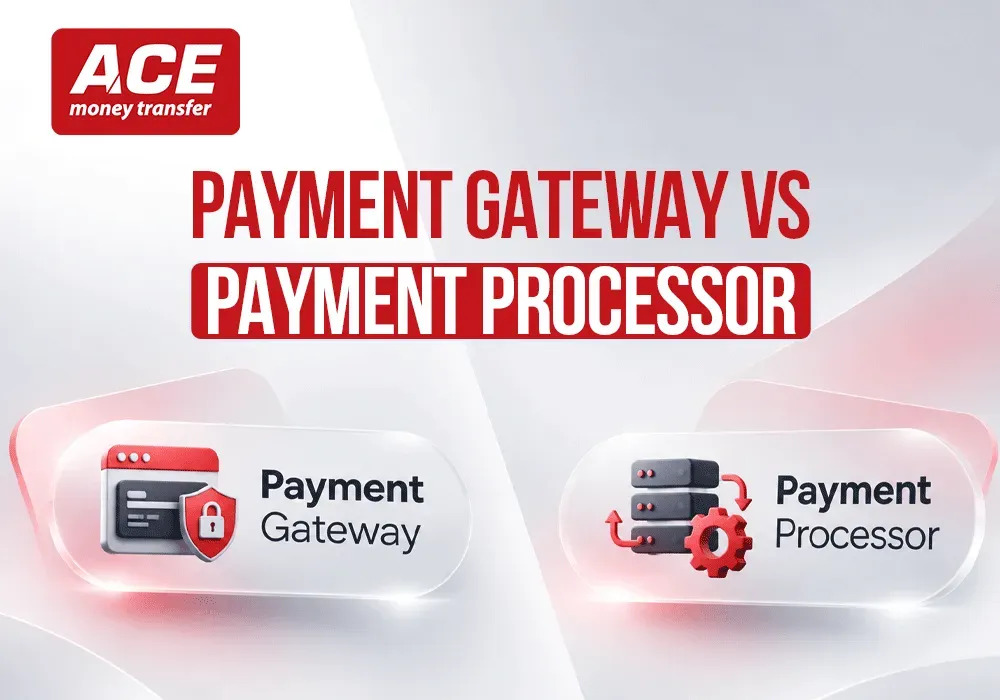
A payment gateway is the secure front-end that collects and encrypts card or wallet details at checkout. Think of it as the digital card machine your customer sees and interacts with. A payment gateway encrypts and transmits payment data from the customer to the next step in the chain-it never moves money itself.
A payment processor is the behind-the-scenes service that communicates with banks and card networks to authorize the transaction and actually transfer funds. The payment processor handles the back-end communication and actual transfer of money between the customer's bank account and the merchant's bank. Payment processors are generally invisible to the customer during a transaction, yet transactions are processed within seconds by payment processors.
For most online payments, businesses need both a payment gateway and a payment processor, though many payment providers offer bundled services that include both gateway and processor functions. Funds from card payments first land in a merchant account-a special holding account-before being deposited into your normal bank account. Here are a few key differences at a glance: the gateway sits at the checkout and handles encryption; the processor routes data to banks and settles funds; gateway fees are often flat per-transaction amounts while processor fees are typically a percentage plus a fixed fee; and you need a gateway whenever customers enter payment details, while you need a processor whenever money needs to move. The sections below cover how gateways and payment processors work together, when you need both, cost factors, security, and how to choose the right setup.
When your needs extend beyond card payments to sending money internationally-paying overseas suppliers or transferring personal funds abroad.
Exchange rates fluctuate and the rate you receive may differ from any rates quoted. Always check the live rate at acemoneytransfer.com before sending.
A payment gateway is the technology that securely captures, encrypts, and forwards customer payment information-credit card details, debit card numbers, or digital wallet credentials-to the processor. It is the online or in-person equivalent of a credit card reader or POS system that the customer directly interacts with.
Payment gateways are essential for online transactions: eCommerce checkouts, in-app purchases, invoice payment links, and recurring billing all rely on a gateway. The payment gateway provides a digital checkout interface for customers and acts as a bridge between customers and payment processors. Some gateways are hosted checkout pages (redirects like PayPal-hosted forms), while others are integrated payment gateways embedded directly on the merchant's e commerce platform via application programming interfaces or SDKs.
In a typical flow, the payment gateway collects customer payment information, the payment gateway encrypts that data, applies basic fraud checks such as AVS and CVV validation, then sends it to the payment processor and returns an approve or decline message to the website. Payment gateways facilitate online transactions for e-commerce businesses and provide multi-currency support for international payments. They also ensure compliance with PCI DSS standards, protecting cardholder data throughout the process.
Well-known payment gateway providers include Authorize.net (a classic standalone gateway), plus full-stack providers like Stripe and Adyen that combine gateway and processor into one platform.
A payment processor is the service that routes transaction data between the payment gateway, card networks like Visa and Mastercard, the customer's issuing bank, and the merchant's acquiring bank. Payment processors transmit data between payment gateways and banks, verify customer identity and transaction approval, and handle the movement of funds between banks.
Processors manage both authorization and settlement. During transaction processing, the issuing bank checks for available funds and the processor relays an approval or decline. After authorization, the payment processor facilitates the actual settlement-moving money from the customer's account through the acquiring bank into the merchant account, and eventually into the business's bank account. Payment processors handle card-present and card-not-present transactions alike, powering everything from point of sale systems in stores to online business checkouts.
Payment processors handle fraud detection and chargeback management, enforce card network rules, and meet regulatory standards. The payment processor sends authorization requests, manages disputes, and generates reporting. Payment processors charge service fees per transaction-either a flat fee, a percentage, or both.
Companies acting as payment processors include Square (which bundles processing with POS hardware), Stripe and Braintree (which combine processor and gateway), and traditional credit card processors like Worldpay that focus on the back-end. Many payment processors also provide or connect to a merchant account, simplifying the setup for small businesses.
The gateway vs payment processor distinction is about two roles in the same card transaction, not competing technologies. Many modern providers perform both, which is why the lines blur in marketing materials-but they are separated in contracts and pricing.
The payment gateway sits at the customer-facing edge (checkout forms, hosted pages, POS terminals), collects and encrypts card data, performs initial fraud screening (AVS, CVV checks), and sends an approve or decline message back to the website or app. The payment processor sits in the back-end, communicates with card networks and banks, moves funds between the customer's issuing bank and the merchant's acquiring bank, and manages settlement, refunds, chargebacks, and reporting.
In terms of fees, gateway-only services like Authorize.net typically use a pricing structure that can include a fixed per-transaction fee and a monthly account or gateway fee, with the exact amounts varying by plan and transaction arrangement. While processors charge a percentage-based markup on top of interchange. When you see a rate like "2.9% + $0.30," that usually bundles both. In terms of daily operations, if your checkout form breaks, that is a gateway issue; if your payout is delayed or statement fees look wrong, that is a processor or acquiring bank issue. Always check whether your agreement covers payment gateway services, payment processing services, or both-some companies are explicitly labeled as payment gateway providers, some as processors, and some as both a payment gateway and payment processor under one roof.
Here is how a typical online card payment flows, step by step. A customer visits an online store, adds items to cart, and enters credit card details on the secure checkout page-this is the gateway capturing payment data. The payment gateway encrypts the customer's credit card information and forwards the transaction data to the payment processor. The payment processor sends an authorization request through the relevant card network to the customer's issuing bank. The issuing bank checks whether the card is valid, funds are available, and no fraud flags exist, then returns an approval or decline. The response travels back through the processor to the gateway. The gateway shows the result to the customer on the merchant's site. Later, the payment processor facilitates settlement-batching approved transactions, coordinating with the acquiring bank to transfer funds into the merchant account, and eventually depositing into the business's bank account.
For in person transactions, the POS terminal usually includes an embedded gateway, but the cooperation with the processor and banks follows the same pattern. In 2026, many providers sell an integrated stack where gateways and payment processors are tightly coupled, reducing technical overhead. This cooperation also applies to contactless payments, digital wallets, and other digital payment methods-though routing paths vary.
International or cross-border transactions may add extra layers such as currency conversion and local acquiring banks. For personal and business transfers outside of the standard card payment flow, ACE Money Transfer complements a gateway and processor by handling remittances and FX with speed and low fees.
Most businesses that accept payments online need both a payment gateway and a payment processor-whether as separate services or one combined platform. Pure eCommerce stores, subscription or SaaS businesses, and marketplaces receiving card or wallet payments all require both to accept credit card payments and process transactions.
Some brick-and-mortar shops rely mainly on a payment processor with embedded gateway functionality through integrated POS systems or mobile card readers that bundle hardware, gateway, and processing. Payment aggregators or PSPs like Stripe and Square provide both a payment processor and a payment gateway plus a shared merchant account. Traditional setups pair a standalone gateway with a separate processor and dedicated merchant account for more control.
If customers type card details into a form or tap a card on your device, you are using a gateway. If money needs to arrive in your merchant or bank account, you are using a processor-often the same provider does both.
Edge cases exist: invoicing-only businesses or B2B firms using ACH transfers may not need a classic card gateway but still rely on a processor for managing online transactions or bank rails. Small businesses often simplify by choosing a payment service provider that packages everything together.
A merchant account is a special type of account where card payments are stored temporarily before being transferred to the business's normal bank account. Historically, merchants contracted a merchant account provider, chose a payment processor connected to that account, and integrated a separate payment gateway provider for online payments-three vendors, three contracts.
Modern payment service providers combine a merchant account, both a payment gateway and a payment processor, and risk management into a single service. The pros include simpler onboarding, consistent reporting, fewer vendors to manage, and often more predictable pricing. The trade-offs are less flexibility to shop around for lower processing rates from different acquirers, and possible lock-in due to proprietary APIs.
ACE Money Transfer fits a different role: not as a payment gateway provider or processor, but as a dedicated, regulated service for low-cost, fast international money transfers-useful for paying overseas suppliers, handling foreign credit cards settlement gaps, or sending personal funds abroad alongside your traditional merchant services.
Rates and fees may vary. Visit acemoneytransfer.com for current rates
Both gateways and payment processors must comply with PCI DSS to protect cardholder data. Payment gateways encrypt customer payment data for security, focusing on encrypting data in transit, tokenizing card numbers so merchants never store raw PANs, implementing 3-D Secure authentication, and offering built-in fraud tools like velocity checks, AVS, and CVV validation.
The payment processor acts as the enforcement layer-running advanced fraud scoring engines, monitoring suspicious patterns across many merchants, enforcing card network rules, and handling secure settlement. Payment processors handle fraud detection and chargeback management as a core function.
Merchants should ensure their own website has an SSL certificate, use secure APIs, and understand their compliance role even when using a hosted gateway. Cross-border transactions can trigger extra checks such as sanctions screening and AML rules. For person-to-person international transfers, specialized services like ACE Money Transfer manage these compliance requirements carefully on your behalf.
Typical pricing models for gateways and processors include a per-transaction percentage plus a fixed fee, monthly subscription or gateway access fees, setup fees, chargeback fees, and cross-border surcharges. Modern providers often use a flat-rate pricing structure for payment processing services. Payment processors charge fees per transaction or as a percentage-effective rates range from about 2.32% for high-volume merchants to 3.07% for smaller operations.
Compare gateway vs payment processor offerings on effective total cost, not just headline rates. Consider the transaction amount, currency mix, and chargeback risk. Key feature considerations include supported payment methods (cards, wallets, bank transfers), supported countries and currencies, ease of integration with platforms like Shopify or WooCommerce, reporting tools, and support availability. For online payment gateways specifically, checkout experience, recurring billing, tokenization, and robust fraud prevention without excessive false declines are critical.
For a small local retailer, a bundled POS provider handling accept card payments in person is ideal. A fast-growing cross-border eCommerce startup should prioritize a provider with broad payment method support, local acquiring, and transparent cross-border fees. A freelancer wanting quick setup and simple fees should choose a PSP like Stripe or Square. And when you need to transfer funds acts outside of card processing-paying international suppliers or sending money home-ACE Money Transfer offers the best combination of speed, competitive FX rates, and a user-friendly app.
A payment gateway is the customer-facing technology that securely captures and encrypts payment details at checkout. A payment processor is the invisible engine that routes those details through card networks and banks, authorizes the transaction, and settles the funds. Together, they make accepting credit cards and other digital payment methods possible for every online business and many physical stores.
The most important key differences: the gateway handles encryption and customer interaction; the processor handles bank communication, settlement, and compliance. Most businesses need both a payment gateway and processor-whether bundled in one platform or sourced separately. Bundled solutions from PSPs simplify operations, while separate components offer more flexibility and negotiating power for larger merchants. A merchant account remains the intermediary where funds land before reaching your bank account.
As digital payments, wallets, and cross-border commerce continue to expand, prioritize secure, flexible, and scalable solutions. For processing payments from customers, choose a gateway and processor combination that fits your volume and growth plans. For moving money globally outside typical card processing flows-whether paying overseas vendors or sending funds to family-pair your payment stack.
Disclaimer: This article is intended for general informational and educational purposes only and should not be construed as legal, regulatory, tax, business, or financial advice. While reasonable efforts have been made to ensure that all facts, figures, and data are accurate and valid as of the date of publication, no warranty or guarantee is given as to the ongoing completeness, accuracy, or currency of the information.
The content is based on information available at the time of publication. Regulations, government policies, market conditions, and service offerings may change over time and vary across jurisdictions and providers. As a result, some information may no longer be current or applicable. Readers should independently verify all information and consult qualified professional advisors before making any financial, legal, or business decisions.