
ACE Money Transfer
ACE Money Transfer
01 Sep 2025
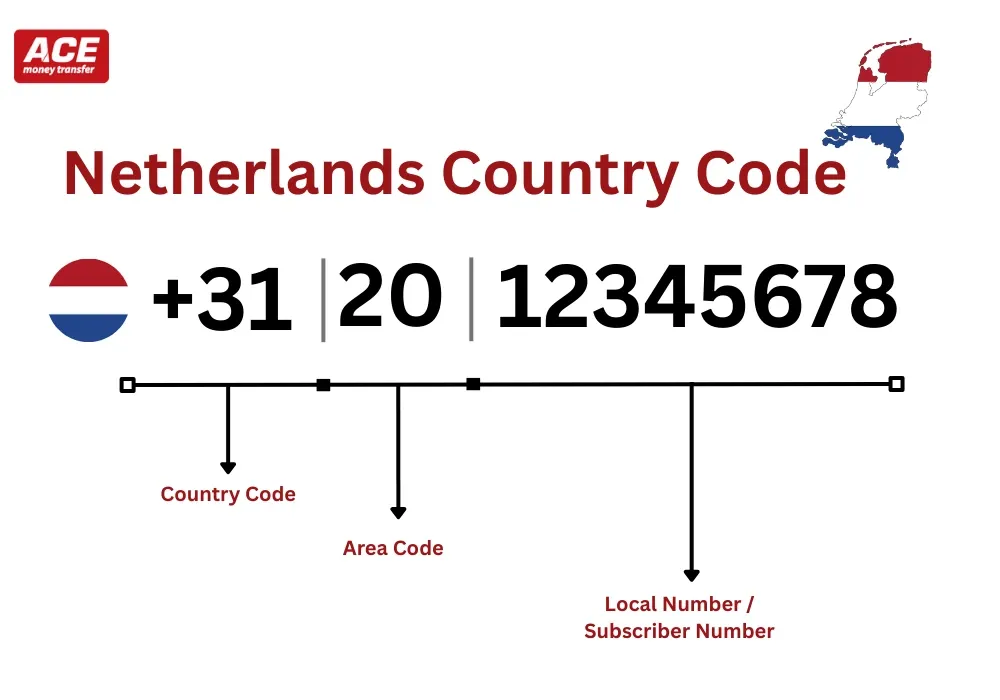
Whether you want to call a family member in Amsterdam, reach a business partner in Rotterdam, or confirm banking details with someone in The Hague, you need to know how Dutch phone numbers work. The Netherlands country code is +31 or 0031, and getting the area code right is the difference between a connected call and a dead line.
This guide breaks down every step of the dialing procedure for Dutch landlines and mobiles, explains the full number structure, and shows you how to send money to the Netherlands using ACE Money Transfer.
The Netherlands ISD code is +31 (also written as 0031). You need this country code every time you make an international call to a Dutch number. Area codes in the Netherlands are used mainly for land phone numbers and identify specific cities or regions. Mobile phone number prefixes work differently and are covered below.
From the United Kingdom: To call the Netherlands, dial 0031 from the UK, then the area code (without its leading 0), followed by the subscriber number. The exit code for Netherlands calls from the UK is 00, so the full sequence is 00 + 31 + area code + number.
From the USA or Canada: Your international access code is 011. So you enter country code 31 after that prefix. The full format is 011 + 31 + area code (minus the 0) + subscriber number.
From other EU countries: Most European nations also use 00 as their international access prefix. The format is the same as from the UK: 00 + 31 + area code without 0 + subscriber number.
On any mobile phone, you can simply use the "+" symbol instead of your country's exit code. So +31 works universally.
The code land phone number format for an international call follows this pattern:
International access code ? country code 31 ? area code (without leading 0) ? land phone number
Example: An Amsterdam landline has the domestic number 020 123 4567. To call this from the UK, you dial: 00 31 20 123 4567. You omit the initial 0 of the city prefix when dialing internationally.
To call a land line from Netherlands domestically, you would simply dial 020 123 4567 - keeping the leading 0 intact.
Mobile numbers in the Netherlands always start with 06 domestically, followed by 8 more digits. Mobile numbers in international format are written as +31 6 followed by the subscriber number. You drop the 0 from "06" just as you do with area codes.
Example: A Dutch mobile with the domestic number 06 1234 5678 becomes 011 31 6 1234 5678 when dialed from the USA. From the UK, the same call to a mobile number would be 00 31 6 1234 5678.
When you call a mobile number in the Netherlands, you do not need a geographic area code. The "6" prefix identifies the number as mobile or land line - in this case, mobile. International calls to Dutch mobiles follow the international dialing format given above: access code + 31 + 6 + subscriber digits.
The term "netherlands direct dialing numbers" simply means you can make a direct connection using your country's international access code + the ISD code or country code 31 + the area or mobile prefix (without the domestic 0) + the recipient's telephone number. No operator assistance is needed. You follow the international dialing sequence, and the call connects automatically after dialing ISD code 31.
Remember: ignore the number within bracket while calling internationally - that bracketed "0" you see in Dutch domestic formatting is only used for calling within the Netherlands.
The Netherlands uses a closed national numbering plan. Domestic geographic numbers consist of 9 digits excluding the trunk prefix "0." When you include that trunk prefix, the total length for domestic calls is always 10 digits including the leading 0. This standardised structure covers all geographic land phone numbers in the country.
City prefixes in the Netherlands start with a 0 when dialed domestically. It is necessary to dial the trunk prefix 0 when calling domestically from within the Netherlands. For example, calling someone in Rotterdam from Amsterdam means dialing 010 followed by the subscriber number.
From abroad, you drop the leading 0 and use the country code instead. So you would enter country code +31, then dial area code 10, then the subscriber digits.
Dutch telephone area codes are two or three digits long (after the trunk prefix 0). The length of the area code determines the length of the local subscriber number in the Netherlands:
Dutch geographic phone numbers consist of a 2-digit area code plus a 7-digit subscriber number.
Alternatively, they consist of a 3-digit area code plus a 6-digit subscriber number.
Either way, the combined area code dial plus subscriber always totals 9 digits (excluding the leading 0), keeping the system uniform.
Here are the most commonly searched area codes to make calls to Dutch cities. Examples of 2-digit area codes include 20 for Amsterdam, 10 for Rotterdam, and 70 for The Hague. Additional major codes include:
030 for Utrecht
040 for Eindhoven
050 for Groningen
071 for Leiden
073 for 's-Hertogenbosch
076 for Breda
Examples of 3-digit area codes include 023 for Haarlem and 0182 for Gouda. When you find area code information for a smaller Dutch town, it will typically be three digits, meaning the code of the city is longer but the subscriber portion is shorter (6 digits instead of 7).
Dutch area codes are either 2 or 3 digits long. Geographic area codes are often tied to specific regions or cities in the Netherlands, so you can usually tell which part of the country a fixed line number originates from just by looking at the area code land phone prefix.
Mobile numbers in the Netherlands always start with 06 domestically and are followed by 8 additional digits. A typical digit mobile number looks like 06-12345678 when written in domestic format. In international format, that same line number or mobile becomes +31 6 12345678.
Mobile numbers are not tied to a particular geographic area. Unlike landlines, you do not need to know a city code to call a mobile - only the "6" prefix and the 8-digit subscriber number. The term "7 digit mobile number" occasionally appears in older references or specific service contexts, but most modern Dutch mobiles follow the 06 + 8-digit pattern, making the full domestic number 10 digits.
Dutch numbers can represent both geographic locations and service types. Beyond standard area codes, the Netherlands assigns several non-geographic prefixes:
Business and VoIP networks often use prefixes like 085 or 088. These are popular among companies with multiple offices that want a single dialed along with area code-style number, but without tying it to one city.
Toll-free numbers begin with the area code 0800, allowing callers within the Netherlands to dial for free.
Premium-rate numbers use 0900, while 0906 and 0909 cover adult and entertainment services respectively.
These special codes can sometimes be dialed from abroad using +31, but premium and toll-free numbers may be restricted or carry extra charges internationally. Always verify before calling after dialing ISD codes for these ranges.
One important note: the Caribbean Netherlands has a separate country code of +599 and is not part of the +31 numbering plan. Do not confuse the two when making any international call to the Dutch Caribbean islands.
When you receive a call from the Netherlands, your caller ID will usually display the number in international format. Expect to see +31 20 for Amsterdam, +31 10 for Rotterdam, +31 70 for The Hague, or +31 6 for a mobile. Some networks display 0031 instead of +31, but the number within bracket or after the prefix remains the same. This lets you quickly identify whether the incoming call is from a landline or mobile.
Understanding the correct ISD code and area codes helps you stay in touch with family, friends, and business contacts in the Netherlands. But communication is only half the equation - services like ACE Money Transfer help you support them financially from abroad, especially when you need to coordinate transfer details over the phone using the right dialing procedure.

Follow these steps each time you need to call an international number in the Netherlands:
Step 1: Dial your country's international access prefix. From most of Europe, this is 00. From the USA and Canada, dial 011. From Australia, use 0011. On a mobile phone, you can simply press and hold "0" to get the "+" symbol.
Step 2: Dial the Netherlands ISD code, which is 31. At this point you have dialed, for example, 00 31 or +31.
Step 3: For a landline, code dial area code without its leading 0, then the land phone number. For instance, to call The Hague from Germany, dial 00 31 70 XXX XXXX. The telephone number after ISD code 31 starts with the city's area code.
Step 4: To call a mobile number, dial 6 (dropping the domestic "0" from "06") and then the remaining 8-digit subscriber number. From the USA, this looks like 011 31 6 XXXXXXXX.
Step 5: Before making any international call, check the current time in Netherlands to schedule calls in order to avoid untimely calls. You need to know the time difference - Netherlands time runs on Central European Time (UTC+1 in winter, UTC+2 during daylight saving). As of Wed 30 Sep 2026 09 27 AM, the time in the Netherlands may differ significantly from your location. For reference, on 30 Sep 2026 09 27 AM 00 04 00 CET, it could be the middle of the night in another country. Always find information about Netherlands time before dialing.
Tip: You can use the "+" format on any smartphone to skip memorising exit codes entirely. Just type +31 followed by the area code or mobile prefix, and the call connects.
Making an international call from Netherlands or to the Netherlands can get expensive, depending on your provider. Here are ways to reduce costs:
Check whether your carrier offers bundled international calling plans that include the Netherlands and is needed for making frequent calls more affordable.
VoIP apps let you make a direct call over the internet, often at a fraction of standard rates, while still using the correct +31 code only while calling.
Be cautious with non-geographic or premium-rate numbers (0900, 0906) - these may incur heavy charges from abroad or be blocked entirely by foreign carriers.
When you want to call someone in the Netherlands to confirm their bank details and then send them money, ACE Money Transfer makes the financial side seamless. You can send international remittances using the ACE Money Transfer platform by creating an online account, entering recipient details, and paying via debit card, credit card, or online bank transfer.
Here is how the transfer process works:
Register or log in to your ACE account using your email, Google, or Apple ID.
Choose the Netherlands as the destination country and select a payout option - bank deposit, mobile wallet, or cash pickup (where available).
Enter accurate recipient details, including the Dutch IBAN for bank deposits or the mobile wallet number linked to a digit mobile number.
Select a payment method such as a debit card, credit card, or online bank transfer.
Add a payment reason and carefully confirm all transfer details before clicking "Pay Now."
Track your transaction in real time using the reference tracking number ACE provides.
ACE Money Transfer offers multiple ways for your recipient in the Netherlands to receive funds. Bank deposit is the most common option: funds go directly into the recipient's Dutch bank account using their IBAN, typically arriving within 1–2 business days. Mobile wallet payouts credit funds to a supported digital wallet account linked to the recipient's mobile phone number - check ACE's current partner list for availability in the Netherlands. Cash pickup allows the recipient to collect money at authorised partner bank branches, though this option may be more limited in the Netherlands compared to bank deposits. All rights to the funds transfer are confirmed once you complete the payment process.
There are practical scenarios where knowing the right Netherlands dial format and using ACE complement each other:
Confirming a Dutch IBAN over the phone: You call your recipient using +31 and the correct area code or mobile prefix, verify their bank details, then enter them into ACE's platform for a bank deposit.
Notifying family that money has arrived: After sending a remittance through ACE, you call a mobile number in the Netherlands (dialing +31 6 XXXXXXXX) to let them know the funds are ready to collect or have been deposited.
Coordinating business payments: You speak with a Dutch partner by phone - perhaps on their Sep 2026 09 27 PM local time - to align on invoicing, then complete the transfer through ACE's secure online platform.
In every case, using the proper dialing format ensures you reach the right person, and using ACE ensures the money arrives safely and on time.
Now that you know how to find area code information for any Dutch city, follow the international dialing steps for landlines and mobiles, and understand the full Netherlands number structure, you can confidently connect with anyone in the country. Use the proper area code Netherlands format - +31 plus the city or mobile prefix - every time you make a call.
And when it is time to send money, create an ACE Money Transfer account to transfer funds to the Netherlands quickly and securely. Whether you choose bank deposit, mobile wallet, or cash pickup, ACE gives you the tools to support the people who matter - while you stay in touch through affordable international calls.