ACE Money Transfer
ACE Money Transfer
03 Oct 2025
Whether you are scheduling a meeting with a colleague in Nairobi, planning travel across eastern Africa, or trying to stay connected with family abroad, understanding the Kenya time zone is essential. This guide covers everything from the current local time to global offsets and practical scheduling tips.
On Thursday, 27 August 2026, the current local time in Nairobi, Kenya is 15:57 under East Africa Time (EAT). The Republic of Kenya uses EAT exclusively, which sits at UTC+3, and this applies uniformly across the entire country. Kenya has only one time zone, which eliminates confusion between cities like Nairobi and Mombasa.
Because Kenya time is identical in all major cities-Nairobi, Mombasa, Kisumu, Nakuru, and Eldoret-there is never a need to adjust your clock when traveling between places within the country.
Time zone name: East Africa Time (EAT)
UTC offset: UTC+3, year-round
Daylight saving time: None-Kenya's local time remains constant throughout the year
East Africa Time is the standard Africa time used across Kenya and several neighbouring countries in eastern Africa. EAT was introduced as a fixed offset and has remained at UTC+3, meaning it is always 3 hours ahead of Coordinated Universal Time and 3 hours ahead of GMT during the northern-hemisphere winter.
In technical systems and global databases, the IANA identifier for EAT is "Africa/Nairobi." This ensures software, servers, and scheduling tools around the world correctly reference Kenya time without accounting for seasonal shifts.
Kenya shares its time zone with Ethiopia, Tanzania, Uganda, Somalia, Djibouti, Eritrea, and Madagascar. This consistency across countries makes cross-border trade, travel, and scheduling far simpler within east Africa.
Time zone: Eastern Africa Time (EAT)
Offset: UTC+3
Regional standard: One of the main time zones used across east Africa, with no DST
Kenya does not observe daylight saving time-and never has in the modern era. The country's equatorial location means sunrise and sunset hover around 6:30 AM and 6:30 PM throughout the year, removing any practical benefit of shifting clocks seasonally.
Because Kenya does not change its clocks, the time difference with countries observing daylight saving time shifts by one hour twice a year. This is worth noting when planning a conference call or meeting with partners in the United Kingdom, Europe, or North America, where clocks move forward and back.
For example, on Tuesday, 25 August 2026, both Nairobi and Mombasa stayed on UTC+3 all day with no clock change, while London was operating under British Summer Time at UTC+1.
No DST in Kenya, now or historically
Scheduling impact: Only the partner country's side shifts-Kenya time stays steady
Benefit: A stable, fixed time zone simplifies year-round coordination
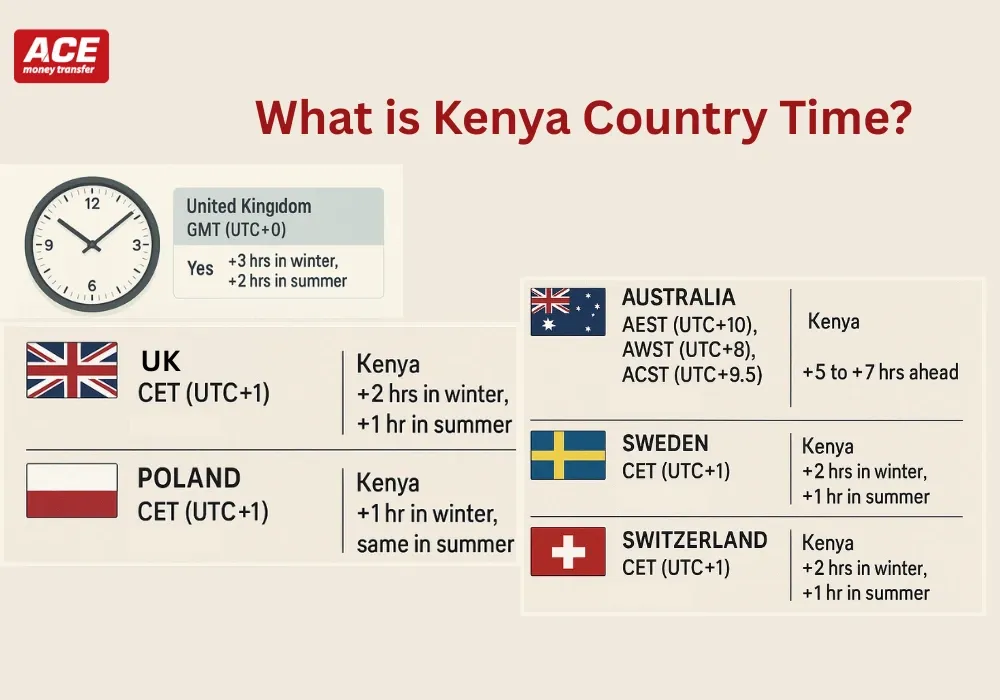
Kenya time, fixed at UTC+3, is a reliable reference point for business, travel, and expat communication across the world. Here is how it compares to key regions.
United Kingdom:
During British Summer Time (BST, UTC+1), Kenya is 2 hours ahead of London. On 25 August 2026, when it was 13:57 in London, it was 15:57 in Nairobi.
In winter, Kenya is 3 hours ahead of the United Kingdom when London reverts to GMT (UTC+0).
North America (Canada and the US):
Kenya is 8 hours ahead of Eastern Time in the United States during standard time, and 7 hours ahead of Eastern Time during daylight saving time.
Kenya is 6 hours ahead of Toronto, Canada during northern winter, and about 7 hours ahead in summer.
Kenya is roughly 10–11 hours ahead of Vancouver, British Columbia, depending on the season. Travelers from regions with a large time difference-including the Pacific islands and territories-may experience jet lag when traveling to Kenya.
Europe, Middle East, and Australia:
Central European countries like Germany, Austria, and Malta are usually 1–2 hours behind Kenya, depending on their daylight saving time status.
Some Middle Eastern countries share the same UTC+3 offset, meaning their local time can match Kenya time for much of the year.
In addition, Australia is generally 7–8 hours ahead of Kenya, depending on the specific state and whether DST is in effect there.
Best conference call windows:
For UK–Kenya business calls, a good window is 9:00 AM–3:00 PM BST, which corresponds to 11:00 AM–5:00 PM Kenya time.
For US–Kenya calls, Kenyan late afternoon overlaps with early US morning hours, making that the most practical meeting window.

A single, fixed nationwide time zone simplifies daily life across the Republic of Kenya for residents, visitors, and businesses alike. Whether skies bring clouds or clear weather, the clock reads the same from coast to highland.
Nairobi, Mombasa, Kisumu, Nakuru, and Eldoret are key economic and cultural hubs, all sharing the same Kenya time.
Typical office hours in major cities run from about 8:00 AM to 5:00 PM EAT. Informal markets often operate more flexibly, and agricultural activities in rural Kenya follow seasonal rains, not clock time. Islamic prayer times also influence daily routines in many communities.
Economic impact: Kenya's stable East Africa Time supports regional trade and logistics, as Kenya aligns with neighbours like Tanzania and Uganda within the East African Community. Consistent local time makes it easier to coordinate transportation, tourism, and regional investment across east Africa.
Expats and remittances: Millions of Kenyans abroad rely on Kenya's fixed UTC+3 time to coordinate family calls and money transfers. Kenya's fixed UTC+3 time enhances communication for expats who need to stay connected with home, and remittances to Kenya have reached hundreds of billions of Kenyan shillings in recent years, representing a significant share of GDP.
Digital tools for planning: Online time zone converters are invaluable for comparing Kenya time with your home time zone. Website owners can also embed a simple Kenya clock widget or world clock anchored to "Africa/Nairobi" to display the current local time in Nairobi for international visitors.

Kenya's time zone may be straightforward, but its predictability is exactly what makes it powerful for international coordination. Whether you are scheduling a conference from London, managing trade routes through eastern Africa, or simply calling home from Canada, knowing that Kenya stays at UTC+3 all year removes one variable from an already complex world.