ACE Money Transfer
ACE Money Transfer
29 May 2026
If you hold an account with Nationwide Building Society and need to send or receive money internationally using Nationwide SWIFT Codes, the SWIFT code is the first thing you need to get right. Whether a family member abroad is sending money into your Nationwide account, an overseas employer is paying your salary, or you are receiving a wire transfer from a foreign client, this guide covers everything — the exact codes, what each part means, how international transfers work with Nationwide, and what to watch out for.
A SWIFT code — also known as a BIC, which stands for Bank Identifier Code — is a globally standardised identifier assigned to every bank and financial institution that participates in international money transfers. SWIFT codes, also known as BICs, are the standard format used to route international wire transfers securely between financial institutions. When funds move across borders, the SWIFT network uses these codes to route payments to the correct bank, in the correct country, at the correct location.
Nationwide Building Society is the largest building society in the world and one of the UK's most trusted financial institutions. Anyone sending money to a Nationwide account from abroad will need the correct SWIFT code to ensure the transfer reaches its destination without delay or misdirection. Nationwide Building Society is the world's largest building society, with total assets of £367.88 billion as of 2025 and over 16.4 million members — making it one of the UK's most significant institutions for both domestic and international banking.
The primary SWIFT code for Nationwide Building Society is:
NBSMGB22XXX
This is the code used for receiving international wire transfers into a UK Nationwide account. It is the code you share with anyone sending you money from outside the United Kingdom.
Nationwide Building Society may use different SWIFT codes for different types of services or transaction categories under Nationwide SWIFT Codes, and different codes may also apply to specific banking services. Always confirm the correct code directly with Nationwide through your online banking portal or by contacting their customer support before initiating or requesting a significant international transfer.
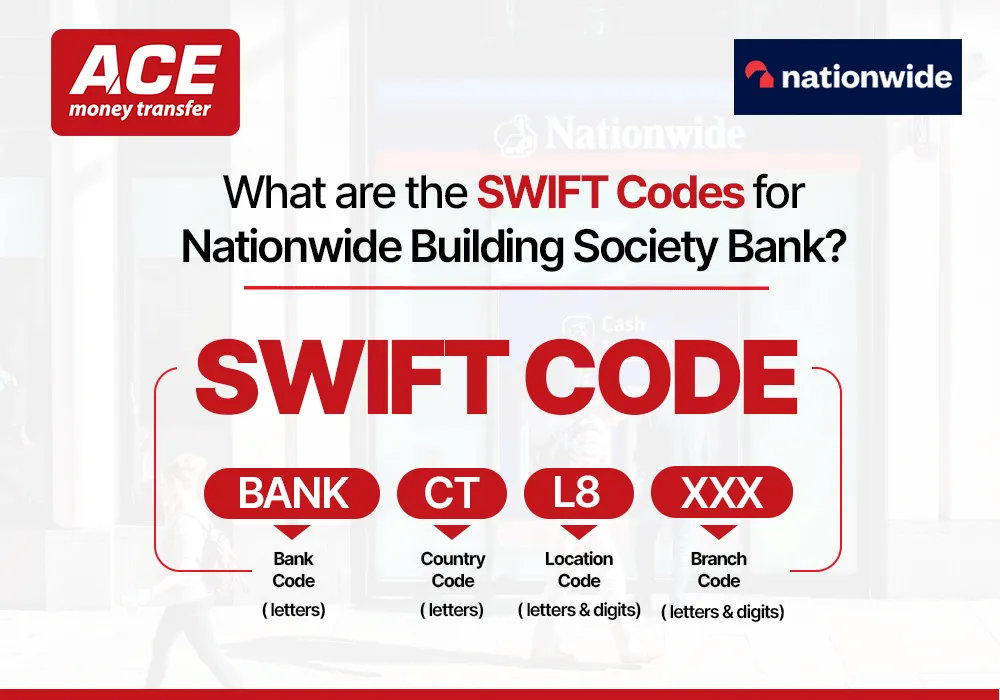
A SWIFT code is governed by international financial systems and breaks down into four parts: Bank Code, Country Code, Location Code, and Branch Code.
Breaking down NBSMGB22XXX:
All SWIFT codes are either 8 or 11 characters in total. An 8-character code or one ending in XXX always identifies the head office. A full 11-character code with a unique 3-digit branch suffix identifies a particular branch location. For most international transfers to Nationwide accounts, NBSMGB22XXX is the correct code to use.
Nationwide Building Society has more than one SWIFT code registered in the United Kingdom, and while Nationwide Building Society branches generally use the same banking details, codes can vary by service. The two known codes are:
If you are unsure which code to use, contact Nationwide customer support or check your online banking account details before sharing any code with a sender.
When someone is sending money to your Nationwide account from abroad, they will typically need the following banking information for your bank account:
| Detail | Information |
|---|---|
| Bank Name | Nationwide Building Society |
| SWIFT/BIC Code | NBSMGB22XXX |
| Bank Address | Nationwide House, Pipers Way, Swindon, SN38 1NW, United Kingdom |
| IBAN | Your personal IBAN, a unique 22-character international bank account number (available in online banking or on a recent statement) |
| Account Number and Sort Code | Available through online banking or in your passbook |
Your unique 22-character IBAN includes a country marker, check digits, Nationwide's code, your branch sort code, and your account number.
For transfers coming from Europe or any country that uses the IBAN system, you will almost always need to provide both your IBAN and the Nationwide SWIFT code. The SWIFT code identifies Nationwide Building Society as the receiving institution. Your IBAN identifies your specific account within that institution. Both are required for a complete and accurate international transfer.
For money moving within the United Kingdom — between UK bank accounts — you do not need a SWIFT code at all. Domestic UK transfers use sort codes and account numbers, processed through Faster Payments, BACS, or CHAPS depending on the amount and urgency. These systems are entirely separate from the international SWIFT network. Providing a SWIFT code for a domestic UK transfer is unnecessary and irrelevant — use your 6-digit sort code and 8-digit account number instead.
When an international payment crosses borders into your Nationwide account, it travels through the SWIFT network. There are two main types: SEPA payments for euros sent within the SEPA Zone, and SWIFT payments for other currencies. The sending bank uses the SWIFT code NBSMGB22XXX to identify Nationwide Building Society within the global network. The payment instruction then travels — sometimes directly, sometimes via one or more correspondent banks — until it reaches Nationwide’s systems. Nationwide then credits the funds to your specific account using your IBAN or account details. Nationwide clears these transfers through HSBC using intermediary BIC MIDLGB22. The UK sent over £9.08 billion in international remittances in 2024 — a 6% rise from 2023 — highlighting just how vital cross-border banking infrastructure like Nationwide’s SWIFT participation is for millions of UK residents.
Processing times for incoming international transfers to Nationwide typically range from one to five business days. Euro payments sent within the SEPA Zone usually arrive by the end of the next working day, while transfers in other currencies may take longer and depend on the destination. The exact timing depends on the sending country, the sending bank, the currencies involved, and whether the transfer passes through intermediary correspondent banks. Transfers can be arranged online or at a local branch, and Nationwide says there is no limit on how much can be sent in pound sterling or other currencies internationally, though SEPA and non-SEPA rules differ. You will receive confirmation through Nationwide’s online banking once the funds are credited. Some inbound SWIFT transfers may be blocked due to international sanctions, regulatory compliance checks, or restricted currencies.
You need the Nationwide SWIFT code in these specific situations:
The UK uses IBAN for international transfers, particularly within Europe. Nationwide accounts come with a full UK IBAN. A UK IBAN begins with GB, followed by two check digits, then the sort code and account number — 22 characters in total. You will need to provide both your IBAN and the Nationwide SWIFT Codes for international transfers. The SWIFT code tells the system which bank to deliver to. The IBAN tells the bank which account to credit. Missing either one can cause a transfer to fail or be delayed.
Sort codes are used exclusively for domestic UK transfers. They identify the bank and branch within the UK's domestic payment infrastructure. They play no role in international transfers and should not be confused with or substituted for a SWIFT code. When someone outside the UK asks for your bank details, provide your IBAN and SWIFT code — not your sort code alone.
Routing numbers are used in the United States to identify banks within the US domestic payment system. They are not used in the UK and have no relevance to Nationwide. If a US-based sender is transferring money to your Nationwide account, they need the Nationwide SWIFT code alongside your IBAN — not any routing number equivalent. The SWIFT code is the internationally recognised standard for cross-border transfers between the US and UK.
IFSC codes — Indian Financial System Codes — are used for domestic bank transfers within India. They identify specific bank branches within the Indian banking system and are entirely separate from the international SWIFT network. If someone in India is sending money to your Nationwide account, they use your Nationwide SWIFT code — NBSMGB22XXX — not any IFSC code. IFSC codes are only relevant for transfers staying within India's domestic payment systems.
Still confused about bank codes like SWIFT, IBAN, or sort codes? Check our complete guide on Bank Codes Explained to understand how they work and when to use them.
There are several straightforward ways to find your Nationwide account details and confirm the correct SWIFT code:
Yes, completely. Your SWIFT code is public information — it identifies the bank, not your personal account. Sharing it carries no financial risk whatsoever. It is the equivalent of giving someone the name and registered address of your bank.
Your IBAN and account number are also generally safe to share for the purpose of receiving money using Nationwide SWIFT Codes. The risk to your account comes only from sharing your online banking login credentials, your card PIN, your one-time passcodes, or full card details. You should never share any of these with anyone under any circumstances — including people claiming to be from Nationwide. The bank will never ask for these details through any external communication.
Did you know? Every international transfer to Nationwide relies on the Nationwide SWIFT Codes to correctly route money across global banking networks?
The primary SWIFT code for Nationwide Building Society is NBSMGB22XXX. This is the code registered to Nationwide House, Pipers Way, Swindon, and is the standard code used for receiving international wire transfers into a Nationwide UK account.
Yes. Nationwide Building Society has more than one registered SWIFT code in the UK. The primary code is NBSMGB22XXX. A secondary code — NABSGB2LXXX — also exists for certain services. Always confirm with Nationwide which code is appropriate for your specific transfer before sharing it with a sender.
Yes, in most cases. The SWIFT code identifies Nationwide Building Society as the receiving bank. Your IBAN identifies your specific account within Nationwide. Both are needed for a complete and accurate international transfer, particularly for transfers originating from Europe.
Most international transfers arrive within one to five business days. The exact timing depends on the sending bank, the countries involved, the currencies being exchanged, and whether the transfer passes through correspondent banks along the way.
No. Sort codes are only used for domestic UK transfers within the British banking system. For international transfers, the SWIFT code is the required identifier. Providing a sort code to an overseas sender will not substitute for the SWIFT code and will likely result in a failed or misdirected transfer.
Whether you are receiving an international salary, payments from overseas clients, or financial support from relatives abroad under Nationwide SWIFT Codes, the Nationwide Building Society SWIFT code — NBSMGB22XXX — is essential for processing global money transfers. Combined with your personal IBAN and account information, it provides everything required for someone to send funds directly to your Nationwide Building Society account from anywhere worldwide.
For sending money overseas quickly and securely, ACE Money Transfer offers a reliable solution with competitive exchange rates, direct bank deposits, transparent pricing, and real-time tracking — all without hidden charges across multiple international destinations.