ACE Money Transfer
ACE Money Transfer
04 Jun 2026
Healthcare in Ireland can get expensive fast. A single GP visit costs €50 to €70, and a prescription can run another €30 to €40 on top. If you're working a low-paid job, supporting family, or sending money home, those bills add up quickly.
The good news is that the Irish government has a system to help. It's called the medical card, and if you qualify, you get GP visits, prescriptions, hospital care, and even some dental and eye services for free.
This guide breaks down what the medical card is, who can get one, the 2026 income limits, and how to apply.
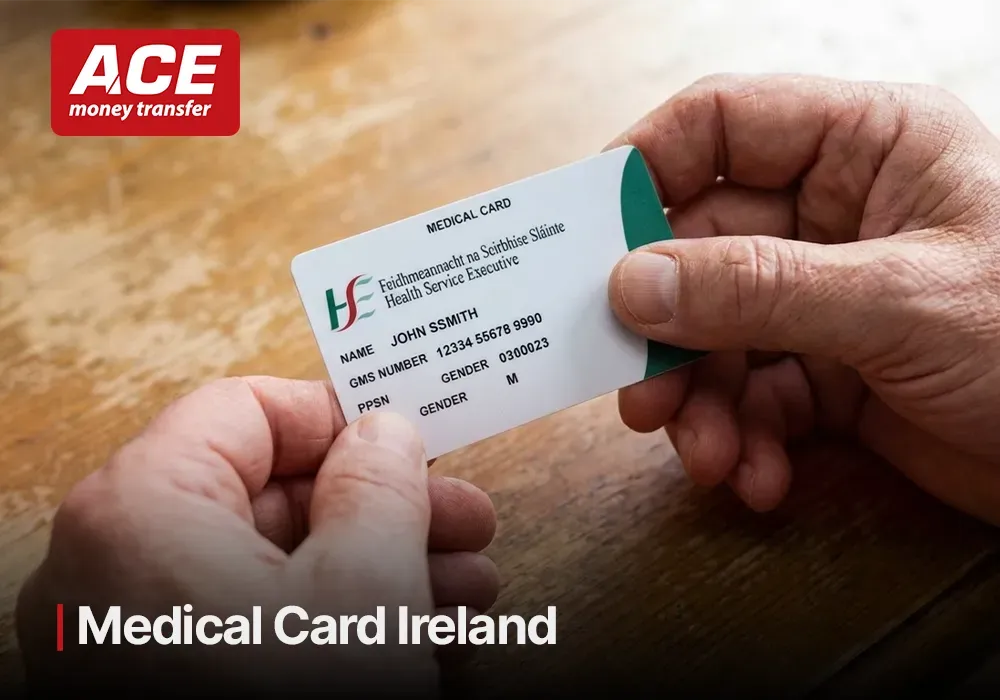
A medical card is issued by the Health Service Executive (HSE) and gives medical card holders free access to certain health services. Your dependent spouse, partner, and children can usually be included on the same card. They generally get the same range of covered services.
You must be ordinarily resident in Ireland to be eligible, which means you're living here and intend to stay for at least one year. Under the medical card scheme, there are three types of card: standard, GP Visit Card, and over-70 medical card. Eligibility is determined through a financial means test and assessment, and income thresholds depend on age, household size, and marital status. If you do not qualify for full cover, you may still have limited eligibility for some services.
If you're coming to Ireland from Ukraine under the Temporary Protection Directive, you can get a medical card immediately using a special application form.
A full medical card covers:
If you don't qualify for a full medical card on income grounds, you may still qualify for a GP visit card, which provides free GP services and represents limited eligibility rather than full cover.
There are two paths: through the means test or automatically because of your situation.
For people under 70, the HSE carries out an assessment of your net weekly income rather than just your gross pay. Allowable expenses like rent, mortgage payments, childcare costs, and travel-to-work costs are deducted before they apply the limit. Applicants must provide evidence of their household income and allowable expenses. In the means test, savings and property other than your own home may also be taken into account.
According to the Citizens Information under-70s means test guide, this net-income approach often means people on modest salaries qualify even if their gross pay looks high. For example, eligibility can depend on staying below a certain figure after deductions.
For people aged 70 and over, age affects the eligibility rules, and under HSE guidelines they are assessed using higher gross income thresholds instead. The 2026 limits are:
| Status | Weekly gross income limit |
|---|---|
| Single person aged 70+ | €550 |
| Couple, one or both aged 70+ | €1,050 |
Applicants over 70 have higher gross income thresholds for medical card eligibility than younger applicants.
If your only income comes from a social welfare or HSE payment, you'll get the medical card even if your income is over the basic rate.
If your income is above the limit but you'd struggle without one, you can apply for a discretionary medical card. The application is the same, but you should include extra information about your family's medical expenses in your application. In exceptional circumstances, including terminal illness, an Emergency Medical Card may be granted quickly.
Some groups qualify for full eligibility rather than limited eligibility. Per the HSE rules, this includes:
You still need to apply, and the HSE may ask for documentary evidence.
There are two ways to apply, both free.
Go to mymedicalcard.ie and fill in the form. You'll need to upload:
If needed, you can also contact the HSE about your application and email documents or applications to pcrs.applications@hse.ie.
The HSE aims to process applications within 15 working days.
Download the MC1 Medical Card Application Form, print it, complete it, and use postal applications to send it with your documents to the Eligibility Unit:
Postal applications are useful if you prefer not to apply online. You can track the progress of your application on the HSE website once it's submitted.
When you apply, you choose a GP from the HSE list of participating doctors, and your chosen GP must accept you as a patient before registration under the scheme. Usually the GP needs to be within 7 miles of where you live. If you apply online, the HSE contacts your chosen doctor directly to register you.
If three GPs in your area refuse to take you, the HSE will assign one to you. Include the names and clinics of the three refusing GPs on your application. If you move area later, you may need to choose a new doctor.
If you have a medical card, your child is automatically included as a dependent.
Some kids qualify for their own medical card without a means test:
Newborns: If you have a medical card and a baby, contact the Medical Card Unit with both PPS numbers, your medical card details, and a copy of the birth certificate.
Under 8s: Children under 8 automatically qualify for a GP Visit Card without a means test.
Aged 16 to 25: If you're financially dependent on a parent or guardian and they have a medical card, you can still get one but you need to apply separately. Even if you were on your parent's card before, you must reapply at 16, as age affects how your eligibility is assessed.
Your medical card has an expiry date and is subject to periodic review by the HSE. The HSE writes to you before it runs out asking for updated information.
A few things to remember:
If your application is refused, you can have it reviewed. The Appeals Office reviews your case using staff who weren't part of the original decision. Details for appeal are in your refusal letter, and your existing card may remain valid while a review is taking place if stated in HSE correspondence.
If you've recently moved to Ireland, the key requirement is that you must be ordinarily resident, which means living here and intending to stay for at least one year.
EU citizens working in Ireland can apply right away. Non-EU workers, including those from Pakistan, India, Bangladesh, the Philippines, and Nigeria, can apply once they're ordinarily resident with a valid work permit. International students generally don't qualify unless they meet specific hardship criteria.
For most non-EU workers in their first year, the path is to apply once you have an employment contract, a PPS number, an Irish address with an Eircode, and proof of income. Sorting those basics first makes the medical card application much smoother. For a fuller breakdown of how to settle in financially, see our financial guide for Pakistanis in Ireland.
A medical card is one of the most useful financial supports in Ireland. It saves you hundreds of euros a year in healthcare costs. For expats, low earners, and anyone supporting family on a tight budget, it's worth applying as soon as you're eligible.
Free up that monthly healthcare spend and you've got more flexibility to send money home to family. ACE Money Transfer is regulated by the Central Bank of Ireland and sends to over 100 countries with a fee-free first transfer. For new arrivals settling in, our cultural handbook for Indian expats in Ireland is also worth a read.
Anyone ordinarily resident in Ireland whose eligibility is determined by a financial means test for most applicants, with an assessment based on weekly income and thresholds that vary by household size and marital status. Some groups, like children with cancer or people from Ukraine under Temporary Protection, qualify without a means test.
For people over 70, the gross weekly limit is €550 for a single person and €1,050 for a couple. For under-70s, the HSE assesses your net income after tax, PRSI, and USC, with allowances for rent, mortgage, childcare, and other expenses, and may also take certain assets into account. Savings up to €36,000 for a single person and €72,000 for a couple are disregarded in the means test.
Yes. Anyone ordinarily resident in Ireland with a valid work permit can apply once they have a PPS number, address, and proof of income. EU citizens working in Ireland can apply immediately.
The HSE aims to process applications within 15 working days. Online applications are faster than postal ones.
A medical card gives broader benefits across state-run services, while a GP Visit Card only gives free GP services. A full medical card can also mean savings on state-run services and may reduce universal social charge in some cases.
Disclaimer: This article is intended for general informational and educational purposes only and should not be construed as legal, regulatory, tax, business, or financial advice. The views expressed are those of the author and do not necessarily reflect the views or positions of ACE Money Transfer. While reasonable efforts have been made to ensure accuracy, no warranty is given as to the completeness, accuracy, or currency of the information. Services and practices mentioned may vary by provider and jurisdiction. Readers should consult qualified professional advisors before making any financial or business decisions.
Enjoy guaranteed competitive INR exchange rates, ultra-fast transfers, and zero fee promotions directly to bank accounts and UPI wallets across India.
Ireland Employment & Schemes | Ireland Family & Allowances |