
ACE Money Transfer
ACE Money Transfer
15 May 2026
CEC Bank is not just any Romanian bank. Founded in 1864 — making it the oldest continuously operating bank in Romania and one of the oldest financial institutions in Eastern Europe — it carries a unique distinction that no other Romanian bank can claim: it remains wholly owned by the Romanian state through the Ministry of Public Finance. For the millions of Romanians spread across Europe and beyond, CEC Bank is often the institution their families at home have trusted for generations. If someone abroad is sending money to a CEC Bank account, or if you are expecting a wire transfer into yours, this guide covers everything — the correct CEC Bank SWIFT codes, how each character is structured, how international payments flow through the bank's network, and what every sender needs to know before initiating a transfer.
Before diving into SWIFT codes, it helps to understand the financial context surrounding CEC Bank's role in international transfers. Romania occupies a remarkable dual position in global remittance flows.
In 2024, Romania had the highest share of emigrants among all EU member states, with approximately 24% of its population — around 4.6 million people — living abroad, up from 14.7% of the population in 2010. The largest Romanian communities abroad are concentrated in Germany (968,697), Italy (880,402), and the United Kingdom (713,578). The money these communities send home passes through Romanian banks — and CEC Bank, with its unrivalled national branch network, is one of the primary receiving institutions.
Romania's banking system uses a structured set of codes depending on whether a transfer is domestic or international. Understanding which code applies to which situation is the foundation of getting a transfer right.
IBAN — International Bank Account Number is the primary identifier for individual accounts. Romanian IBANs begin with RO and are 24 characters long. The IBAN encodes your bank identifier and account number and is used for both domestic and international transfers. This is what identifies your specific account.
SWIFT codes — also called swift bic codes — identify the bank as an institution in the international payment network and consist of 8 or 11 characters. While your IBAN identifies your account, the SWIFT code tells the SWIFT network which bank to route the payment to. For any transfer arriving from outside Romania into a CEC Bank account, the SWIFT code is essential.
Domestic routing codes within Romania are used for transfers between Romanian banks through the national interbank infrastructure — entirely separate from SWIFT.
For international wire transfers, IBAN and SWIFT code work together. One identifies your bank. The other identifies your account. Both are non-negotiable.
The primary SWIFT code for CEC Bank S.A. in Romania is:
CECEROBUXXX
This is the head office SWIFT code registered to CEC Bank's Bucharest headquarters at Calea Victoriei 11-13, including Calea Victoriei 13, Bucharest. It is the standard and universally accepted code for receiving international wire transfers into any Romanian CEC Bank account.
One important fact about CEC Bank's SWIFT codes: while some banks use different swift codes or different codes for different branches or specific banking services, CEC Bank primarily operates with a single unified SWIFT code — CECEROBUXXX — for its standard banking operations. This means there is usually less need to verify branch-level variations than at banks with different branches.
In 2024, CEC Bank's total assets grew by 17.25% to reach 109.43 billion RON, holding a 10.95% market share and ranking as the third largest bank in Romania — a remarkable rise from the 6.5% market share it held in 2018. (TheBanks.eu) This expansion has made CEC Bank an increasingly significant destination for international wire transfers from the Romanian diaspora.
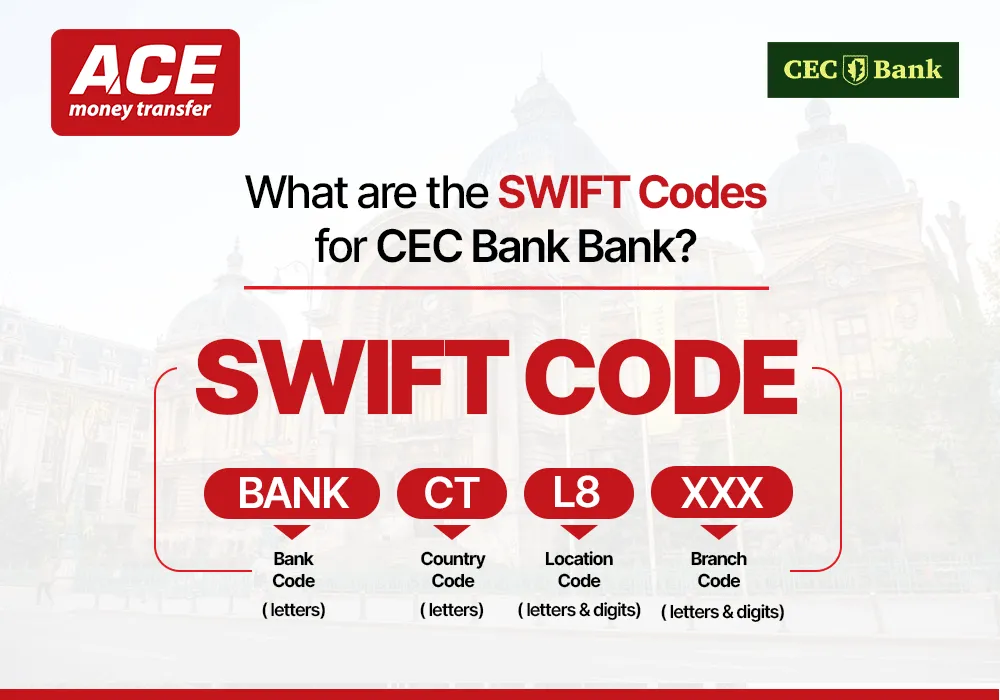
Breaking down the CEC Bank SWIFT code character by character gives an example of how this 11-character code communicates with the international payment system:
When someone abroad is sending an international wire transfer to your CEC Bank account, they will need the following information to complete the payment correctly, and they should check and double check the recipient details before submitting the transfer:
Always provide both your IBAN and the SWIFT code together. The SWIFT code routes the payment to CEC Bank as the receiving institution. The IBAN routes it to your specific account. Providing one without the other is incomplete and will typically result in the transfer being returned or held for additional information.
Using a wrong swift code can cause a delayed or failed transaction, so if the sender is unsure, they should confirm the exact swift code before sending.
For transfers between Romanian bank accounts — whether personal, business, or between different Romanian banks — SWIFT codes play no role. Romanian domestic transfers use IBANs processed through the national interbank payment system. This infrastructure is entirely separate from the international SWIFT network.
If a Romania-based sender is transferring money to your CEC Bank account from another Romanian bank, they need only your IBAN. Providing a SWIFT code for a domestic Romanian transfer is unnecessary and will not affect processing.
When an international wire transfer for your CEC Bank account is initiated, including international money transfers, the payment enters the SWIFT network at the sending bank. The sending institution looks up CECEROBUXXX to identify CEC Bank within the global SWIFT directory, and before a swift payment is released, the sender should confirm the recipient name, IBAN, and SWIFT details. The payment instruction then travels toward Romania — directly between the two institutions if they have a bilateral relationship, or via one or more correspondent banks if a direct relationship does not exist.
Once the payment instruction reaches CEC Bank's systems in Bucharest, CEC Bank credits the funds to your specific account using your IBAN. Most international transfers arrive within one to five business days, depending on the sending country, currencies, sending bank's processing schedule, and any correspondent bank routing, though incorrect details can delay the transaction.
The Romanian National Bank's balance of payments data shows that personal remittances received from Romanians abroad amounted to over USD 9.5 billion in 2024 — making Romania one of the largest per-capita remittance-receiving economies in the European Union. (The Global Economy) Much of this flows through CEC Bank's extensive national network, particularly to families in rural and smaller urban communities across the country.
You need the CEC Bank SWIFT code — CECEROBUXXX — in these specific situations:
European countries use IBAN as the standard account-level identifier for international transfers. For any transfer arriving from Europe into your CEC Bank account, both your Romanian IBAN and the SWIFT code CECEROBUXXX are required. The SWIFT code identifies CEC Bank as the Romanian institution. The IBAN identifies your specific account within CEC Bank. A European transfer submitted with only a SWIFT code and no IBAN cannot be credited to any specific account and will be returned.
Routing numbers are nine-digit codes used exclusively within the United States domestic banking system to identify financial institutions for domestic US transfers. They have no role in international wire transfers leaving the US. If someone in the United States is sending a wire to your CEC Bank account in Romania, they need your Romanian IBAN and CECEROBUXXX — not a routing number. US-based senders will be asked for the receiving bank's SWIFT code as part of their bank's international wire transfer form.
IFSC codes identify specific bank branches within India's domestic payment network for NEFT, RTGS, and IMPS transfers. They are exclusively domestic tools and carry no meaning in international cross-border transfers. If someone in India is sending an international wire to your CEC Bank account, they provide CECEROBUXXX and your IBAN — not any IFSC code.
| Method | How to Find the IBAN / SWIFT Code | Key Details |
|---|---|---|
| CEC Bank Online Banking | Log into your CEC Bank internet banking account and open the account details section | Your IBAN and SWIFT code are displayed alongside your account number and sort code |
| CEC Bank Mobile App | Open the CEC Bank mobile app and access your account information | Your IBAN appears under account details, while the SWIFT code is available in the international payments section |
| Bank Statements | Review your CEC Bank account statements | Statements include your IBAN and may also reference the BIC/SWIFT code, especially if you have received international transfers |
| CEC Bank Branches | Visit any CEC Bank branch for assistance | CEC Bank operates over 1,000 branches and territorial units across Romania, including more than 800 rural locations, making in-person verification widely accessible |
| CEC Bank Customer Service | Contact CEC Bank through official customer support channels | Customer service can confirm the correct SWIFT code before making a high-value international transfer |
Accuracy matters here because one wrong detail can affect the transaction.
| Common Mistake | What Happens | Correct Approach |
|---|---|---|
| Using a SWIFT code for domestic Romanian transfers | Creates unnecessary confusion because Romanian domestic payments do not use the SWIFT network | Use only the recipient’s IBAN for transfers between Romanian bank accounts |
| Typing CECEROBUXXX with spaces or breaks | Banking systems may reject or fail to process the transfer | Enter the SWIFT code exactly as one continuous string: CECEROBUXXX |
| Providing only the SWIFT code without the IBAN | The bank can identify the institution but not the individual account | Always provide both the IBAN and SWIFT code together for international transfers |
| Failing to verify the IBAN carefully | Even one incorrect character can send funds to the wrong account or cause rejection | Copy the 24-character Romanian IBAN directly from official banking sources rather than entering it manually, and verify the recipient details with the bank to avoid delays |
| Relying on an old SWIFT code from outdated documents | Older codes may no longer be valid for international processing | Check the official CEC Bank page or contact the bank to confirm the current code before making important transfers |
Absolutely not. Your SWIFT code is public information — it identifies CEC Bank SA as a Romanian banking institution, not your individual account. Sharing it with anyone, including those sending you money from abroad, carries no financial risk.
Your IBAN is also safe to share for the purpose of receiving payments. It enables someone to credit your account but cannot be used to access it, authorise payments from it, or retrieve any personal financial information about you.
What you should protect carefully and never share with anyone: your CEC Bank internet banking username and password, your card PIN, one-time security codes sent to your phone, or your full card details including expiry date and CVV. CEC Bank will never request any of these through an unsolicited call, email, or text message. Any such request should be treated as a fraud attempt and reported to CEC Bank immediately through their official channels.
This information is general guidance only, and you should verify all details with CEC Bank before any international transaction in respect of official bank confirmation and the limits of how this information is used.
CEC Bank carries 160 years of financial history and a branch network that reaches further into rural Romania than any other institution. When someone abroad sends money to a CEC Bank account, they are connecting to that legacy through a single code: CECEROBUXXX. Pair it with your 24-character Romanian IBAN — available instantly through your CEC Bank app or any branch — and you give any sender around the world everything they need to transfer funds directly to your account.
For Romanians living abroad who regularly send remittances home to family banking with CEC Bank, finding a reliable and affordable transfer platform makes a direct difference to the total amount received. ACE Money Transfer's practical guide covers exactly this: How to Send Money to Romania Online Safely — with information on transfer methods, costs, and what to look for in a remittance service for the Romanian corridor.
If you are sending money internationally and need a fast, transparent, and cost-effective option, ACE Money Transfer delivers competitive exchange rates, direct CEC Bank account delivery, and real-time transfer tracking — with no hidden charges at any stage of the process.
The primary SWIFT code for CEC Bank SA is CECEROBUXXX. This is registered to CEC Bank's Bucharest head office at Calea Victoriei 11-13 and is the standard code for receiving international wire transfers into Romanian CEC Bank accounts.
CEC Bank primarily operates with a single unified SWIFT code — CECEROBUXXX — for standard banking operations, making it simpler to use than banks with multiple branch-specific codes. Always verify with CEC Bank directly if you receive conflicting information.
CEC Bank was founded on 28 July 1864, making it Romania's oldest continuously operating bank — over 160 years old. It is wholly owned by the Romanian Ministry of Public Finance and has remained in state hands through all of Romania's post-communist banking privatisations, serving a public mandate for financial inclusion particularly in rural areas.
Yes. The SWIFT code identifies CEC Bank as the receiving institution within the international payment network. The IBAN identifies your specific account within CEC Bank. Both are required for a complete and accurate international wire transfer.
Most international wire transfers arrive within one to five business days. The exact timing depends on the sending country, currencies involved, and whether correspondent banks are involved in the routing. Transfers sent during Romanian business hours on weekdays typically process most efficiently.
Disclaimer: This article is intended for general informational and educational purposes only and should not be construed as legal, regulatory, tax, business, or financial advice. The views expressed are those of the author and do not necessarily reflect the views or positions of ACE Money Transfer. While reasonable efforts have been made to ensure accuracy, no warranty is given as to the completeness, accuracy, or currency of the information. Services and practices mentioned may vary by provider and jurisdiction. Readers should consult qualified professional advisors before making any financial or business decisions.
Enjoy guaranteed competitive PKR exchange rates, ultra-fast transfers, and zero fee promotions directly to bank accounts and mobile wallets.