
31 Oct 2025
Every cheque carries a coded line of numbers along its bottom edge, and each of those numbers serves a specific purpose in routing payments, identifying accounts, and keeping financial records straight. While digital payments have grown rapidly, canadian cheques still play a major role in rent, payroll, and business transactions across Canada-and understanding the numbers printed on them saves time and prevents costly errors.
This article focuses primarily on canadian cheque numbers, though formats differ slightly in countries like the U.S. and India. Here is what you will learn:
What a cheque number is and how it differs from transit, institution, account, and routing numbers
Where each number appears on a Canadian cheque and how to read them correctly
How cheque numbers help with record keeping, fraud prevention, and payment tracking
Common situations where these numbers matter: setting up direct deposit, pre-authorized debits, online banking forms, bill payments, and resolving payment disputes
How Canadian cheque formats compare with those in other many countries
A cheque number is the unique serial number assigned to each individual cheque leaf in a chequebook. If you open a fresh book, you will see numbers like 001, 002, 003 or perhaps 101, 102, 103 printed on each leaf. Cheque numbers typically consist of 3-6 digits, depending on the financial institution and region.
The cheque number itself does not move money. Instead, cheque numbers serve as unique identifiers for specific cheques throughout their lifecycle-from the moment you write a cheque to the point it clears or is cancelled. They exist to help you and your bank identify that specific piece of paper for tracking, reconciliation, and security purposes.
Here is how a cheque number works in practice:
Each cheque has a unique serial number for tracking, linking it to entries in your chequebook stubs, accounting software, or online banking history
Cheque numbers help track payments and identify specific transactions, making it easy to match a cheque payment to a particular invoice, rent payment, or bill
Cheque numbers help prevent duplicate payments in transactions by giving you a clear reference for every outgoing payment
They provide a clear reference for payroll audits and discrepancies
Typical lengths vary by region: often 3 digits on Canadian cheques, 4 digits on many U.S. cheques, and 6 digits on some Indian cheques. The cheque number is always shorter than-and independent from-the account number, transit number, and routing number, which we will cover in later sections.
Canadian cheques have two main zones: a top section with personal and payment details, and a bottom section containing the banking information encoded in the MICR line using magnetic ink.
Top section:
Issuer's name and address in the top left hand corner
Date field in the top right corner
The payee line ("Pay to the Order of") where you write the named payee
A cheque amount box for the specified amount in numbers
An amount-in-words line to confirm the cheque amount
A memo line for notes about the payment's purpose
A signature line at the bottom right of this section
Bottom MICR line (magnetic ink character recognition):
The numbers printed along the bottom of a Canadian cheque follow a specific order, read from left to right:
Cheque number (the first field, typically 3-6 digits)
Transit number (5 digits identifying the specific branch)
Institution number (3 digits identifying the bank)
Account number (7-12 digits linking to your bank account)
This sequence is standardized under Payments Canada's Standard 006, which governs how all MICR-encoded payment items must be printed. The E-13B font used for these characters is designed so machines can scan and route cheques quickly through Canadian clearing systems.
While exact layout details can differ slightly between banks like TD, RBC, Scotiabank, CIBC, and BMO, the core elements and the order of the bottom numbers stay the same across all Canadian financial institutions.

On most Canadian cheques, the cheque number appears in two places. Cheque numbers are usually found in the top-right corner of the cheque leaf, printed in standard ink. The same number appears as the first field on the MICR line at the bottom of the cheque. Cheque numbers appear in the top-right corner and bottom MICR line of a cheque, so you can cross-reference both locations to confirm you are reading the right designation number.
In a chequebook, the detachable stub also shows the cheque number, and it should match the number on the cheque leaf exactly. For example, if you write cheque 103 for January rent, your stub should record "103" alongside the date, payee, and amount.
Key details about cheque numbering:
New cheque books usually start numbering at 001 or 101 and increase sequentially (e.g., 001–050 or 601–650)
Sequential tracking of cheque numbers helps identify missing cheques-gaps in the sequence may indicate voided, lost, or unrecorded cheques
Cheque numbers provide a chronological trail of payments, making it straightforward to see which cheques have been used
Be aware that temporary or counter cheques from a branch may have a generic layout where you need to write or confirm the cheque number manually. Always check that it aligns with your bank's records. When entering a cheque number in online banking-for stop payments or support requests-double-check the digits from both the top of the cheque and your chequebook stub to avoid mistakes.
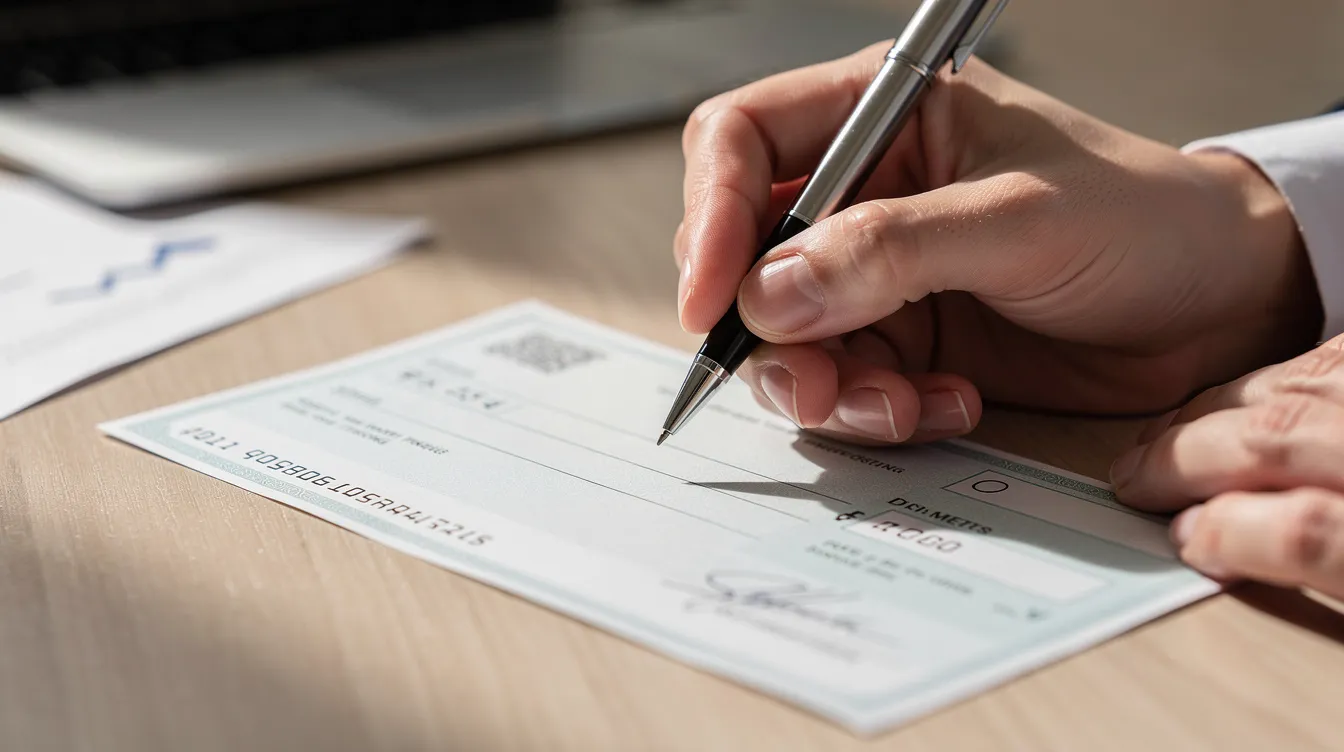
The transit number, also called the branch number, is a five-digit code on Canadian cheques that identifies the specific branch where your bank account was originally opened. The transit number is a five-digit number after the cheque number in the MICR line, often separated by a transit symbol in the E-13B font.
On some cheques, the transit number also appears near the top of the cheque alongside the bank's branch address. Even if you primarily bank online or at different branches, your transit number usually stays tied to the "home" branch where the account was set up.
Here is where the transit number matters in everyday banking:
Setting up direct deposit for employment income or government benefits requires your transit number
Pre-authorized debits for utilities, insurance, and loan payments need it as well
Payroll departments and government agencies (such as CRA for tax refunds) use it to route funds to your specific branch
A sample transit number might look like "40611" for a branch in Ottawa. When combined with the institution number, it forms part of the routing number used for electronic transfers and automated processing across the Canadian payments system.
If you are filling out a form for transferring funds and the form asks for your "branch number," this is your transit number.
The institution number is the 3-digit code that identifies your financial institution across all of Canada, regardless of which branch you use. The institution number identifies your bank and is three digits long.
Here are some of the most common institution numbers for major Canadian banks:
BMO (Bank of Montreal) = 001
Scotiabank = 002
RBC (Royal Bank of Canada) = 003
TD (Toronto-Dominion) = 004
CIBC = 010
Desjardins caisses often use 815
On your cheque, the institution number appears on the MICR line immediately after the transit number. Unlike transit numbers, which change from branch to branch, one institution number applies to every branch of the same bank across the country.
When you fill out forms for direct deposit, bill payments, or other banking transactions, you will typically need to enter all three: transit number, institution number, and account number-exactly as they appear on your cheque. Getting even one digit wrong can delay payments or send funds to the wrong account, so take a moment to verify before submitting.
The account number is the unique series of digits that ties your cheque to your personal or business account at a specific bank. Account numbers on cheques can be between 7 to 12 digits long, depending on the financial institution and the type of account.
On a Canadian cheque, the account number sits to the right of the institution number on the MICR line. It is the final numeric field in the MICR encoding. When setting up direct deposit, payroll, or automatic withdrawals, this number must be entered exactly as it appears-including any leading zeros.
Important points about account numbers:
Some banks pad account numbers with leading zeros (e.g., "0001234567"), and those zeros are part of the number. Omitting them on forms can cause transactions to fail or be routed incorrectly.
The account number plus the transit and institution number together provide full access to your bank account for deposits and debits. Share this account information only with trusted, verified organizations.
A sample 7-digit account number might look like "1234567" at one bank, while another bank uses 12 digits like "000123456789."
Most online banking and mobile apps display the account number-sometimes partially masked for security-and many Canadian banks now offer a downloadable "void cheque" or direct deposit form that reproduces your transit, institution, and account number in standard cheque format. This is especially useful for the account holder who no longer carries a physical chequebook.
The Canadian routing number is an 8-digit combination of the 5-digit transit number and the 3-digit institution number, commonly formatted as XXXXX-YYY. It identifies both the financial institution and the specific branch for the purpose of electronic funds transfers, pre-authorized debits, and direct deposit.
Here is a simple example:
Transit number: 12345
Institution number: 004 (TD Bank)
Routing number: 12345-004
This is different from the 9-digit ABA routing number used on U.S. cheques, which appears near the bottom-left of American checks and follows a completely different structure. Canadian routing numbers work within Canada-only clearing systems, while U.S. routing numbers serve the American banking network.
When filling out forms, some ask for "branch/transit" and "institution" separately, while others ask for the full routing number. Either way, the information comes from the same MICR line on your cheque.
Who typically requests the routing number:
Payroll departments when you start a new job
Government agencies like CRA for tax refund deposits
Investment firms when linking to your Canadian bank account for making payments or receiving distributions
Landlords or property managers setting up pre-authorized rent withdrawals
Always confirm you are entering the Canadian format and not copying a U.S. routing number format from an online example.

Understanding the difference between these three numbers is essential for reading any cheque correctly and knowing which number to provide in different situations.
| Feature | Cheque Number | Routing Number | Account Number |
|---|---|---|---|
| What it identifies | A single cheque leaf | The bank and branch | Your own account |
| Typical length | 3-6 digits | 8 digits (5+3) | 7-12 digits |
| Changes? | Every cheque | Only if you switch branches | Only if account is closed/reopened |
| Used for | Tracking, stop payments, reconciliation | Directing funds to the right bank/branch | Identifying which account to debit or credit |
Routing and account numbers are used repeatedly across many transactions-every deposit, every pre-authorized debit, every wire transfer. The cheque number, on the other hand, is unique to a single cheque payment and is never reused.
Here are two scenarios that show the difference:
Setting up a gym membership debit: The gym needs your transit number, institution number, and account number (routing + account) but does not need a cheque number. These numbers ensure funds are withdrawn from the correct bank account.
Stopping payment on a lost cheque: You must provide the specific cheque number to your bank, along with the cheque amount, date, and payee, so the bank can intercept that particular cheque if it is presented. To cancel a lost cheque, you must provide the specific cheque number to your bank.
A cheque can still be processed smoothly even if someone miscopies the printed cheque number from the top corner, because machines rely on the MICR line for routing and account information. But for non-automated tasks like stop payments, disputes, or support calls, the cheque number is indispensable.
Sequential cheque numbers make it easy to maintain organized financial records for both personal and business transactions. When you write cheque 152 for May 2026 rent, then cheque 153 for a utility bill, you create a clear, numbered trail of every payment leaving your account.
You should record the cheque number in your cheque register after issuing a cheque. Alongside the number, note the date, payee, cheque amount, and purpose. This simple habit pays dividends when it is time to reconcile your bank statement.
Best practices for cheque-based record keeping:
Record every cheque immediately-even if you are in a rush. Cheque numbers aid in maintaining organized financial records over time.
Watch for gaps in the sequence. A missing number could mean a voided cheque, a lost cheque, or one you forgot to record. Sequential tracking helps identify missing cheques before they become a problem.
When reconciling your bank statement or online banking transaction list, match entries by cheque number to confirm that payees deposited the correct amounts. Cheque numbers facilitate automatic payment reconciliation in accounting software.
Many businesses require cheque numbers on invoices or remittance advice to speed up payment matching and reduce back-and-forth communication with suppliers.
Cheque numbers aid in estate management by tracking transactions-executors can review cheque registers to identify obligations and outstanding payments.
For business accounts, accounting software like QuickBooks or Sage typically includes a cheque number field alongside vendor, date, and amount. This makes future audits or vendor queries traceable and helps avoid confusion when reviewing months of business transactions.
Modern online banking platforms display cleared cheque images alongside cheque numbers, dates, payees, and amounts. This makes it easy to confirm which cheque was cashed and when, without needing to call your bank or visit a branch.
Most mobile banking apps let you search or filter by cheque number or cheque status-such as "in transit," "cleared," or "returned." This is especially useful for a business account where dozens of cheque transactions flow through each month.
Here are practical ways digital tools use cheque numbers:
Confirming a payment cleared: A contractor asks whether you mailed the cheque. You open your bank app, search for cheque 214, and confirm it cleared on June 3.
Downloading a void cheque: Many Canadian banks let you download a void cheque PDF from your online banking portal, which reproduces your transit, institution, and account number in standard format-ready to submit to an employer or government agency for direct deposit setup.
Accounting software integration: Tools like QuickBooks, Xero, and Wave include dedicated fields for cheque numbers. When bank feeds import transactions, the cheque number links the digital record to the physical cheque, improving audit trails.
Using cheque numbers consistently in online systems simplifies locating specific payments months or years later. Instead of scrolling through hundreds of transactions, you search by cheque number and find exactly what you need. This saves time, reduces errors, and supports clean financial reporting.
The cheque number helps prevent fraud by identifying irregular transactions. If a cheque is lost, stolen, or altered, the cheque number gives you and your bank a unique reference to identify and potentially stop that specific payment.
Here is how a stop payment typically works in Canada:
You contact your financial institution
You provide the cheque number, cheque amount, payee, and date
The bank flags that specific cheque so it will be rejected if presented for deposit or cash
The financial meaning of the word "check" historically relates to preventing forgery-a fitting origin for a negotiable instrument that still depends on numbered tracking to catch unauthorized activity.
Fraud detection tips using cheque numbers:
Watch for cheque numbers you never wrote appearing as cleared in your bank account. This could indicate a counterfeit or unauthorized cheque tied to your account number.
If cheque numbers appear out of sequence-say cheque 50 clears before 49, or a number you skipped shows up-investigate immediately.
Never sign blank cheques. Even though the cheque number still provides a trace, a signed blank cheque gives a dishonest person full control over the payee and amount.
Store unused cheques securely, line out unused space on amount lines, and review your cheque sequence regularly for unexplained gaps.
While cheque numbers themselves are not secret, the sensitive data on a cheque is your routing and account information. Share cheque images or void cheques only when necessary and only with trusted parties to prevent fraud.
Not every cheque follows the standard personal chequebook format. Business, temporary, and replacement cheques each have their own quirks worth understanding.
Business cheques often include additional internal numbering, such as department codes or cost-centre indicators, alongside the standard cheque, transit, institution, and account numbers in the MICR line. Many businesses use pre printed cheques with company logos and sequential numbering that integrates with their accounting systems.
Temporary or counter cheques are issued at a branch when you need a cheque immediately. These may have pre printed MICR lines but generic layouts. Pay close attention to the cheque number sequence when you later order full chequebooks, since temporary cheques may use a separate numbering range.
Replacement cheques come into play when a cheque is lost or voided. The business or individual issues a new cheque with a different cheque number and records both the original (now a cancelled cheque) and the replacement number. This prevents double payments and keeps the audit trail clean.
Some additional cheque types worth knowing:
A bearer cheque is payable to the holder of the cheque-whoever presents it can withdraw money
An order cheque is payable only to the named person or endorsed individual written on the payee line
A crossed cheque features two parallel lines drawn across it, meaning it can only be deposited into a bank account, not cashed over the counter. Those parallel lines signal to the bank that the cheque must go into the payee's account
A post dated cheque carries a future date and cannot be cashed before its specified date
A self cheque is written by the account holder to themselves on their own account
A banker's cheque or bank draft carries its own number and the funds are guaranteed by the issuing institution
An open cheque has no crossing and can be cashed at the counter
Aligning internal accounting records with the correct cheque number when reissuing or cancelling cheques is essential for many businesses handling payroll, supplier refunds, or damage deposit returns.
Cheques have origins in ancient banking systems, like bills of exchange, and the first known cheque was drawn in London on February 16, 1659. The term "cheque" originated from the French word "chèque," and the spelling became standard in the Commonwealth around 1828. The original English spelling was "check," used interchangeably until the 20th century-which is why Americans still write "checks" while Canadians write "cheques."
Canada vs. United States:
U.S. cheques use a 9-digit ABA routing number printed at the bottom left, compared to Canada's 8-digit routing number (transit + institution). Cheque numbers on American checks are often 4 digits and may appear at both the top right and bottom of the MICR line. The term "checking account" replaces "chequing account."
India:
Indian cheques commonly feature 6-digit cheque numbers alongside a 9-digit MICR code identifying bank and branch. A stale cheque is invalid after three months from its issue date in India, compared to six months in Canada. Physical cheques continue to be used for large payments, though digital alternatives are growing.
United Kingdom and Europe:
Cheque usage has declined dramatically. Where cheques are still used, sort codes (6 digits) and account numbers serve as primary routing identifiers. A traveller's cheque, designed for safe currency exchange while traveling, has also largely been replaced by cards and digital transfers.
Despite these differences, the core idea is consistent across all countries: each cheque leaf has a unique serial number for tracking and reconciliation. If you are filling out Canadian direct deposit or pre-authorized debit forms, always follow Canadian routing and account number conventions-never copy formats from foreign examples.
Do cheque numbers have to be in perfect sequence?
No. Gaps are allowed when cheques are voided, destroyed, or skipped. However, you should document why any numbers are missing. Unexplained gaps can raise questions during audits or make it harder to identify if a cheque was lost or misused. Good record keeping means noting voided numbers alongside active ones.
Can a bank process a cheque if the printed cheque number is damaged?
In most cases, yes. Automated processing relies on the MICR line, so if the MICR-encoded data is intact, the cheque can be processed smoothly. If the MICR itself is damaged, manual review may be necessary, which slows things down and could lead to the cheque being returned. The number appears in the MICR line as a backup to the printed version in the top right corner.
Do cheque numbers reset when you change branches?
Generally, no. Cheque numbers are assigned per chequebook series, not per branch. If you close an account and open a new one, a new chequebook with a fresh number series will begin. Simply switching branches within the same bank does not reset your cheque numbering.
Is it safe to share cheque numbers with payees?
Yes, the cheque number alone is not sensitive. The risk lies in sharing your full account and routing details or signing blank cheques. Only provide void cheque images to verified, trusted organizations when truly necessary-for instance, when an employer needs your banking information for payroll.
What if I accidentally issue a duplicate cheque payment?
Use cheque numbers and bank records to identify both cheques. Contact the payee to arrange a refund or credit. If both cleared, your bank may assist in resolving the issue. Cheque numbers help prevent double payments because you can quickly see in your register that you issued two cheques for the same invoice. Having cheques continue to be referenced in your ledger is the simplest way to catch this early. Ensure the payee also has sufficient funds context-amount, date, invoice number-to process the reversal.
Understanding cheque numbers meaning comes down to knowing the role each number on a cheque plays. The cheque number identifies a single piece of paper. The transit number points to your specific branch. The institution number identifies your bank. Together, those form the routing number that directs funds. And the account number connects everything to your personal or business bank account. When you can read a cheque correctly, you fill out forms accurately, catch errors early, and resolve disputes faster.
Even as online banking, e-transfers, and cards become the dominant way of making payments, cheques still appear in scenarios like rent, business transactions, refunds, government disbursements, and situations involving a dated cheque or bounced cheques. Understanding what each number means helps you avoid confusion regardless of the context.
Keep at least one up-to-date void cheque on file. Review your cheque sequences periodically. Record every cheque number in your register. These small habits protect your money, support clean record keeping, and ensure your cheque transactions are always processed smoothly.