ACE Money Transfer
ACE Money Transfer
22 May 2026
Planning to send money internationally to or from an ING Bank account? Before your funds move a single kilometre, your bank needs one crucial piece of information: the right ING Bank SWIFT Codes. Get them wrong and your transfer could stall, be returned, or end up at the wrong destination. This guide covers every ING Bank SWIFT/BIC code you need, explains how these codes are structured, and shows you how to use them confidently whether you are transferring money to the Netherlands, Romania, Germany, Poland, or beyond.
ING Bank N.V. is headquartered in Amsterdam, Netherlands, and stands as one of Europe's most significant financial institutions. Founded in 1991 through the merger of Nationale-Nederlanden and NMB Postbank Groep, the bank has grown into a truly global operation. As of 2024, ING Bank holds total assets of €1,020.72 billion, making it the largest bank in the Netherlands by a wide margin with a 37.06% domestic market share.
According to ING's own filings, ING Bank's more than 60,000 employees offer retail and wholesale banking services to customers in over 100 countries. The bank offers retail banking in 10 countries — Australia, Belgium, Germany, Italy, Luxembourg, the Netherlands, Poland, Romania, Spain, and Turkey — and serves nearly 40 million retail customers globally.
That global footprint is precisely why ING Bank has multiple SWIFT codes. Each country branch, each specialised service, and each city office may carry its own unique identifier. Knowing which one applies to your transfer is what this guide is for.
A SWIFT code — also called a BIC (Business Identifier Code) — is a standardised alphanumeric string used to identify a specific bank or branch during international wire transfers. The Society for Worldwide Interbank Financial Telecommunication (SWIFT) maintains this global messaging network, which connects financial institutions across more than 200 countries and territories.
The scale of the SWIFT network is staggering. Europe alone dominates with 35.2% of global message volume, processing approximately 1.55 million daily messages. In August 2024, the US dollar accounted for 49.1% of payments processed on SWIFT, with the euro following at 21.6%.
Every SWIFT code follows a rigid structure: 8 characters for the head office, 11 for a specific branch. Think of it as a postal address for a bank — a way for the global payments network to route your funds precisely where they need to go. Without it, an international transfer simply cannot be completed through the SWIFT system.
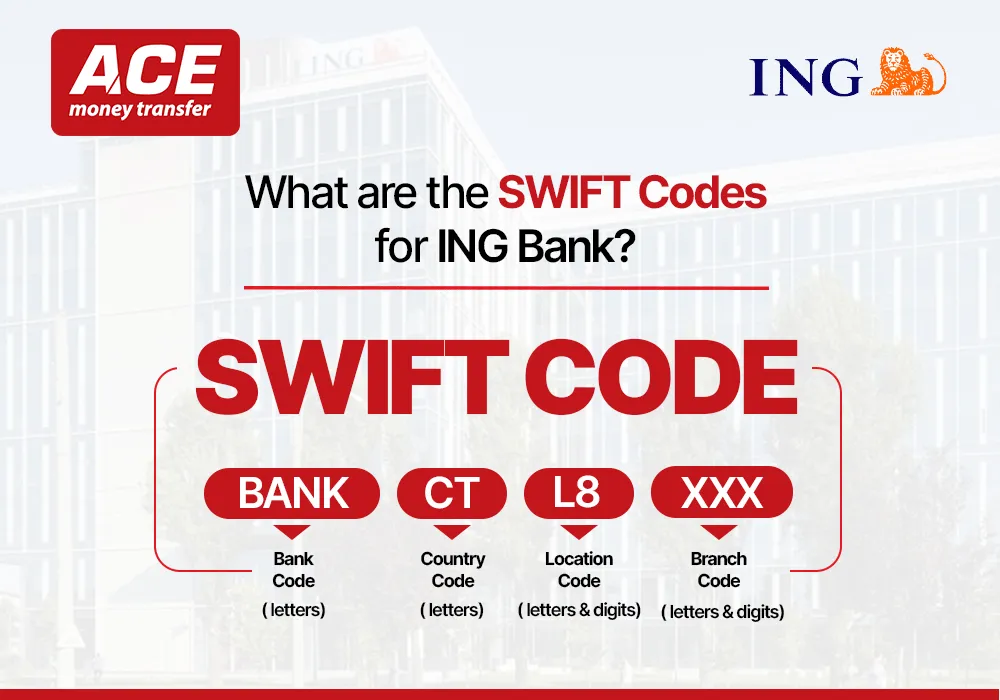
Every ING Bank SWIFT code follows the same logical structure. Understanding this structure helps you verify any code before you use it:
Position | Characters | What It Represents | ING Example |
1–4 | 4 letters | Bank/institution code | INGB |
5–6 | 2 letters | Country code (ISO) | NL = Netherlands | RO = Romania |
7–8 | 2 letters/digits | Location code | 2A (Amsterdam primary) |
9–11 | 3 characters (optional) | Branch code | XXX = head office |
So INGBNL2AXXX breaks down as: INGB (ING Bank) + NL (Netherlands) + 2A (Amsterdam, active) + XXX (head office). An 8-character code ending in no branch suffix, or written as INGBNL2A, refers to the same head office. When in doubt and no branch code is specified, always use the head office code — most transfers route correctly through it.
ING Bank operates branches and subsidiaries across multiple continents. Below is a comprehensive table of ING Bank SWIFT/BIC codes organised by country, drawn from official SWIFT network data and ING's own published records.
Country | Bank Entity | SWIFT/BIC Code | City |
Netherlands | ING Bank N.V. (Head Office) | INGBNL2AXXX | Amsterdam |
Netherlands | ING Bank N.V. | INGBNL2CXXX | Amsterdam |
Netherlands | ING Bank N.V. (Securities) | INGBNL2SSMK | Amsterdam |
Romania | ING Bank N.V., Amsterdam — Bucharest Branch | INGBROBU | Bucharest |
Belgium | ING Belgium NV/SA | BBRUCHGG | Brussels |
Germany | ING-DiBa AG | INGDDEFFXXX | Frankfurt |
Poland | ING Bank Slaski SA | INGBPLPWXXX | Katowice |
Hungary | ING Bank N.V. Hungary Branch | INGBHUHB | Budapest |
Bulgaria | ING Bank N.V. Sofia Branch | INGBBGSF | Sofia |
Slovakia | ING Bank N.V. | INGBSKBX | Bratislava |
Ireland | ING Bank NV | INGBIE2D | Dublin |
Spain | ING Bank NV, Spanish Branch | BBRUESMX | Madrid |
Portugal | ING Bank NV, Sucursal em Portugal | BBRUPTPL | Lisbon |
Switzerland | ING Bank N.V., Amsterdam | BBRUCHGT | Petit-Lancy |
Luxembourg | ING Luxembourg S.A. | CELLLULL | Luxembourg |
Country | Bank Entity | SWIFT/BIC Code | City |
Australia | ING Bank NV, Sydney Branch | INGAAU2SXXX | Sydney |
Singapore | ING Bank N.V. | INGBSGSG | Singapore |
Philippines | ING Bank N.V. | INGBPHMM | Taguig, Metro Manila |
Taiwan | ING Bank N.V. Taipei Branch | INGBTWTP | Taipei |
Turkey | ING Bank A.S. | INGBTR2A | Istanbul |
Important: Always confirm the correct SWIFT code directly with your recipient or ING Bank before initiating a transfer. Codes can vary depending on the type of transaction, the service involved, or the specific department handling the payment.
For the vast majority of international transfers going to or from a standard ING Bank account in the Netherlands, you will use INGBNL2AXXX. This is the head office code registered at Bijlmerdreef 106, Amsterdam.
Detail | Information |
Full SWIFT/BIC Code | INGBNL2AXXX |
Bank Name | ING Bank N.V. |
Registered Address | Bijlmerdreef 106, Amsterdam, Netherlands |
Country Code | NL (Netherlands) |
Code Status | Active |
Code Type | Head Office (XXX) |
IBAN Required? | Yes — always for Eurozone transfers |
In the Eurozone, you will always need both the SWIFT/BIC code and the recipient's IBAN (International Bank Account Number). The SWIFT code identifies the bank; the IBAN identifies the specific account. Neither replaces the other.
ING Bank has a significant presence in Romania. According to ING's 2025 Annual Report, ING ranked number one in Romania among its retail markets based on NPS (Net Promoter Score), demonstrating strong customer satisfaction in the market.
Detail | Information |
SWIFT/BIC Code | INGBROBU |
Bank Entity | ING Bank N.V., Amsterdam — Bucharest Branch |
City | Bucharest |
Country Code | RO (Romania) |
IBAN Format | RO + 2 check digits + 4-letter bank code + 16-digit account |
IBAN Required? | Yes — for all transfers within the EU |
Romania is part of the EU and uses IBANs, so any transfer to an ING Bank Romania account will require both INGBROBU and the recipient's full Romanian IBAN. Double-check the IBAN with your recipient before submitting the transfer.
When you initiate an international bank transfer to an ING Bank account, here is what happens behind the scenes:
The average SWIFT GPI payment processing time is around eight hours and 36 minutes end-to-end, though the median is considerably faster at just one hour and 38 minutes for well-established corridors between high-income countries.
A common source of confusion is the distinction between IBAN and SWIFT codes. They serve completely different purposes and, for transfers to ING Bank in Europe, you typically need both.
Feature | SWIFT/BIC Code | IBAN |
What it identifies | The bank or branch | The specific account |
Format | 8–11 alphanumeric characters | Up to 34 alphanumeric characters |
Used for | Routing between banks | Identifying the recipient account |
Required in Eurozone? | Yes | Yes |
Required outside Eurozone? | Yes | Varies by country |
ING Netherlands example | INGBNL2AXXX | NL + check digits + account |
A useful analogy: the SWIFT code is the street address of ING Bank, while the IBAN is the specific flat number. Both are needed for the post to arrive at the right door.
There are several reliable ways to locate the correct SWIFT code for an ING Bank transfer:
Log into your ING account via the website or the ING app. Your SWIFT/BIC code is usually displayed in the international payments section or within your account details screen.
ING Bank prints its SWIFT/BIC code on account statements and correspondence. Check any recent statement from the relevant ING branch.
Call or message the ING Bank customer service team in the relevant country. They can confirm the exact SWIFT code for the type of transaction you are making.
The Society for Worldwide Interbank Financial Telecommunication publishes an official register of all active BIC codes at swift.com. This is the authoritative source for verification.
A wrong SWIFT code can delay your transfer, trigger a return, or in rare cases send funds to the wrong institution. Here are the most common errors and how to sidestep them:
Yes. Sharing your SWIFT/BIC code is completely safe. ING Bank SWIFT Codes are public banking identifiers used to route international payments — they identify the bank, not your personal account. Anyone can look up ING Bank’s SWIFT codes through the official SWIFT directory or banking records.
The information you should never share unsolicited includes your full account number, IBAN, PIN, online banking credentials, or one-time passwords. Unlike those sensitive details, ING Bank SWIFT codes are designed to be shared with people or businesses sending you money internationally and do not create a security risk on their own.
ING Bank serves nearly 40 million retail customers across more than 40 countries. To manage the complexity of serving clients in jurisdictions with different regulatory frameworks, languages, and correspondent banking relationships, ING operates a range of entities and branches — each with its own SWIFT identity.
This also explains why looking up 'ING Bank SWIFT code' without specifying a country can return several results. There is no single universal ING SWIFT code. The correct one always depends on which country and which ING entity holds the recipient's account.
As of mid-2024, ING Group manages total assets of €1,041 billion and added 1.1 million new mobile primary customers during 2024 alone, reaching a total of 14.4 million mobile primary customers. Mobile primary customers now make up 89% of the bank's 16.2 million primary customers.
The primary SWIFT/BIC code for ING Bank N.V. in the Netherlands is INGBNL2AXXX. This is the head office code for Amsterdam and is the one to use when sending money to a standard ING Netherlands account, unless your recipient specifies a different branch code.
Yes, for transfers within the European Union and the broader SEPA zone, both the SWIFT/BIC code and the recipient's IBAN are required. The SWIFT code routes the payment to ING Bank, while the IBAN identifies the individual account. Providing only one of these will typically result in a delayed or rejected transfer.
No. ING Bank uses different SWIFT codes for different countries, branches, and service types. For example, the Dutch head office uses INGBNL2AXXX, the Romanian branch uses INGBROBU, and the Polish subsidiary ING Bank Slaski uses INGBPLPWXXX. Always use the code that corresponds to the specific country and entity where your recipient holds their account.
Using an incorrect SWIFT code can cause your transfer to be delayed while the banks investigate, rejected and returned to your account, or in rare cases routed to the wrong institution. Most banks charge a fee to trace and recall a misdirected payment, so it is worth verifying the code carefully before you send.
International SWIFT transfers to ING Bank typically take between 1 and 3 business days. Transfers within the SEPA zone can often arrive the same day or next business day. Transfers from outside Europe may take slightly longer depending on the number of correspondent banks involved and any compliance checks required.
You can find your ING Bank SWIFT code in your online banking portal under account details or international payments settings, on a printed bank statement, in the ING mobile app, or by contacting ING Bank customer service directly.
While bank-to-bank SWIFT transfers are reliable, they are not always the fastest or cheapest option — particularly for regular remittances. Traditional international wire transfers through banks often come with hefty fees, exchange rate markups, and processing delays that eat into the amount your recipient actually receives.
ACE Money Transfer is an FCA-regulated remittance service that lets you send money to over 100 countries with competitive exchange rates, low transfer fees, and 24/7 availability. Unlike traditional SWIFT transfers, ACE offers bank deposits, cash pickup, and mobile wallet options — all from the ACE app or website. To understand how SWIFT numbers work in the context of modern remittances, read What is a SWIFT Number on the ACE Money Transfer blog — a practical guide to how these codes operate in real-world money transfers.
Whether you are supporting family abroad, paying overseas invoices, or making a one-off international payment, comparing your options before committing to a bank transfer could save you more than you expect. Send money internationally with ACE Money Transfer — get started at acemoneytransfer.com.
Enjoy guaranteed competitive PKR exchange rates, ultra-fast transfers, and zero fee promotions directly to bank accounts and mobile wallets.