16 Oct 2025
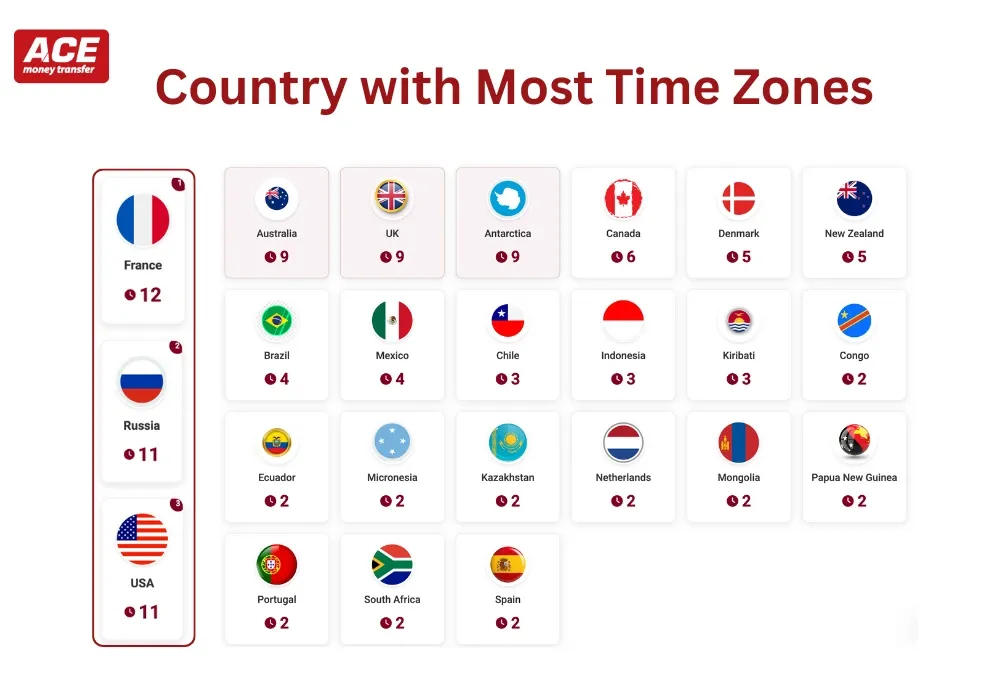
If you’ve ever juggled meetings from San Francisco to Sydney, you’ve felt how slippery “time” can be. So let’s settle the big one up front: France has the most time zones of any country in the world—thanks to its far-flung overseas territories. Russia isn’t far behind, but France still edges it out.
France leads the world in total time zones (driven by overseas territories), Russia holds the record for the most contiguous time zones, and the planet’s largest possible time difference is 26 hours.
Moreover, understanding the time zone difference ensures your money transfers land during local banking hours, avoids cut-offs, and reaches them when it matters most.
This blog will provide a comprehensive guide to help you understand different time zones, helping you stay connected with your loved ones and enabling you to send money home.
Most people guess Russia—and for good reason. Russia spans 11 time zones across one continuous landmass (Kaliningrad is the only outlier). But France counts 12 distinct local times when you include its territories in the Atlantic, Indian, and Pacific Oceans. In seasons when Saint-Pierre-et-Miquelon observes DST, a 13th local time appears in the French system.
The furthest-ahead standard time on Earth is UTC+14, used on the Line Islands of Kiribati (LINT). That’s an entire 14 hours ahead of UTC and a full day ahead of U.S. islands on UTC−12.
The largest difference between two places on Earth is 26 hours—between UTC−12 (e.g., Howland & Baker Islands, U.S., uninhabited) and UTC+14 (Line Islands, Kiribati).
“GMT” (Greenwich Mean Time) often stands in for UTC±0 in everyday speech. Countries that commonly align year-round with GMT/UTC±0 include Ghana, Senegal, Sierra Leone, Togo, Guinea-Bissau, Liberia, Mauritania, and Saint Helena. Iceland uses UTC±0 but calls it GMT all year.
A core set of 15+ West African and Atlantic jurisdictions sits near GMT/UTC±0 on the world map.
U.S. DST runs second Sunday in March → first Sunday in November each year.
No. DST is far from universal. As of 2025, about 70 countries and territories use it in some part of the year, while 100+ do not.
Several have abolished DST in recent years or changed rules:
No. Regions change on different dates—and some not at all.
Start/end dates for DST can differ by weeks between North America and Europe, which is why transatlantic meeting times “shift” twice each spring and fall.
For 2025, North America, most of Europe, parts of the Middle East, and Oceania still use seasonal clock changes. Large parts of Africa and Asia do not. A current, maintained list of who’s in and who’s out (plus dates) is best checked via DST tracker.
GMT is a time zone name and historical reference; UTC is the modern time standard used for clocks and networks. A country can say it uses GMT or UTC±0 and effectively mean the same wall time. For conversions and software, UTC is the safe reference.
UTC replaced GMT as the global timekeeping standard, but people still say “GMT” out of habit.
Because one side of the International Date Line can be UTC−12 and the other UTC+14, the maximum gap is 26 hours. That’s why a New Year’s broadcast from Kiribati’s Line Islands happens while Howland Island is still waking up the day before.
The IDL’s “zig-zag” (not a straight meridian) lets nations like Kiribati keep all islands on the same calendar date.
Time zones should follow 15-degree slices of longitude, but politics, trade, and daylight needs warp the lines:
Half-hour and 45-minute offsets exist in multiple places, so the world has more than 24 time zones in practice.
On the calendar, Howland and Baker Islands (U.S. uninhabited territories) sit at UTC−12, a full day behind UTC+12/14 regions. If you want “yesterday,” that’s as far back as it gets.
When you’re coordinating trains, flights, or meetings across borders, “off-peak” often maps to local late evenings or mid-afternoons—but DST shifts can change the sweet spot.
A reliable approach:
Learn About the Country Time Difference as Comapre to the UK |
|---|
| What time is it in Australia? |
| What time is it in Pakistan? |
| What time is it in Canada? |
| What time is it in the Philippines? |
| What time is it in France? |
| What time is it in Colombia? |
| What time is it in Malaysia? |
| What time is it in Italy? |
| What time is it in Peru? |
| What time is it in Austria? |
| What time is it in Latvia? |
| What time is it in Cyprus? |
| What time is it in Turkey? |
| What time is it in Ghana? |
| What time is it in India? |
| What time is it in Mexico? |
Understanding time zone differences is crucial when you send money from 29 countries—including the UK, EU nations, Australia, and Canada—to other countries like Pakistan, India, Bangladesh, the Philippines, Ghana, Gambia, Nepal, Morocco, Egypt, and Colombia.
Transfers initiated during the recipient’s banking hours are more likely to clear faster, avoid weekend or holiday cut-offs, and reduce frustrating delays. Knowing when it’s morning in Lahore, evening in Accra, or a banking holiday in Manila helps you plan payments for school fees, medical bills, or monthly support so funds arrive when your family needs them most.
A little timing strategy can also help you catch better FX windows and ensure your loved ones can cash out or receive mobile-wallet credits without waiting overnight.
ACE Money Transfer makes cross-border timing simple with clear delivery estimates, real-time status tracking, and 24/7 ACE app access so you can remit money when it suits you and they receive when it helps most.
With wide payout options—bank deposit, cash pickup, and mobile wallets—your family can get funds during their local business hours. Special rates, no hidden fees, and instant notifications keep you in control.
Plan the send; ACE handles the rest with speed and reliability.
France—12 local time zones (and a 13th when Saint-Pierre-et-Miquelon observes DST). Russia and the United States have 11 each.
Kiribati’s Line Islands at UTC+14—the earliest places to see a new calendar day.
26 hours.
Maximum time difference between two countries is 26 hours ⏱ You can see that the most extreme time zones are +14 hours at Line Islands (Kiribati), and -12 hours in and around Baker Islands (US). Therefore, the maximum possible difference between times on Earth is 26 hours.
About 70 countries/territories—mostly in Europe and North America. Many others don’t.
No. The U.S./Canada switch on different dates from Europe, and many countries don’t switch at all. Always check the current year’s schedule.