ACE Money Transfer
ACE Money Transfer
17 Nov 2026
Receiving money from abroad does not always require family members to travel to a cash collection point. For bank deposit for all banks of Bangladesh international money transfer, the key point is that money can be sent directly to a recipient’s bank account in Bangladesh through a supported money transfer provider, but bank availability depends on the sending country, the provider’s payout arrangements and the recipient’s bank. This gives senders abroad and recipients in Bangladesh to manage support for household expenses, education, medical costs and other personal needs without relying on cash pickup.
However, not every bank in Bangladesh is automatically available through every international money transfer provider. With ACE Money Transfer, eligible customers can check the available bank deposit options for Bangladesh, enter the recipient’s account details and review the transaction before making payment.
This guide explains how international bank deposits to Bangladesh work, what recipient information is required, which Bangladeshi banks may be supported, how to send money step by step with ACE, how long delivery may take, how bank deposit compares with other payout methods and what senders and recipients should check before completing a transfer.
A bank deposit is a payout method through which money sent from another country is credited directly to a recipient's bank account in Bangladesh. Instead of collecting cash from a physical location, the beneficiary receives the payment through their bank, provided the account and receiving institution are supported by the selected money transfer provider.
This method can be useful for people who regularly receive financial support from family members working abroad. Once the funds have been credited, recipients can access and manage them through the banking services available on their account, subject to the bank's terms and applicable transaction rules.
International bank deposits are different from cash pickup and mobile wallet transfers:
Bank deposit: Money is sent to an eligible bank account in the recipient's name.
Cash pickup: The recipient collects the funds from an available payout location using the required transaction reference and identification.
Mobile wallet: Money is credited to a supported digital wallet, subject to the wallet provider's requirements.
The appropriate method depends on the recipient's preferences, the available payout network and how they want to access the funds.
An international bank deposit involves the sender, the money transfer provider and the recipient's bank. The sender initiates the transaction from their country of residence, provides the beneficiary's banking information and pays using an available funding method.
The general process works as follows:
The sender starts the transfer: They select Bangladesh as the destination country, enter the amount and choose bank deposit if it is available.
The sender provides recipient details: The beneficiary's name, bank account number and any other requested banking information are entered.
The sender pays: The transaction is funded using an available payment method, such as a debit card, credit card or online bank transfer.
The provider processes the payment: The money transfer company completes the required payment and verification procedures before forwarding the transaction through its payout arrangements.
The receiving bank processes the deposit: The recipient's bank receives the payment instructions and processes the incoming funds.
The beneficiary checks the account: The recipient can review their account balance or transaction history to confirm that the funds have arrived.
The exact process can vary according to the sending country, provider, payment method and receiving bank. ACE's online transfer guidance, accessed on 10 November 2026, explains the general steps of selecting a destination, payout option, recipient details and payment method before confirming a transaction.
If the provider indicates that a transaction has been sent for payout but the money is not visible in the recipient's account, the sender should contact the provider with the transaction reference and request an update.
Bank deposits offer practical advantages for people receiving money from overseas. The funds are sent to an account rather than requiring the recipient to visit a cash collection point. This can be convenient for families who already use banking services to manage their finances.
Recipients can receive money through a bank account they already use, provided it is supported for the selected transfer. They can then access the funds through the services their bank makes available, such as branch transactions, ATM withdrawals or digital banking.
International bank deposits can help families organise financial support from relatives abroad. The money may be used for household bills, everyday purchases, rent, education costs or medical expenses, depending on the recipient's needs.
Some recipients prefer to keep funds in an account rather than collect the full amount in cash. This can help them manage their available balance and plan future expenses. The account's features, charges and withdrawal conditions depend on the receiving bank.
When funds are credited directly to an account, the recipient does not need to travel to a cash pickup location. This may be useful for people who live far from a payout branch or have limited time to collect money.
Senders should compare the estimated delivery time, transfer fees, exchange rate and final amount received before choosing a payout method.
Bangladesh has several categories of banks, including state-owned commercial banks, specialised banks, private commercial banks and foreign commercial banks. Bangladesh Bank explains the country's scheduled and non-scheduled banking structure in its official banking overview, accessed on 10 November 2026.
However, a bank's presence in Bangladesh does not automatically mean that every international money transfer provider supports deposits to its accounts. The available receiving banks depend on the provider's payout arrangements, the sending country and the transfer route.
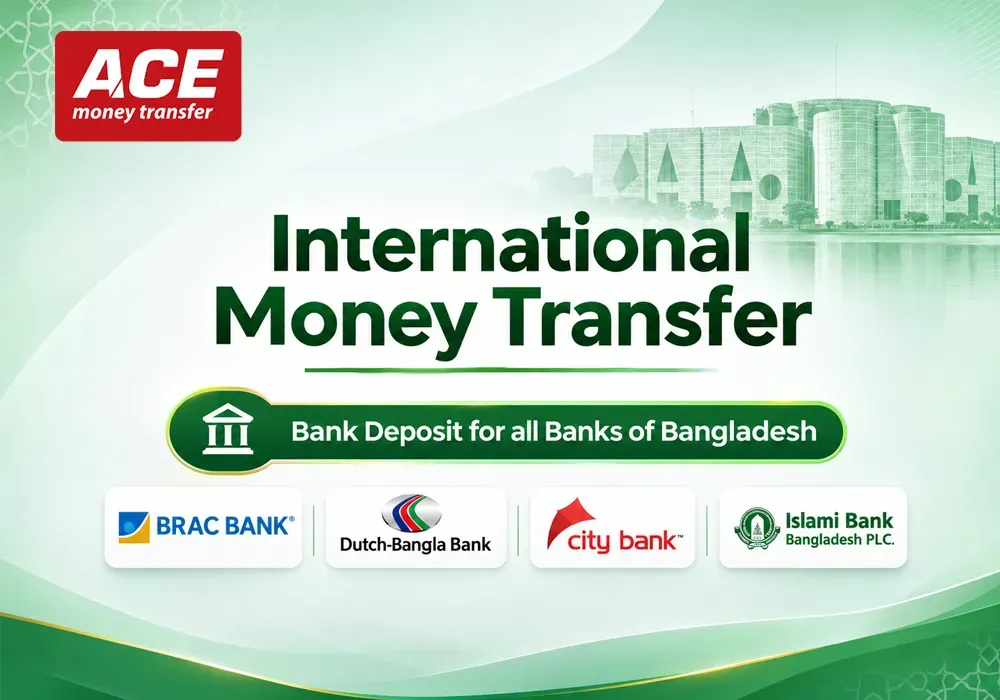
ACE's article, How to Send Money in Bangladesh Online, published on 20 November 2025, identifies the following institutions as examples of banks through which ACE bank deposits have been described:
Sonali Bank: A state-owned commercial bank.
Islami Bank Bangladesh: A private commercial bank operating according to Islamic banking principles.
BRAC Bank: A private commercial bank serving individual and business customers.
Dutch-Bangla Bank: A commercial bank offering conventional banking and digital financial services.
City Bank: A private commercial bank providing personal and business banking services.
One Bank: A private commercial bank offering retail and corporate banking services.
These names are examples from ACE's published information, not a guarantee that every bank will be available for every transaction today. The article was published in November 2025, so senders should check the current payout options displayed during their own transaction rather than relying solely on a previously published list.
The most practical way to confirm availability is to start a transfer through the ACE website or mobile application.
Select Bangladesh as the destination country.
Enter the amount you want to send.
Choose bank deposit from the available receiving methods.
Check the bank selection displayed during the transaction.
Confirm that the recipient's bank is listed before entering the account details.
If the bank appears in the available options, follow the instructions to enter the beneficiary's information. If it does not appear, contact ACE to ask whether another payout arrangement is available.
Bangladesh Bank's banking directory can help readers understand the country's banking structure, but it does not establish which banks are supported by a particular international money transfer provider.
ACE allows eligible customers to initiate international transfers through its website or mobile application. The following steps explain the general process of sending money to a supported bank account in Bangladesh. The exact payment and payout options depend on the sender's country and the information displayed during the transaction.
Visit the ACE website or open the mobile application. Register if you are a new customer, or sign in using your existing account details.
Complete the requested profile information and provide any identification documents required for verification. ACE's customer FAQs, accessed on 10 November 2026, explain that customers may need to provide a valid photo ID and other information depending on the applicable verification requirements.
Choose Bangladesh as the receiving country and enter the amount you want to send. The available sending currencies and funding methods depend on your country of residence.
Before proceeding, review the displayed exchange rate, transfer fee and expected amount the recipient will receive. This lets you judge the real cost by both the fee and the exchange rate, since some providers advertise zero fees but offer a weaker rate.
Select bank deposit as the payout method for your international transfer. Check the available receiving banks and choose the recipient's bank from the displayed list. Some licensed providers support different banks depending on the route and payout arrangements.
Do not assume that every bank in Bangladesh is supported. If the required bank is missing, contact ACE to confirm whether it can be added or whether another receiving method is available.
Provide the beneficiary's information carefully. Depending on the details requested during the transaction, you may need:
Recipient's full name as registered with the bank.
Bank name.
Bank account number.
Branch details, if requested.
Recipient's contact information, where required.
Any other beneficiary information requested by ACE.
Check the information with the recipient before submitting it. Incorrect account details or differences between the beneficiary's name and bank records can result in processing delays or complications.
Select an available funding method. Depending on your sending country, ACE may offer options such as a debit card, credit card or online bank transfer, and costs can vary by how you pay; for larger amounts sent abroad, bank transfers often come with lower fees. Other payment methods may be available in specific countries.
Review the transaction summary, including the recipient's details, exchange rate, applicable fees, the cost of your chosen funding option and expected payout amount. Confirm the transfer only after checking that the information is correct.
After submitting the payment, use your ACE account to monitor the transaction status. Keep the confirmation and transaction reference available in case you need to contact customer support.
ACE's FAQs explain that a bank deposit can move through different transaction stages, including a status indicating that the payment has been sent for payout to the recipient's bank. If the transfer status indicates that it has been sent for payout but the deposit is not visible, contact ACE and provide the transaction reference so the payment can be checked.
Providing accurate beneficiary information is essential when sending money internationally. The details required can vary according to the receiving bank, provider and payout arrangement.
The sender should enter the recipient's full name exactly as it appears in their bank records. Differences in spelling, name order or other personal information may require clarification.
The recipient may also need to provide a mobile number, address or identification information if requested during the transaction or verification process.
The sender should obtain the correct bank account number and bank name directly from the recipient. Branch information or additional banking details may also be necessary, depending on the receiving bank and provider.
Before paying, verify that the account is active and can receive the intended payment. Do not rely solely on old or saved details that may no longer be accurate.
Licensed providers may request a valid ID or other supporting documents to verify the sender's identity, and for some payments they may also ask for proof of purpose. Additional information may be required for certain transactions, including payments that need further review.
ACE's Bangladesh transfer information, accessed on 10 November 2026, explains that customers may be asked for identity, address or source-of-funds documents depending on the transaction and compliance requirements. Financial institutions also review transactions for compliance with regulations. The recipient may also need to provide information if the receiving bank requests clarification. Requirements vary, so customers should follow the instructions given by their bank and transfer provider rather than assuming that the same documents are required for every payment.
The processing time for an international bank deposit depends on the sending country, funding method, receiving bank, banking hours and verification requirements.
ACE's general delivery guidance, accessed on 10 November 2026, states that bank deposits usually reach recipients within one to two business days, although delivery times vary by country. This is an indicative timeframe, not a guaranteed delivery commitment for every transaction to Bangladesh.
Several factors can influence when the recipient receives the funds. This is not financial or legal advice. Please consult a qualified professional.
Payment method: The transfer method can affect delivery speed, cost, and convenience, and faster options may come with higher fees.
Banking hours: A payment initiated outside normal operating hours may be processed on the next banking day.
Weekends and public holidays: Bank closures in the sending or destination country can affect processing.
Recipient details: Incorrect or incomplete account information may cause delays.
Compliance checks: The provider may request additional documents or information before processing a transaction.
Payment partner availability: Operational issues involving a bank or payout partner may affect delivery.
If the money is needed for an urgent payment, such as tuition fees or medical expenses, check the estimated delivery time before choosing bank deposit. Do not assume that a transfer will arrive immediately simply because it is initiated online.
A few checks before payment can help reduce avoidable problems and make the receiving process easier for family members. This is not financial or legal advice. Please consult a qualified professional.
Ask the recipient to confirm their account number, registered name and bank details before making the payment. Check the bank selection carefully and ensure that it matches the recipient's actual account.
Even a small difference in account information can affect the transaction. If the provider asks for branch details, obtain the correct information directly from the recipient or their bank.
The amount received in Bangladeshi taka depends on the applicable exchange rate and any transfer charges. These can vary according to the sending country, transfer amount and funding method.
Review the exchange rate, fees and final payout amount displayed by ACE before confirming the transfer. A lower advertised fee does not necessarily mean a lower total cost if the provider applies wider exchange rate margins. Some providers promote transparent fees, but you should still compare the recipient’s final payout to catch hidden fees.
Comparing the amount the recipient will receive, rather than looking only at the initial service charge, is often the cheapest way to judge the overall value of available options. Check the transaction summary for the charges and payout information applicable to your transfer.
Exchange rates fluctuate, and the rate you receive may differ from any rates quoted. Always check the live rate at acemoneytransfer.com before sending. Rates and fees may vary. Visit acemoneytransfer.com for current rates.
Transfer limits can vary based on the sender's country, payment method, account verification status, local rules, and, where relevant, the purpose of sending money from Bangladesh. Bangladesh enforces limits on outbound transfers based on purpose, and education, medical, and business payments can be subject to different thresholds. Larger transfers may require additional identity or source-of-funds information.
If you plan to send a larger amount, check the limits and verification requirements before starting the transaction. ACE may request supporting documents depending on the circumstances and applicable requirements.
Bank deposits may take additional time if a transaction is initiated outside banking hours or during public holidays in Bangladesh or the sending country.
If the recipient needs the funds by a particular date, allow enough time for payment processing and any required checks. The estimated delivery time shown during the transaction is the most relevant guide for that specific transfer.
Save the payment confirmation and transaction reference after completing the transfer. These details can help the sender or recipient contact customer support if the payment needs to be investigated.
If you notice an error after submitting the transaction, contact ACE as soon as possible. Whether a transfer can be amended or cancelled depends on its processing status and the applicable procedures.
Bank deposits are one of several ways to send money abroad to Bangladesh. The most suitable method depends on how the recipient prefers to receive funds and which payout options are available for the sender's country.
| Receiving method | How it works | May suit recipients who |
|---|---|---|
| Bank deposit | Funds are credited to a supported bank account | Prefer to manage money through a bank |
| Cash pickup | Recipient collects funds from an available payout location | Need physical cash or do not have a suitable bank account |
| Mobile wallet | Funds are credited to a supported digital wallet | Prefer to receive money through a mobile financial service |
Senders may also compare banks, digital platforms, or exchange houses depending on the route and permitted payout options. ACE's Bangladesh transfer page, accessed on 10 November 2026, lists bank deposits, cash pickup and mobile wallets among the available receiving methods. The page identifies bKash, Rocket through Dutch-Bangla Bank, Nagad and UPay as wallet options. Availability depends on the sending corridor and the options displayed during the transfer.
ACE provides international money transfer services to Bangladesh through its website and mobile application. Bank deposit is one of the payout methods displayed for the destination, allowing eligible senders to transfer funds to supported bank accounts.
Customers can start an online money transfer, enter the recipient's information, select an available payout method and review the transaction before paying. Many providers offer similar online processes, though availability and steps can vary by route and provider. The process allows eligible senders to manage their transfer through the ACE website or mobile application.
ACE's Bangladesh service information, accessed on 10 November 2026, lists payment options for fund transfers that include debit cards, credit cards and online bank transfers, as well as certain regional payment methods, and the available funding method can affect cost and processing time. Choose the right funding method for your budget, access, and route requirements. The options available depend on the sender's location and should be checked during checkout.
Alongside bank deposits, ACE's Bangladesh service information identifies cash pickup and mobile wallet payments. These options give senders alternatives when a bank deposit is not suitable or the recipient prefers a different way to receive funds.
Customers can monitor their cross-border payments through their ACE account and retain the transaction reference for follow-up. If additional information is required, ACE may contact the sender to complete verification or compliance checks before the payment can proceed.
ACE Money Transfer Limited is authorised by the UK Financial Conduct Authority (FCA) as an Authorised Payment Institution (API) under Firm Reference Number (FRN) 506692 to provide payment services in the UK. Its details can be checked through the FCA Register, accessed on 10 November 2026. This authorisation relates to its UK payment services and should not be interpreted as a statement about regulatory permissions in every country where a customer may use a service. When customers transfer money internationally, they should use licensed providers because authorisation, verification, and compliance controls help reduce risk.
For details about available services, payment methods and destination options, visit the ACE Bangladesh transfer page.
Supporting family members in Bangladesh is an important responsibility for many people living and working abroad. International bank deposits provide a way to send money directly to eligible recipient accounts without requiring beneficiaries to visit a cash collection location.
With ACE, eligible customers can check the available banks, select bank deposit, provide the required beneficiary information and monitor their transactions online. Before sending, verify the recipient's account details, confirm that their bank is listed for the selected transfer route, and review the live exchange rate, fees and estimated delivery time. When receiving funds by bank deposit, recipients in Bangladesh receive Bangladeshi taka. The best way to send money internationally to Bangladesh depends on the recipient’s bank, the chosen funding method, fees, exchange rates, and delivery time.
This is not financial or legal advice. Please consult a qualified professional.
This depends on the receiving bank's rules and the money transfer provider's requirements. Before sending, confirm whether the selected payout service accepts joint accounts and whether the recipient's name must match a particular account holder's details.
In most cases, the recipient does not need to visit a branch simply to receive a deposit. However, they may need to contact their bank if it requests additional information, documentation or confirmation before crediting the funds.
A completed transfer may not be reversible. If a sender requests a cancellation or correction, the outcome depends on the transaction's processing stage, the provider's procedures and whether the receiving bank has already processed the payment.
The recipient should contact their bank through its official customer service channels and ask for the payment to be verified. They should not spend or return unexpected funds to someone who contacts them directly until the bank has confirmed the appropriate procedure.
This depends on the account's terms, the receiving bank's policies and the applicable foreign exchange and remittance requirements. The recipient should check with their bank whether it accepts incoming international payments from the relevant countries.
The tax treatment depends on the purpose and nature of the payment, the recipient's circumstances and applicable Bangladeshi tax rules. A personal family remittance may be treated differently from income, business proceeds or payment for services. Recipients should consult a qualified tax professional if they are unsure how a particular payment should be reported.
The recipient should contact their bank before the sender initiates the transfer. An inactive, frozen or restricted account may not be able to receive or access the funds normally, and the bank can explain the steps required to resolve the account issue.
Disclaimer: This article is intended for general informational and educational purposes only and should not be construed as legal, regulatory, tax, business, or financial advice. While reasonable efforts have been made to ensure that all facts, figures, and data are accurate and valid as of the date of publication, no warranty or guarantee is given as to the ongoing completeness, accuracy, or currency of the information.
The content is based on information available at the time of publication. Regulations, government policies, market conditions, and service offerings may change over time and vary across jurisdictions and providers. As a result, some information may no longer be current or applicable. Readers should independently verify all information and consult qualified professional advisors before making any financial, legal, or business decisions.