
ACE Money Transfer
ACE Money Transfer

09 Apr 2025
If you're a Nigerian professional looking to work in Canada, understanding the exact requirements before you start your application can save you months of frustration and thousands of naira in wasted fees. This guide breaks down every requirement, document, and step you need to follow to apply for a Canada work visa from Nigeria in 2026.
Most Nigerian citizens need a work permit to legally work in Canada. In addition, Nigerians typically require a Temporary Resident Visa (TRV) to enter Canada, since Nigeria is not a visa-exempt country.
Here are the core requirements at a glance:
A valid passport with at least 6 months validity beyond your planned stay
A concrete job offer from a Canadian employer (for employer specific work permits)
A positive LMIA obtained by your employer, or proof of LMIA exemption
Proof of sufficient funds to support yourself and any family members
A clean criminal record, verified through a police certificate from Nigeria
A medical exam when required by Immigration, Refugees and Citizenship Canada (IRCC)
Biometric data must be submitted as part of the work permit application process
As of 2026, Nigerians apply online through the official IRCC portal and submit biometrics at VFS Global centres in Lagos or Abuja. The application process is managed by Immigration, Refugees and Citizenship Canada.
Processing time from Nigeria currently ranges from about 10 to 26 weeks depending on category and season, with some streams recently hitting approximately 16 weeks. Family members can often be included in the work permit application, with spouses sometimes eligible for their own open work permit.
A Canadian work permit is a temporary immigration document that authorizes foreign nationals to legally work in Canada for a set period. It is different from a visitor visa (which only allows tourism or business visits) and from permanent residence, which grants the right to live and work in Canada indefinitely.
There are two main categories of Canada work permit: employer specific work permits, which tie you to one employer and job, and open work permits, which let you work for almost any Canadian employer without being locked to a single position.
Most Nigerians coming directly from Nigeria use employer specific work permits under the Temporary Foreign Worker Program, which requires an LMIA, or through certain International Mobility Program streams. Common pathways include:
TFWP with a Labour Market Impact Assessment
IMP LMIA exempt work permits for qualifying roles
Post-Graduation Work Permits after completing Canadian studies
Open work permits for spouses of skilled workers or international students
A work permit lets you work in Canada temporarily, but Canadian work experience can also support future permanent residence through programs like Express Entry or Provincial Nominee Programs.
The type of work permit you choose directly affects the requirements you must meet, your processing time, and how freely you can change employers once in Canada. There are three types of Canada work permits that Nigerians commonly encounter.
Employer-specific work permits are tied to one specific employer, job title, salary, and work location. They typically require a positive LMIA from Employment and Social Development Canada (ESDC). These are ideal for Nigerians who already have a definite job offer from a Canadian employer.
Open work permits allow you to work for any Canadian employer across most industries without needing an LMIA or a specific job offer. However, eligibility is limited to specific program categories such as post-graduation work permits, spousal permits, or certain IMP streams. Post-graduation work permits last up to three years, depending on program length.
LMIA-exempt employer-specific permits fall under the International Mobility Program and still tie you to one employer but skip the LMIA process.
| Feature | Employer-Specific | Open Work Permit |
|---|---|---|
| Job offer required | Yes | Usually no |
| LMIA needed | Usually yes | No |
| Can change employers | No | Yes |
| Easier to qualify | With strong offer, yes | Narrower eligibility |
Later sections break down the documents required and eligibility criteria for each type.
Eligibility for a Canada work visa involves both general conditions that apply to everyone and program-specific requirements that depend on your chosen stream.
General conditions:
Be at least 18 years old for most work permits
Applicants must demonstrate intent to leave Canada when their work permit expires
Have enough money to support yourself and any dependent children or common law partners
No criminal record is necessary for work permit eligibility
Pose no security risk to Canada
Language proficiency in English or French may be required based on job category
Nigerians must demonstrate strong ties to Nigeria, such as employment, family, property ownership, or a running business. Immigration officers look for evidence that you genuinely plan to return after your permit expires.
While IRCC does not always mandate a formal English test like IELTS for work permits, most employers expect solid language proficiency, and it becomes essential for later permanent residency applications. For regulated occupations like nursing, engineering, or teaching, you may need provincial licensing or registration before your permit can be approved, which means your credentials must be recognized by the relevant Canadian regulatory body.
Proof of work experience is needed for work permit applications, typically demonstrated through reference letters, pay slips, and a detailed CV.
This Nigeria-focused checklist covers what you will need. Keep in mind that required documents can vary slightly by work permit type and IRCC updates, so always confirm with the latest guidance.
Core documents:
Valid Nigerian passport (applicants need to submit a valid passport with their application)
Completed work permit application form (IMM 1295 for applications from outside Canada)
Two passport-sized photos meeting IRCC specifications
Family information form (IMM 5645) for married applicants
Receipt for processing and biometrics fees
Proof of job:
A job offer letter is mandatory for LMIA-required work permits, including salary, duties, and location
Copy of the positive LMIA or, for LMIA exempt work permits, the offer of employment number from the employer portal
Employment contract if available
Financial and background documents:
Bank statements covering the last 3 to 6 months
CV and educational certificates
Reference letters and pay slips from current or past employers
Police certificate from the Nigeria Police Force
Copies of any previous visas or travel history
Supporting documents that strengthen your case:
Marriage certificate (for married applicants)
Children's birth certificates
Property ownership documents or business registration papers
Employer reference letters from Nigeria showing ties to your home country
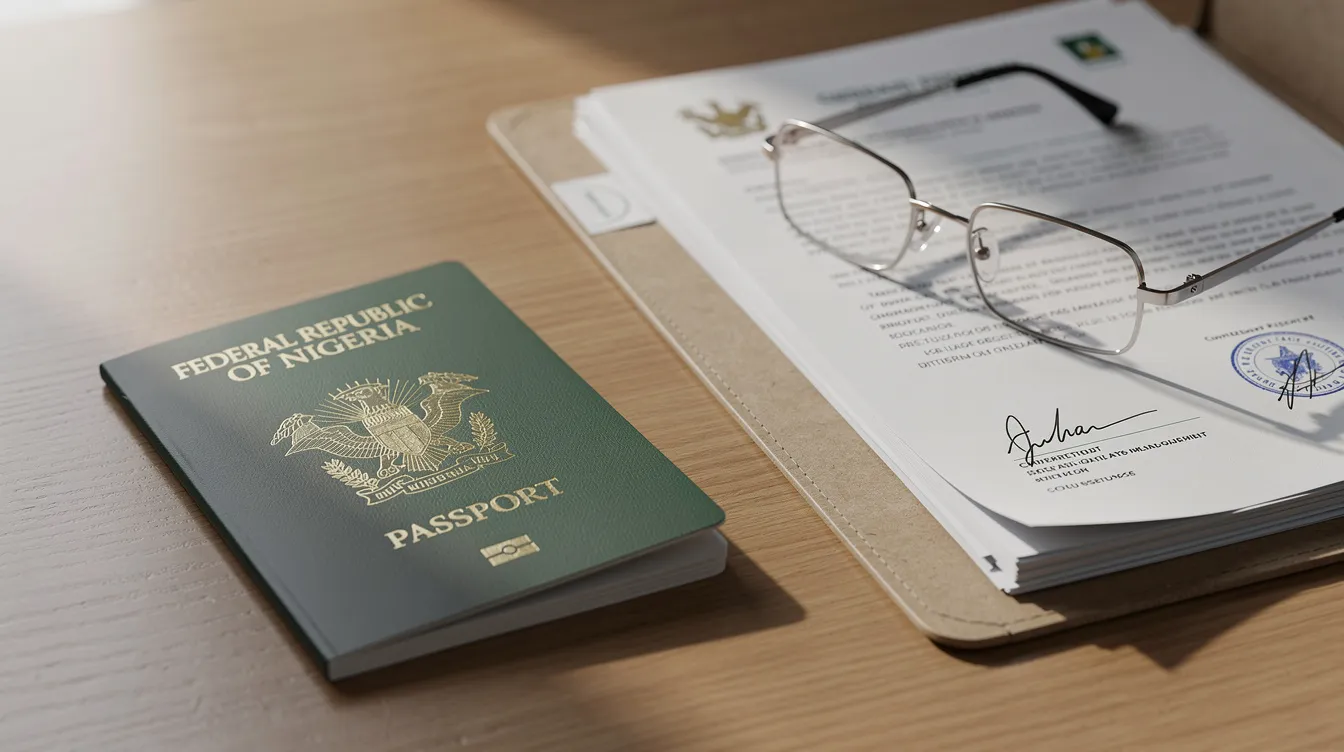
Most Nigerians working in Canada for the first time will use an employer-specific work permit. Here is how the process works from your perspective as the Nigerian applicant.
Your Canadian employer applies to Employment and Social Development Canada ESDC for a Labour Market Impact Assessment. This market impact assessment LMIA process requires the employer to prove that no Canadian citizen or permanent resident is available for the role, and that hiring foreign workers will not negatively affect the Canadian labour market. A positive LMIA is required for employer-specific work permits.
Once approved, the employer must provide you with:
A copy of the positive LMIA or confirmation letter
A detailed job offer letter specifying salary, hours, duties, and location
The employment contract, if available
Candidates must obtain a job offer before applying for a work permit. For LMIA exempt employer-specific roles under the International Mobility Program, the employer submits an online offer of employment through the IRCC Employer Portal and gives you an "A########" offer of employment number. An offer of employment number is needed for LMIA-exempt permits.
For open work permits, you do not submit LMIA or employer documents. If the system requests them, upload a note stating "Not applicable - open work permit."
LMIA processing times vary by stream. High-wage positions average about 88 business days, while the Global Talent Stream can take as few as 10 days on the employer's side.
Open work permits are attractive because they are not tied to a specific employer, giving you the freedom to work across Canada. However, they are only available under specific program categories.
The main open work permit pathways Nigerians commonly use include:
Post-Graduation Work Permit (PGWP): Available after successful completion of a full-time program at a designated Canadian post secondary institution lasting at least 8 months. You must apply within 180 days of graduation, and the work permit duration matches your program length up to three years.
Spouse or common law partners of skilled workers: If the principal worker holds a permit in a qualifying NOC category with at least 16 months remaining.
Spouse of international students: Eligible if the student is in a master's program of 16+ months, a doctoral program, or certain professional degrees. Changes effective January 2025 tightened these rules.
Some IMP categories covering academic exchanges, religious workers, media crews, and business visitors can also lead to open or LMIA exempt work permits under a specific program.
Open work permits generally require proof of relationship (for spouses), valid status of the main permit holder in Canada, and funds to support yourself and any family members.
This section walks you through the entire process of applying for a Canada work permit from Nigeria, step by step.
Step 1: Secure a valid job offer for employer-specific permits, or confirm your eligibility under an open work permit category. Make sure your employer understands whether an LMIA or IMP offer is required. The online application system is used to submit work permit applications from outside Canada.
Step 2: Gather all following documents and complete forms (IMM 1295 and others) via the IRCC secure account. Accuracy matters. Names, dates, and job titles must be consistent across your passport, job offer, and application forms.
Step 3: Pay fees online. The standard work permit processing fee is CAD $155. Add CAD $85 for biometrics and CAD $100 for the open work permit holder fee where applicable.
Step 4: Book and attend a biometrics appointment at a VFS Global Visa Application Centre in Lagos or Abuja. Biometrics are usually valid for 10 years once submitted.
Step 5: Complete any required medical exam with an IRCC-approved panel physician in Nigeria, particularly if you are staying over six months or if your job requires it (healthcare, childcare, agriculture).
Step 6: Wait for IRCC to process the work permit application. Processing times for work permits can fluctuate and vary by application. The application process may take several weeks to months. If approved, you receive a Port of Entry Letter of Introduction and typically a TRV counterfoil in your passport. A Port of Entry Letter is issued upon approval and is needed to collect the work permit in Canada.
Step 7: At the Canadian border, present your passport, POE letter, job offer, and additional documents to the border officer, who prints your actual work permit.

Health and security checks are non-negotiable parts of the work permit application process, designed to protect public safety in Canada.
When is a medical exam required?
A medical examination may be required for Nigerian applicants applying for a work permit. Specifically, medical exams may be required based on specific conditions: planned stays longer than six months, or work in healthcare, elder care, childcare, teaching, or agriculture. The exam includes medical history questions, a physical exam, blood and urine tests, and a chest X-ray, all conducted by IRCC panel physicians in Nigeria.
Police certificate requirements:
A Nigerian Police Clearance Certificate may be required to prove a clean criminal record. You obtain this through the Nigeria Police Force's Central Criminal Registry or approved online platforms. The certificate must typically be less than six months old at the time of application.
IRCC also performs its own security checks using biometrics and information shared with partner countries. Answer every question on your application truthfully. Misrepresentation can lead to refusals, bans, or both.
Processing time and cost are among the first practical questions Nigerian applicants ask.
| Fee Type | Amount (CAD) |
|---|---|
| Work permit processing | $155 |
| Biometrics (individual) | $85 |
| Open work permit holder fee | $100 |
| Biometrics (family) | Up to $170 |
Processing times from Nigeria currently range from about 10 to 26 weeks, with recent data showing a jump to approximately 16 weeks for many categories. Always check the IRCC website for the most current timelines, as these shift regularly.
Most Nigerians apply online through the IRCC portal and attend biometrics at VFS Global centres in Lagos or Abuja. Submitting a complete, accurate package in one go - with no missing documents - is the single best way to avoid delays in visa approval.
Many Nigerian workers want to bring their families to Canada, and in many cases this is possible. Family members can often be included in the work permit application.
Spouses or common law partners of skilled workers may qualify for an open work permit, allowing them to work for most Canadian employers. Dependent children can usually apply for study permits or visitor records.
All accompanying family members must complete their own application forms, pay separate fees, and provide biometrics, medical exams, and police certificates where required. Proof of funds must cover the main worker plus all family members. You will need marriage certificates, children's birth certificates, and proof of financial support.
Extended family members like parents and siblings generally cannot be added to a temporary work visa application. They would need separate visitor visas or long-term sponsorship under other immigration programs.

Work permit refusal rates for Nigerian applicants are notably high - around 45% in some International Mobility Program streams. Many of these refusals stem from avoidable mistakes.
Frequent causes of refusal:
Weak proof of intention to return to Nigeria after the permit expires
Insufficient funds or unconvincing bank statements
Inconsistent or incomplete documents (mismatched names, dates, or job titles)
Doubts about the genuineness of the job offer from the visa officer
Poor match between the applicant's experience and the Canadian job
How to avoid refusal:
Include strong evidence of ties to Nigeria: property, business registration, family, employment
Ensure all forms and documents are consistent and complete
Provide a cover letter explaining any employment gaps or unusual travel history
Verify your employer is not on IRCC's non-compliant employer list
Consult immigration lawyers or immigration experts if your case is complex
If refused, carefully review the refusal letter and consider requesting GCMS notes to understand the officer's reasoning. Reapply with stronger evidence or explore a different, more suitable visa types or work permit category.
Many Nigerians treat their Canadian work permit as the first step toward becoming a permanent resident. One year of full-time skilled Canadian work experience can unlock eligibility for Express Entry's Canadian Experience Class, significantly boost your CRS score, or make you competitive for Provincial Nominee Programs.
Several provinces specifically target foreign workers and foreign students already employed locally, sometimes with direct employer support through the Federal Skilled Worker Program or provincial streams for skilled workers.
Holding a work permit does not guarantee permanent residency, but strong Canadian work history combined with solid language scores, recognized education credentials, and a clean record builds a powerful profile. The Canadian government continues to prioritize immigration through these pathways.
Start planning for permanent residence early. Even while preparing your initial work permit, choose job roles, locations, and NOC codes that align with your long-term goals under International Experience Canada or other streams. The decisions you make now about where to work and what role to accept directly shape your path to becoming a permanent resident. Planning ahead turns a temporary opportunity into a lasting one.