24 Oct 2025
Are you an expat in Austria trying to send money to loved ones back home? Whether you're coordinating with family and friends in countries like Pakistan, India, Nepal, Philippines, Kenya, Uganda, Sri Lanka, or Egypt, understanding the time differences between Austria and these countries is key to ensuring efficient communication and smooth money transfers. This blog will guide you through the time zones in Austria and how they affect your transactions, helping you avoid delays and miscommunications.
Austria, located in Central Europe, operates in Central European Time (CET) during the winter months (UTC +1) and switches to Central European Summer Time (CEST) (UTC +2) during the summer months. This shift can impact international money transfers, especially if you're sending money to countries in different time zones. Let's dive into the details.
Austria follows Central European Time (CET) during the winter months, which is UTC +1. When the country observes daylight saving time (from the last Sunday in March until the last Sunday in October), Austria shifts to Central European Summer Time (CEST), which is UTC +2.
Knowing the time zone difference is crucial when planning money transfers, calls, and business activities. In this blog, we will look at the time difference between Austria and key receiving countries and how it affects your transactions.
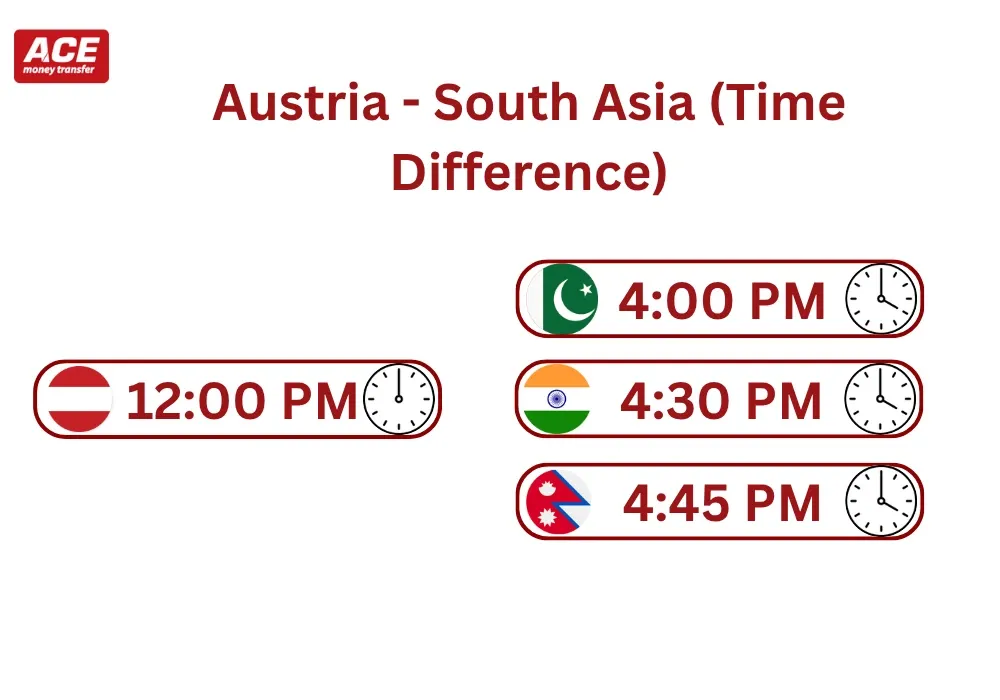
Austria and Pakistan Time Difference:
| Austria (CET) | Pakistan |
12:00 PM | 4:00 PM |
When sending money to Pakistan, be aware that Pakistan Standard Time (PST) is UTC +5, which is 4 hours ahead of Austria. To ensure your transaction is processed efficiently, it's best to send money during Austria's business hours (8:00 AM to 5:00 PM CET). If you send money later in the day, the recipient may not receive it until the next business day.
Austria and India Time Difference:
| Austria (CET) | India |
12:00 PM | 4:30 PM |
India follows Indian Standard Time (IST) (UTC +5.5), which is 4.5 hours ahead of Austria. If you’re sending money to India, remember that India's banking hours usually run from 10:00 AM to 4:00 PM IST. To ensure your funds are received promptly, it's best to send money early in Austria’s day.
Austria and Nepal Time Difference:
| Austria (CET) | Nepal |
12:00 PM | 4:45 PM |
Nepal follows Nepal Time (NPT) (UTC +5.75), making the time difference with Austria 4.75 hours. If you're sending money to Nepal, consider that Nepal’s banking hours are generally from 10:00 AM to 5:00 PM NPT.
Austria and Philippines Time Difference:
Austria is 7 hours behind the Philippines
| Austria (CET) | Philippines |
12:00 PM | 7:00 PM |
The Philippines follows Philippine Standard Time (PST) (UTC +8), meaning it’s 7 hours ahead of Austria. This is the largest time difference between Austria and the countries in this list. With such a gap, it’s important to initiate transfers early in the day to ensure they reach the recipient in a timely manner.
Austria and Kenya Time Difference:
| Austria (CET) | Kenya |
12:00 PM | 2:00 PM |
Kenya follows East Africa Time (EAT) (UTC +3), which means it is only 2 hours ahead of Austria. This small time difference allows for smooth coordination for money transfers, as both countries share similar banking hours.
Austria and Uganda Time Difference:
| Austria (CET) | Uganda |
12:00 PM | 2:00 PM |
Uganda follows East Africa Time (EAT) (UTC +3), which is the same time zone as Kenya. As a result, the time difference between Austria and Uganda is also 2 hours.
Austria and Sri Lanka Time Difference:
| Austria (CET) | Sri Lanka |
12:00 PM | 4:30 PM |
Sri Lanka follows Sri Lanka Standard Time (SLST) (UTC +5.5), resulting in a 4.5-hour time difference with Austria. When sending money to Sri Lanka, it’s best to initiate the transaction early during Austria’s business day to avoid delays.
Austria and Egypt Time Difference:
| Austria (CET) | Egypt |
12:00 PM | 1:00 PM |
Egypt follows Eastern European Time (EET) (UTC +2), making the time difference between Austria and Egypt only 1 hour. This close time zone difference makes it easier to send money between the two countries.
Understanding Austria’s time zone and adjusting your schedule accordingly is key to making the most of your time in Austria. Whether you’re coordinating family events, managing finances, or ensuring timely remittances to countries like Sri Lanka or Nepal, having a clear understanding of the current time in Vienna will help you avoid misunderstandings, delays, and missed opportunities.
Time to Get It Right!
The time difference with Austria can sometimes create challenges, but with careful planning and understanding of the time zones, you can navigate the complexities of remittance services and stay in touch with loved ones effortlessly. Whether it’s for business, remittances, or socializing, a little time zone knowledge can go a long way in making your interactions more seamless.
Austria follows Central European Time (CET, UTC +1) during standard time and switches to Central European Summer Time (CEST, UTC +2) in the summer months.
Time differences can delay transfers if they are initiated late in the day in Austria. For instance, if it's after 5:00 PM CET, the transfer may not be processed until the next business day.
Yes, you can send money on weekends, but it may not be processed until the next business day due to non-business hours in both Austria and receiving countries like India and Pakistan.
To reach customer service during business hours, call between 8:00 AM – 5:00 PM CET in Austria, keeping the time difference in mind.
Yes, Austria observes daylight saving time, shifting from CET (UTC +1) to CEST (UTC +2) during the summer months.