
ACE Money Transfer
ACE Money Transfer
13 May 2026
If you’re self-employed in the UK or have income outside PAYE, chances are you’ve come across the SA302 form—a document a self employed person often needs to provide as official proof of income for financial services.
The primary purpose of the SA302 is to act as official proof of income for individuals not recorded through the PAYE system. Whether you’re applying for a mortgage or proving income for financial services, this document plays a critical role.
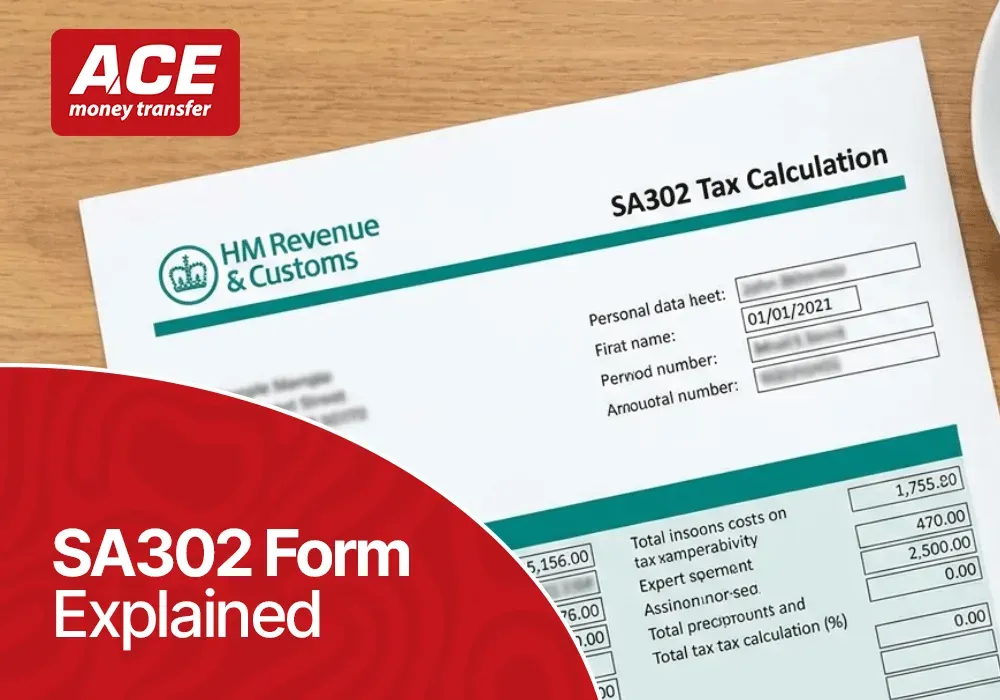
The SA302 form is an official tax calculation issued by HM Revenue and Customs (HMRC). It summarises your income and tax liability for a specific tax year, based on your Self Assessment tax return. It is HMRC's official evidence of earnings for individuals who complete a self assessment tax return, including self-employed individuals and company directors.
An SA302 shows a detailed breakdown of your finances, including declared earnings, personal allowance, taxable income, and income tax. It includes total income from employment, self-employment, dividends, rental income, and interest. It also highlights tax owed, tax paid, and any remaining balance.
The term “SA302” comes from HMRC’s internal coding system. While users often call it an SA302, it’s essentially a tax calculation summary generated after filing your Self Assessment return.
The SA302 acts as proof of income and evidence for loan applications for individuals without traditional payslips. Lenders almost always require SA302 forms from applicants to verify earnings and assess their ability to repay loans. Banks and lenders prefer the SA302 form over the tax overview because it provides a more comprehensive picture of an individual's financial situation.
Mortgage lenders in the UK rely heavily on SA302 forms when assessing self-employed applicants. Lenders often require both the SA302 calculation and a Tax Year Overview to confirm income. They typically review the last two or three years of SA302 forms. According to data from UK Finance, around 15% of mortgage applications in the UK involve self-employed individuals.
Beyond mortgages, the SA302 is used when renting properties, applying for business loans, or proving self-employed income for large remittances abroad. For example, if you’re transferring money internationally, perhaps converting GBP to PKR or GBP to INR, financial institutions may request proof of income to comply with anti-money laundering regulations.
Obtaining your SA302 is straightforward through these methods:
If you file directly through HMRC, you can download your SA302 instantly. Select the relevant tax year, navigate to 'Tax Return Options' and 'More Self Assessment Details'. You can access SA302 forms for up to the last four tax years, but you must wait 72 hours after submitting your return before the calculation is available.
Key Differences:
While primarily associated with self-employed individuals, the SA302 is useful in several situations, especially for sole traders. Unlike employees who receive payslips, self-employed individuals use SA302 forms as their official proof of income.
If you run your own business or work as a freelancer, the SA302 is your main proof of income. Recent figures from the Office for National Statistics show that over 4.2 million people in the UK are self-employed, highlighting the widespread relevance of SA302 forms.
Compliance Tips:
Mismatched Figures: Ensure consistency between the SA302 and the Tax Year Overview. Discrepancies can delay applications.
Late Filing: Submit returns on time to avoid HMRC penalties and ensure your SA302 is ready when you need it.
Being proactive with your financial records can make a big difference. Most lenders ask for at least two years of SA302 forms. Keeping three years ready can strengthen your financial profile. Filing accurate and timely tax returns ensures your SA302 reflects a reliable income pattern.
The SA302 form is a cornerstone document for anyone navigating the UK financial system without traditional employment. It validates your income, builds trust with lenders, and supports major life decisions. Keeping your SA302 forms updated and accurate ensures you’re always ready when financial opportunities arise.
Yes, the SA302 is widely accepted as official proof of income in the UK. It is especially important for self-employed individuals who do not have payslips.
Most lenders require two to three years of SA302 forms. Providing more years can sometimes improve your chances of approval if your income is stable.
No, your tax return is what you submit to HMRC. The SA302 is the calculation summary generated after your return is processed.
Yes, you can download it directly from your HMRC online account if you file your own taxes. It is a simple process and does not require professional assistance.
If you notice errors, you should amend your Self Assessment tax return through HMRC. Once corrected, a new SA302 will be generated with updated figures.
Enjoy guaranteed competitive PKR exchange rates, ultra-fast transfers, and zero fee promotions directly to bank accounts and mobile wallets.