
ACE Money Transfer
ACE Money Transfer
09 Jun 2026
If you've ever tried to set up social welfare, renew a driving licence, or access public services online in Ireland, you'll have heard of the Public Services Card. It's one of the first pieces of ID you need to sort once you start working or living here.
This guide explains what the card is, who needs one, how to apply, and what documents to bring. There's also a section for non-Irish workers who often run into more paperwork than locals.
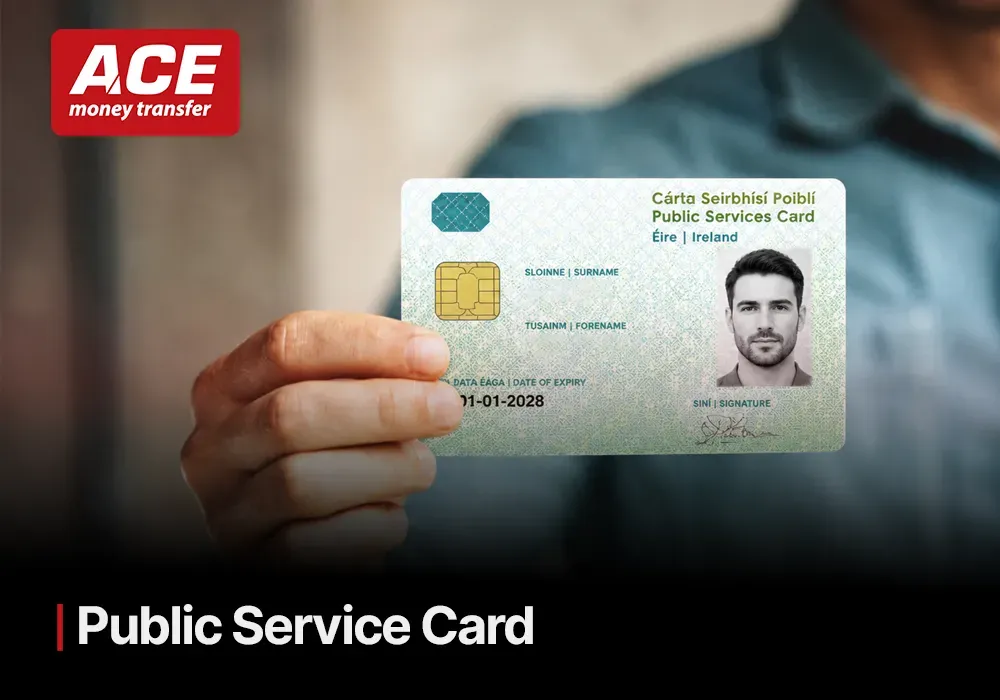
A Public Services Card (PSC) is a physical ID card issued by the Department of Social Protection. It proves your identity when you're accessing public services, especially social welfare payments.
Most people get a PSC around the same time as their PPS number, which is the Irish equivalent of a national insurance number or tax ID.
If you're entitled to Free Travel, the card also shows a code in the top left corner:
You need a PSC if you want to:
In short: if you live in Ireland and ever expect to use a government service, or need to collect social welfare payments, you'll need one. From 1 March 2026, you also need a valid in-date Free Travel Public Services Card to use your free travel entitlement.
There are two ways to apply: through the MyGovID app on your phone, or in person at a PSC/SAFE Registration Centre.
You can register for a PSC entirely through your phone if you apply online and:
Download the MyGovID app from the App Store or Google Play. Your phone needs a front-facing camera and NFC (Near Field Communication) so it can read the chip in your passport.
Once your app application is approved, your online application gives you a verified MyGovID account immediately and your PSC arrives in the post within 7-10 working days.
An out-of-date PSC can still be used to set up MyGovID if your details can be verified online.
If the DSP can't process your application through the app, they'll tell you what to bring to an in-person appointment instead.
If the app route isn't available to you (most non-Irish citizens fall into this category), you book an appointment at your local PSC/SAFE Registration Centre, your local PSC centre, which is usually your local Intreo Centre.
Some centres allow walk-ins with no appointment as a walk in service. It's worth ringing ahead to check.
The appointment itself takes around 15 minutes. When you book, you will receive a letter confirming your SAFE registration appointment. Bring certain documents for the appointment. You'll:
Bring your mobile phone with you so the DSP can verify your mobile phone number, which you'll need for online services later.
You need to bring two types of evidence: identity and address. Photocopies and expired documents aren't accepted.
What you bring depends on your nationality, and acceptable ID can include a passport or driving licence where relevant.
| Status | Documents required |
|---|---|
| Irish citizens born in Ireland | Current Irish passport, or current Irish/UK current driving licence, or an Irish or UK driving learner permit |
| Irish citizens born in NI or UK citizens | Current passport, or birth certificate plus driving licence |
| Irish citizens via naturalisation | Irish passport or Certificate of Naturalisation, plus licence or Irish learner permit |
| EU citizens (non-Irish, non-UK) | Current passport or national identity card |
| Non-EU citizens | Current passport or 1951 travel document |
For Irish citizens born in Ireland, the DSP can usually check your birth details online with the General Register Office. If no birth record is found, they may still ask you to bring a birth certificate.
This applies to everyone, regardless of nationality. The document must show your name and bill address and be less than 6 months old. Acceptable documents include:
If you're staying with friends or relatives, bring an original household bill in their name plus a short handwritten note from the bill holder confirming you live there. The note can be written directly on the bill itself, with the bill holder confirming your address.
Bring these if you have them, since they are additional helpful documents and can speed up identity verification:
These don't count as proof of identity:
SAFE stands for Standard Authentication Framework Environment. It's the formal process the DSP uses to verify your identity before issuing your PSC.
During SAFE registration, a registration officer reviews your documents, takes your photo, records your signature, and verifies your identity against official records. The whole thing takes about 15 minutes.
If you've been asked to do SAFE registration and you don't show up, the DSP can suspend your social welfare payments, including Child Benefit and Free Travel. Completing it helps confirm your identity for social welfare entitlements and enable social welfare payments and other services.
After SAFE registration is complete, your PSC is posted to you within 7-10 working days. The card can only be posted to an Irish address.
If you've moved house and your address isn't updated with the DSP, your card won't reach you. Update your address before your appointment.
Your PSC is valid for either 7 or 10 years depending on when it was issued:
You can renew online if your card is due to expire within the next 45 days or has already expired. You'll need a verified MyGovID account to renew online. You can also renew in person at a PSC Centre.
If you're a Free Travel customer, make sure to renew before your card expires to avoid losing your free transport entitlement.
If your PSC—sometimes called a social services card—is lost, stolen, or damaged, immediately contact the Public Services Card Helpdesk on 0818 837 000. They'll arrange a replacement.
If your name changes (through marriage, divorce, deed poll, or use and repute), you need to update your PSC in person at a SAFE Registration Centre because a new signature is required.
If you've moved to Ireland from outside the EU or UK as a non-EU citizen, the PSC process can feel like extra paperwork compared to Irish citizens, and document rules can also differ for Irish citizens, a UK citizen, and people born in Northern Ireland. A few things worth knowing:
Once you have a PSC and a verified MyGovID account, almost every other piece of admin in Ireland gets easier, from tax to social welfare to renewing your driving licence. For more on setting up financially after you arrive, see our financial guide for Pakistanis in Ireland.
And if you're sending money home in the meantime, ACE Money Transfer is regulated by the Central Bank of Ireland and sends to over 100 countries with a fee-free first transfer.
The Public Services Card is one of those quiet pieces of Irish admin that opens a lot of doors. This is also why some first time passport applicants may be asked for a PSC when completing Irish admin. Once you have one, social welfare, driving licences, online government services, and Free Travel all become a lot simpler.
For new arrivals, get yours sorted in your first month if you can. Most centres will see you in 15 minutes, and you'll have the card in the post within two weeks. For more on settling in, our cultural handbook for Indian expats in Ireland is also worth a read.
SAFE registration takes 15 minutes at the appointment, and your card is posted to you within 7-10 working days after that.
You're not legally required to have one just for living here, but you'll need one for almost any social welfare payment, driving licence renewal, or verified MyGovID account.
Cards issued before November 2018 are valid for 7 years. Cards issued after that are valid for 10 years. Some COVID-era renewals are valid for 3 years only.
Yes, if you have a current Irish passport. Use the MyGovID app. Most non-Irish citizens still need to apply in person at a PSC Centre.
Call the Public Services Card Helpdesk on 0818 837 000 right away to report it and arrange a replacement.
Disclaimer: This article is intended for general informational and educational purposes only and should not be construed as legal, regulatory, tax, business, or financial advice. The views expressed are those of the author and do not necessarily reflect the views or positions of ACE Money Transfer. While reasonable efforts have been made to ensure accuracy, no warranty is given as to the completeness, accuracy, or currency of the information. Services and practices mentioned may vary by provider and jurisdiction. Readers should consult qualified professional advisors before making any financial or business decisions.
Enjoy guaranteed competitive INR exchange rates, ultra-fast transfers, and zero fee promotions directly to bank accounts across India.
Ireland Employment & Schemes | Ireland Family & Allowances |