09 Feb 2026
Germany stands as one of Europe’s most powerful economies and a top destination for expats looking to improve their income and quality of life. Each year, over 1 million foreigners move to Germany for work, studies, and better financial opportunities. As of early 2026, data from the Federal Statistical Office (Destatis) and major demographic tracking organizations shows that around 15.9 to 16.9 million people living in Germany were born abroad, making up approximately 19% to 20.2% of the total population. When we also count the children of immigrants who were born in Germany, the total grows to around 21.2 to 25.2 million people, nearly one-quarter to almost one-third of the country’s population. This clearly shows how central expats and migrant communities have become Germany's workforce and economy, shaping labor demand, skill development, and the growing need for international financial services.
What attracts expats is not just job availability, but Germany’s strong labor protection, high minimum wages, career development culture, and growing demand for international workers.
In fact, Germany officially needs around 400,000 new foreign workers every year to sustain its economy especially in healthcare, IT, construction, logistics, and manufacturing.
Let’s explore in detail how expats earn money in Germany, the real income levels, best sectors to work in, and how earnings can grow over time.
Germany has the largest economy in Europe and is ranked among the top 4 economies globally. It contributes trillions of euros in GDP annually and hosts:
However, Germany faces a serious workforce shortage. By 2035, experts estimate the country could lack up to 7 million workers due to retirement.
This is why Germany actively recruits:
For expats, this shortage creates easier access to jobs, long-term stability, and consistent salary growth.
Many expats begin working within weeks of arrival in Germany, especially in high-demand sectors that don’t require advanced degrees.
Germany handles billions of online deliveries every year. Companies like Amazon, DHL, and logistics centers employ hundreds of thousands of workers nationwide.
Typical earnings:
These jobs often provide permanent contracts after 6–12 months.
The hospitality industry employs more than 2 million workers in Germany.
Common roles include:
Average monthly income:
Germany has over 38,000 supermarkets employing massive staff numbers.
Typical earnings:
These roles offer stability and flexible shifts.
Expats with education or experience can earn much higher salaries.
Germany currently lacks over 150,000 IT professionals.
Average monthly salaries:
Many companies work in English, making it easier for expats.
Germany employs more than 2.5 million engineers and technicians.
Monthly income ranges:
Germany urgently needs 200,000+ nurses and caregivers.
Typical monthly pay:
Hospitals often support visa processes for foreign workers.
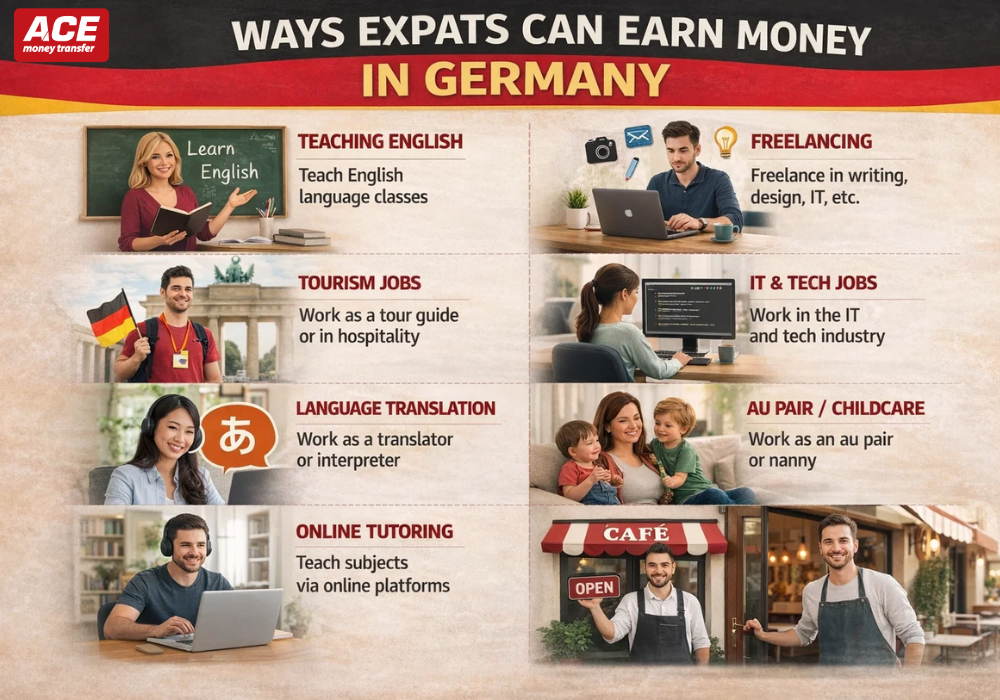
Germany has over 4 million freelancers, and expats are increasingly joining this economy.
Popular income streams include:
Many expats combine freelancing with part-time work and earn €3,000–€5,000+ monthly.
Most expats don’t stay at their starting salary for long. Germany strongly rewards skill growth.
Studies show workers who reach basic German proficiency increase earnings by 15–30% within the first year.
Short training programs (3–6 months) in:
often raise salaries by €500–€1,500 per month.
Many expats:
Germany values experience and stability.
Apart from regular income, expats in Germany can also earn additional money using ACE Money Transfer’s Invite a Friend & Earn program.
By referring friends and family:
Many expats use this as a simple monthly bonus while supporting loved ones abroad.
Invite friends to use ACE and get rewarded every time they send home. It’s free, instant, and boosts your earnings while helping others.
Monthly average living costs (single person):
City Type | Cost (€) |
Smaller cities | €800 – €1,100 |
Big cities | €1,200 – €1,600 |
With average earnings of €2,000–€3,500, many expats still save €500–€1,000+ monthly.
Successful expats in Germany don’t just earn more, they manage money better.
They usually:
Using fast and cost-effective remittance platforms like ACE Money Transfer helps maximize every euro earned.
Germany offers one of the strongest earning environments in Europe for expats, backed by real worker shortages, high wages, and long-term stability.
From entry-level jobs paying over €2,000 monthly, to skilled professions exceeding €5,000–€6,000, to freelancing opportunities with flexible high income, the possibilities are extensive.
With dedication, continuous learning, and smart money management, many expats transform their financial future within just a few years of living in Germany.
For anyone seeking growth, security, and higher income, Germany remains one of the best destinations to earn and build a better life.
Yes, Germany offers high minimum wages, strong worker protections, and constant demand for foreign workers across skilled and entry-level sectors, making it one of Europe’s best earning destinations for expats.
Many entry-level jobs and tech roles don’t require German at the start. However, learning basic German significantly improves job opportunities and salary growth over time.
IT professionals, engineers, healthcare workers, and skilled trades earn the highest salaries, often exceeding €5,000 per month with experience.
Most newcomers earn between €1,900 and €2,700 monthly in entry-level roles, with strong potential to increase income within a few years.
Yes, many expats boost earnings through freelancing, overtime work, and referral programs like ACE Money Transfer’s Invite & Earn initiative.