
ACE Money Transfer
ACE Money Transfer

28 Aug 2024
If you have ever hesitated over whether to write "cheque" or "check" when referring to a paper payment, you are not alone. The confusion is widespread, but the answer is straightforward once you understand where your reader is. This guide breaks down the spelling, meaning, usage, and history of both forms so you can write with confidence every time.
The difference between cheque and check comes down to regional spelling preferences. Both words refer to the same paper payment document used to pay money from one bank account to another, but British and American English handle the spelling differently.
"Cheque" is the standard British English spelling for the paper payment instrument used in banking.
"Check" is the standard American English spelling for the same document.
In both dialects, "check" (not "cheque") is used for all the other meanings of the word, including to inspect, to verify, a check mark, or a restaurant bill.
Here is one simple example pair to make it concrete:
UK: "I wrote a cheque to my landlord for the deposit."
US: "I wrote a check to my landlord for the deposit."
Both sentences carry the same meaning. The only thing that changes is the spelling, which reflects the region and dialect of the writer.
Before diving deeper, here is a high-level comparison of the two spellings, the regions where each is preferred, and the contexts where they apply.
The meaning of both words as a bank payment document is identical. A cheque and a check both represent a written order directing a bank to pay a specific sum from the drawer's account to a named payee. The difference is purely about spelling and regional preference.
"Cheque" belongs to British English spelling conventions. It is the preferred spelling in the UK, Ireland, India, Pakistan, Australia, New Zealand, and most other Commonwealth countries. "Check," on the other hand, belongs to American English spelling conventions and is the standard in the United States.
Outside of banking, both British and American English use the spelling "check." Whether you are talking about a security check, a health check, or asking someone to check their bank account balance online, the word is always spelled "check" in every variety of English. The spelling "cheque" is reserved exclusively for the financial instrument.
| Feature | British English | American English |
|---|---|---|
| Banking document | Cheque | Check |
| Verb (to verify) | Check | Check |
| Noun (inspection) | Check | Check |
| Restaurant bill | Bill | Check |
| Book of payment slips | Chequebook | Checkbook |
| Transaction account | Current account | Checking account |
Writers should match their spelling to their audience's dialect, especially in formal documents and financial contexts. The sections below cover regional usage, example sentences, and related terms like chequebook, checking account, and current account.
A cheque (or check) is a written order instructing a bank to pay a specific amount of money from the drawer's bank account to a named person or organization. It is a financial instrument that has been used for centuries in business and personal transactions alike.
Most modern cheques and checks include several standard details:
The date
The payee's name (the person or entity being paid)
The amount in both figures and words
The drawer's signature
A unique cheque or check number
Bank identifiers such as a sort code (UK) or routing number (US)
Both cheques and checks require a drawer, a payee, and a signature to be valid. This paper document is used mainly for non-cash payments such as rent, supplier invoices, and larger one-off transactions where a direct bank transfer may not be convenient.
The process works like this: the drawer writes the cheque or check and hands it to the payee. The payee deposits it at their bank, which submits it through a clearing system. Once cleared, the funds are debited from the drawer's account and credited to the payee's account.
The rules governing cheques and checks can differ between countries. For instance, UK cheques fall under the Bills of Exchange Act 1882, while US checks are governed by the Uniform Commercial Code. Despite the rise of digital payments, cheques and checks remain in use for some personal and business transactions in many countries.
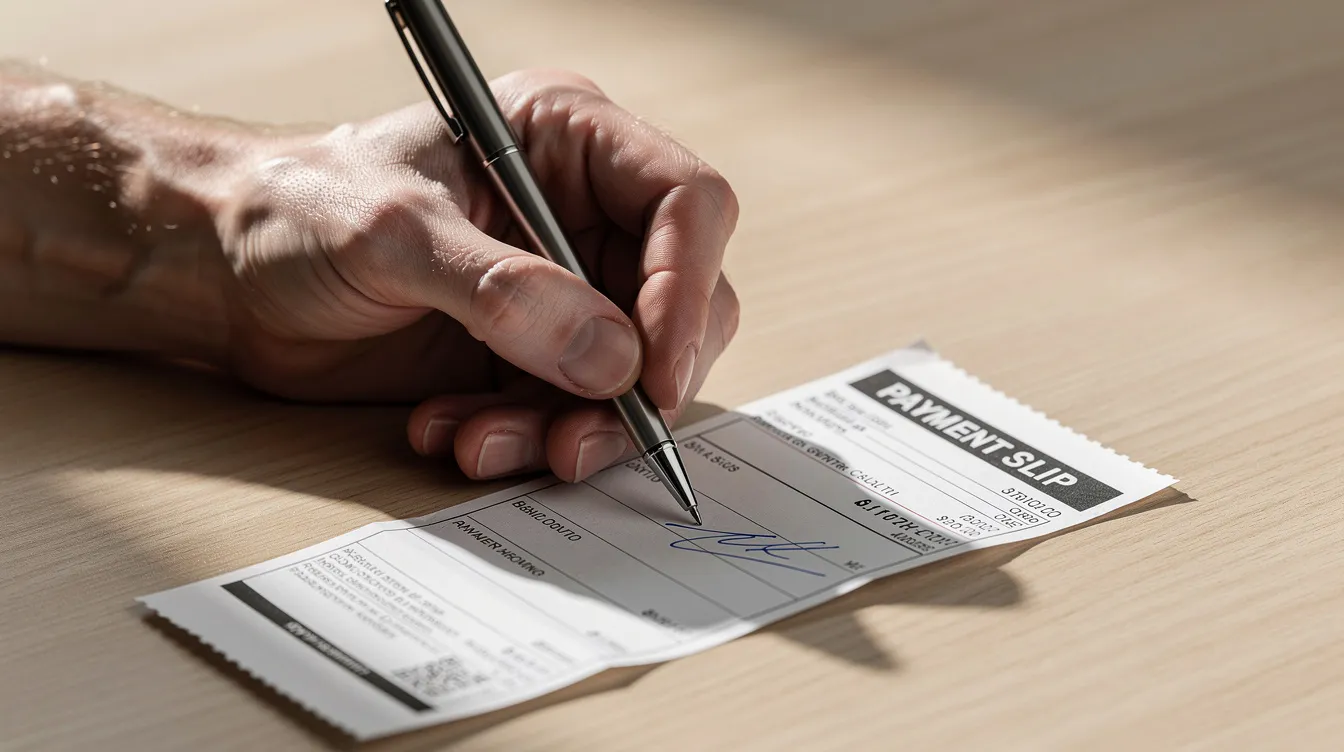
Spelling follows regional standards rather than personal preference, and this is especially important in professional writing. Using the wrong form in a financial or legal document can undermine your credibility and create unnecessary confusion.
Here is how the spelling breaks down by region:
British English, Irish English, and many Commonwealth varieties (including India, Pakistan, Australia, and New Zealand) prefer "cheque" for the banking term. Cheque is used in British English for payment documents, and this pattern extends throughout Commonwealth countries.
American English uses "check" in all contexts, including banking. The spelling "check" is primarily used in American English, and it covers both the financial instrument and every other sense of the word. Check is also the term used in the Philippines for payment documents.
Canadian English is mixed: banks and law often use "cheque" (including terms like "chequing account"), but "check" appears in non-banking senses. In Canada, both cheque and check are commonly used depending on the context.
Style guides reinforce these regional patterns. The Oxford style guide and Cambridge dictionaries follow British English spelling for the banking term. The Associated Press Stylebook and Chicago Manual of Style consistently use "check" for American audiences. Canada's federal government writing guidelines specify "cheque" for the bank instrument and "check" for everything else.
Writers working with international clients should confirm whether British English spelling or American English is required before choosing cheque vs check. This is true for contracts, marketing materials, and even internal documents. The spelling choice does not change how the bank instrument works. It only affects regional appropriateness and perceived correctness.

The word "check" carries many meanings in both British and American English, but the spelling "cheque" is restricted entirely to the banking instrument. In British English, check refers to verification or inspection but not to banking. In American English, check has many meanings, including verification and restaurant bills.
Here are key verb uses of "check" with short examples:
To examine or verify: "Check your bank account balance online before making a large purchase."
To look at something briefly: "Check the weather before you leave for work."
To stop or restrain: "New rules were introduced to check inflation and control rising costs."
Common noun uses of "check" include:
"We did a quick safety check before starting the machine."
"The teacher put a check mark next to each correct answer."
"The security check at the airport took 20 minutes."
In American English, "check" also means a restaurant bill: "Can I get the check, please?"
These non-banking uses always take the spelling "check" in both British and American English. Writing "cheque your email" or "security cheque" is never correct, regardless of dialect. Learners of English should treat "cheque" as a very specific financial term, and "check" as the default spelling for everyday verbs and most other noun senses.
Related banking words follow the same regional spelling pattern as cheque and check. Consistency matters, especially in the financial world where precision in language signals professionalism.
Here are the main pairs:
"Chequebook" (British English) vs "checkbook" (American English) for a book of pre-printed payment slips tied to a bank account.
"Chequing account" (Canadian English) vs "checking account" (American English) for a transaction-focused bank account used for day-to-day payments.
In the UK, the common term is "current account" instead of "chequing account," even though the account historically included a chequebook. A current account is used for salary deposits, bill payments, and debit card transactions.
These accounts are usually linked to a debit card and online banking, and they typically earn little or no interest compared to savings accounts. The type of account a customer opens depends on local banking terminology, not on any functional difference driven by the cheque vs check spelling.
Writers should keep the spelling consistent throughout the same document. If you choose British English spelling, use chequebook, cheque card, and cheque guarantee. If you are writing in American English, use checkbook and checking account. Mixing the two forms in a single document looks careless and can hit your credibility in business or academic writing.
Concrete examples help learners see how the spelling changes while the meaning stays the same. Below are parallel sentences in both dialects.
British English examples (using "cheque"):
"The landlord asked for the first month's rent by cheque."
"Amira posted a cheque to her university for the tuition fee."
"The company sent cheques to all affected customers as refunds."
"Please make the bank cheque payable to the supplier listed on the invoice."
American English examples (using "check"):
"The landlord asked for the first month's rent by check."
"Marcus received his paycheck as a paper check in the mail."
"The charity accepts donations by check or online transfer."
"She deposited the check using her phone's mobile banking app."
Non-banking use (identical in both dialects):
"Please check your email before the meeting." - This sentence is correct in both British and American English. The verb "check" meaning "to verify" is never spelled "cheque."
Notice that the two spellings sound exactly the same when spoken aloud. The difference only appears in writing and depends entirely on the region of your reader.
Correct regional spelling improves clarity and professionalism, especially in business and financial communication. A small spelling error in the wrong context can signal a lack of knowledge or carelessness, particularly in formal writing.
Here is clear guidance:
Use "cheque" when writing for readers in the UK, Ireland, India, Pakistan, Australia, New Zealand, and other countries that follow British English spelling. In formal writing, use "cheque" for British contexts.
Use "check" when writing for audiences in the United States and most of Latin America where American English is dominant. In North America, "check" is the standard term.
Use "cheque" when communicating with UK residents, even if you personally learned American English. Your reader's expectations matter more than your own habit.
For mixed or global audiences, choose one standard (often American English for international business) and apply it consistently.
Legal documents, contracts, and bank forms should always follow the spelling used in the jurisdiction of the bank or court. A contract drafted for a London-based company should use "cheque," while one for a company in New York should use "check."
A simple trick: check your reader's location. Look at the address on the bank form or company website to decide whether cheque or check is appropriate. Consistency within a single document is essential. Avoid switching between cheque and check unless you are quoting or contrasting dialects deliberately, as you would in an article like this one.
Bank account terminology also differs between British and American English, and understanding these differences is important for anyone who writes about money or works in the financial world.
Here is how the language breaks down:
In the UK, "current account" is the standard term for the main day-to-day bank account used for salary deposits, direct debits, and debit card payments. Cheques are a declining but still recognized payment option on these accounts.
In the US, "checking account" is the equivalent. A "savings account" refers to a separate interest-bearing account, as opposed to the transaction-focused checking account.
Canadian banks often advertise "chequing accounts" and "savings accounts," reflecting a mix of British and American influences in the language.
In everyday British English, people may say "my bank account" without specifying whether it is a current or savings account. In American English, distinguishing between "my checking account" and "my savings account" is more common in everyday conversation.
Writers preparing customer-facing materials, informational leaflets, or online help pages should match local banking terms. If your customer is in Britain, refer to a "current account" and a "chequebook." If your customer is in America, refer to a "checking account" and a "checkbook."
For learners of English, understanding these differences prevents confusion when opening a bank account or reading bank documents in another English-speaking country.
Errors with cheque vs check usually fall into one of three categories: using the wrong form for the region, applying "cheque" to non-banking senses, or mixing both spellings in one piece of writing without reason.
Typical mistakes:
Writing "cheque your email" instead of "check your email." The word "cheque" is only for the bank paper. It is never a verb.
Using "check" for the banking instrument in a British English exam, UK legal document, or academic essay where "cheque" is expected. This can cost marks or undermine credibility.
Mixing both spellings in one article or report without a clear reason. This creates confusion and looks inconsistent.
How to avoid them:
Remember that "cheque" is completely restricted to the bank payment document. For actions like checking messages, verifying facts, or reviewing a document, always use "check."
Confirm which variety of English your school, employer, or client prefers and follow that standard consistently.
Do a final scan of your writing: search for every instance of "cheque" and "check" and make sure each one matches its context. If you find "cheque" used as a verb, that is an error.
A useful proofreading habit: search your document for "cheque" and verify that every instance refers to the paper payment slip. If it does not, change it to "check."
Learners may find it helpful to keep a short flashcard or note summarizing the pattern until it becomes automatic.
The modern cheque or check has deep roots in the history of trade and finance. Written payment orders date back to ancient Mesopotamia, where merchants used clay tablets to authorize the transfer of grain and other goods between accounts held at temples.
By the 15th century, bills of exchange were used in Europe for trade, allowing merchants to move money between cities without the risk of carrying coins over long distances. These instruments laid the groundwork for what would become the modern cheque.
The cheque originated in 17th century France, and the concept quickly spread to England, where London goldsmith-bankers began issuing written payment orders drawn on deposited funds. One of the earliest surviving examples is a cheque drawn by Morris and Clayton in London in 1659, now held in the NatWest heritage collection.
The term "cheque" is derived from the Arabic word "sikkah," reflecting the long history of financial exchange across cultures. Over time, the word entered French as "chèque" before being adopted into English.
Cheques became standardized in the 18th and 19th centuries, as banks printed pre-numbered forms with fixed layouts to reduce fraud and streamline clearing. The original English spelling is "check." The variant "cheque" became standard in the UK in the 19th century, as part of a broader pattern of British English adopting French-influenced spellings. This mirrors other spelling splits like colour vs color and centre vs center.
In the late 20th and early 21st centuries, electronic transfers, debit cards, and online banking reduced everyday reliance on cheques and checks, though they remain important for some business and government payments to this day.

Cheques and checks are becoming a smaller share of payments overall in many countries, driven by the rapid adoption of digital payment methods. Cheques have been phasing out in favor of digital payments in many regions, but the pace of decline varies.
In the UK, cheque usage has been falling since the 1990s. According to UK Finance's Payment Markets Report, the total number of cheques used for payments fell by 17% compared to 2023, reaching just 91 million cheques. Projections suggest that by 2031, only about 0.2% of all UK payments will be made by cheque. Many retailers no longer accept cheques at the till, and Brits increasingly rely on contactless cards, direct debits, and mobile apps.
In the US, checks remain somewhat more common for rent, business-to-business payments, and some government disbursements. According to the Federal Reserve, checks accounted for roughly 9.2 billion transactions in 2024, worth about $24.45 trillion in value. However, as a share of non-cash payments, checks fell from about 59% by number in 2000 to just 4% in 2024. Only about 6% of US consumers reported paying a bill by check in 2024, and the average check value has increased, suggesting checks are now used mainly for larger, less frequent payments.
Some countries have moved even further. The Netherlands and the Nordic countries have almost completely phased out cheques in favor of account-to-account transfers and mobile payment apps, as opposed to markets like India and Pakistan where cheques still play a player role in business transactions.
Because cheques and checks are slower and can carry greater risk of certain types of fraud (forged signatures, altered amounts), many banks actively promote alternatives like online bill pay and instant transfer services.
While the spelling difference between cheque and check will remain relevant for as long as these instruments exist, learners and professionals also need to be familiar with newer payment vocabulary like "bank transfer," "wire transfer," and "direct debit."
If you are learning English and are unsure which form to use in exams and real-life situations, here are answers that will help you get it right.
Decide whether you are primarily learning British English or American English and adopt the corresponding spelling: cheque for British, check for American. This depends on your region, your teacher, or your goals.
When preparing for international exams, follow the exam's spelling standard. IELTS generally expects British English spelling, so use "cheque." TOEFL follows American English, so use "check."
Create example sentences in a notebook using cheque or check with bank-related vocabulary like "bank account," "deposit," "signature," and "funds." Writing the words by hand helps build muscle memory.
Read authentic materials from UK bank websites and US bank websites. Notice how British sites refer to "current accounts" and "chequebooks," while American sites use "checking accounts" and "checkbooks."
Use grammar and spell-checking tools that allow you to set British English or American English. Most word processors and browser extensions let you choose a dialect, so the software can flag inconsistent spellings automatically.
The importance of getting this right goes beyond exams. In professional communication, using the correct spelling signals that you understand your audience and pay attention to detail. Universities, employers, and clients in both Britain and America notice these things.
The main difference between cheque and check is regional spelling, not meaning. Both words refer to the same financial instrument: a written order to a bank to pay money to a named payee. The sound is identical. The usage is identical. Only the spelling changes based on where your reader is.
Here is the core rule in one sentence: "Cheque" is the British English spelling for the bank payment slip; "check" is the American English spelling, and "check" is used for all non-banking senses in both dialects.
Keep these reminders handy:
Match spelling to your audience's variety of English (British English vs American English).
Use "check" when you mean "examine" or "verify," regardless of region.
Keep spelling consistent throughout any document, especially in financial or legal contexts.
Understanding cheque vs check is a small detail, but it makes a real difference in everyday banking tasks and clear, professional English writing. The next time you sit down to write about payment, take a moment to confirm your audience's dialect, and the correct spelling will follow naturally.